ECO Exam 3
 Call Kai
 Learn
 Practice Test
 Spaced Repetition
 Match
 Flashcards
 Knowt Play
1/79

There's no tags or description
Looks like no tags are added yet.
80 Terms
introduced species
a species that is introduced to a region of the world where it has not historically existed
invasive species
an introduced species that spreads rapidly and has negative effects on other species
biological control
Introduction of one species to help control the abundance of another species
can go good or bad
parastoids
live within and consumes tissues of a living host, eventually killing the host
Lotka-Volterra Equation for Prey

Lotka-Volterra Equation for Predators

Equation for population of predators when prey population rate is 0

Equation for population of prey when predator population rate is 0

r is…
intrinsic per capita rate increase of prey
N is…
number of prey
P is…
number of predators
c is…
capture rate (refers to how effective a predator is at locating, catching, and retaining prey relative to the number of encounters or attacks the predator has with prey
NP is…
encounter rate
cNP is…
Mortality of prey by predators
m is…
mortality rate
a is…
conversion efficiency (how much energy predators put into consuming prey and turn it into energy for producing offspring).
Explain/write predator-prey oscillations

Equilibrium Isocline
The population size of one species that causes the population of another species to be stable

Explain the point of Huffaker 1958
if there are enough obstacles for predators and give prey hiding spaces, you are adjusting the capture rate, allowing for the predator and prey oscillations

Give an example of each type
Type 1- filter feeders (eat till full)
Type 2- birds eating crabs (handling time)
Type 3- Shark eating seals, then orca waiting to eat seal (prey switching, search image, refuge)
functional response
the relations hip between the density of prey, and an individual predator’s rate of food consumption
numerical response
rate of predator population growth (dP/dt)
Give an example behavior, structural, chemical defense
Behavioral- alarm calling
Structural- spines/shells
Chemical- toxic compounds
competition
a negative interaction between two individuals that depend on the same limiting resource to survive, grow, and reproduce
intraspecific
same species
interspecific
different species
resource
anything an organism consumes or uses that causes an increase in the growth rate of a population when it becomes more available
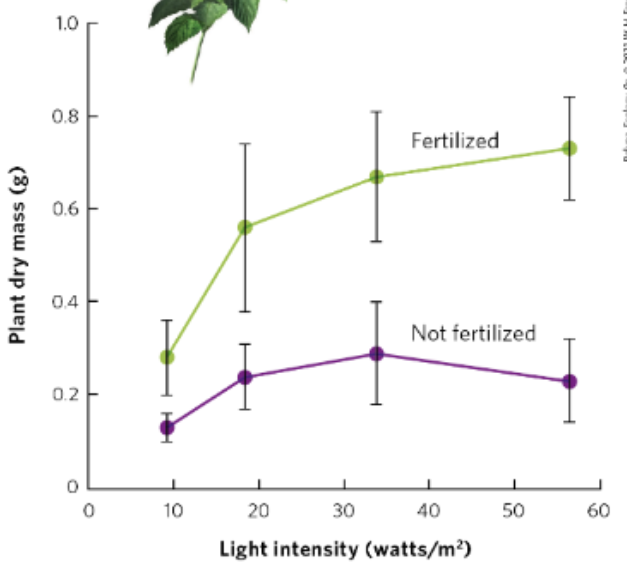
Liebig’s Law of Minimum
An individual’s growth and a population’s size will increase until the supply of the most limiting essential resource prevents it from increasing further
ex. plant growing
plant growing with fertilizer
plant growing with fertilizer and water
Competitive exclusion principle (Gause)
Two species cannot coexist indefinitely when they are both limited by the same resource
Tilman Mechanistic Hypothesis of Competition (David Tilman)
When 2 species compete, the winner is the one that can persist at the lower level of the resource

competition coefficients
convert between the number of individuals of one species and the number of individuals of the other species using alpha and beta

Explain…
The outcome of competition can be altered by…
abiotic conditions, disturbances, biological interactions
abiotic condition example
barnacles in the intertidal zone-limited by space, rather than by plankton
disturbance example
forest fires limiting ability for competition from reaching carrying capacity
Interactions- predation
One active tadpole species gets eaten more when there is a predator compared to a less active tadpole
exploitive competition
competitors consume and drive down the abundance of limited resources
interference competition
Competitors defend rather than consume limited resources
ex. one ant species plugging another ant species’ nest early in the morning
apparent competition
An indirect ecological interaction where two distinct species negatively affect each other's survival not by fighting for shared physical resources (like food or space), but by sharing a common predator, parasite, or pathogen
ex. Squirrel population increases, allowing the hawk population to increase, but the mice population decreasing b/c there are more hawks
Symbiosis
when two organisms live in a close physical relationship.
Mutualism
positive interaction between two species; both partners receive fitness benefit.
Commensalism
One partner benefits; the other neutral
ex. barnacles on whales: the barnacles get nutrient-rich water while whales are not affected
Parasitism
one partner benefits, the other is negatively impacted
ex. ticks feeding on moose killing moose
Mutualism – resource acquisition
Mycorrhiza helps the plant absorb water, and the plant provides the fungus with organic carbon and sugars
Mutualism – defense
Cleaner wrasse eats parasite off fish
Mutualism – pollination example
Yucca Moth pollinates the yucca plant, and the yucca plant allows the moth to lay eggs
Mutualism – dispersal
Ants eat elaiosomes from plants, and ants disperse plant seeds
Mutualism – Effects on Species Distributions
Whether a plant spreads depends on how much mycorrhizal there is
Mutualism – Effects on Community Structure and Composition
Acacia trees protect ants, and ants protect trees, so with no ants, more herbivores will eat the trees
Mutualists – The slippery slope to being herbivore, predator, parasite or pathogen
If there are no parasites on fish the cleaner wrasse will eat the fish scales
Mutualism – How to deal with cheater
If the yucca moth produces too many eggs on a plant, the plant will drop leaves to no longer support shelter
Mutualism – Effects on Ecosystem Processes
The more mycorrhizal, the more tree species, by enhancing the nutrient cycle and productivity
Ecosystem
ecological communities interacting with non-living physical and chemical environment
Systems Ecology
the study of pools and fluxes of matter (nutrients) and energy (carbon) in ecosystems.
Primary productivity
the conversion of solar or chemical energy into biochemicals (assimilated) via photosynthesis or chemosynthesis by autotrophs (producers)
Gross primary productivity (GPP)
the rate at which energy is assimilated by producers in a given area
Net primary productivity (NPP)
the rate at which energy is assimilated by producers and converted into producer biomass in a given area
NPP = GPP - respiration
Ways to Estimate Primary Productivity
Standing crop
Remote sensing
Growth Chambers
Standing crop
the biomass of producers present in a given area of an ecosystem at a particular moment in time [total biomass (g), C mass (g), energy (J)]
What limits energy at higher trophic levels?
1. Efficiencies of Energy Transfer
2. Rate of Primary Productivity
What did Raymond Lineman do?
Researched energy flow in trophic dynamics
Ingested/Consumed energy
total chemical energy contained in the food or organic matter an organism eats or takes into its body.
Egested energy
The energy in the food that is not digested or absorbed by the organism, which is expelled as feces or waste. (poop or throw up)
Assimilated energy
he portion of ingested energy that the consumer actually digests and absorbs across the gut wall into its tissues (calculated as Consumed Energy - Egested Energy).
Respired energy
The energy from assimilated food that the organism uses and releases as heat during cellular respiration to fuel metabolic maintenance.
Net secondary production
The energy stored in the form of new consumer biomass (growth and reproduction) after accounting for respiration, calculated as Assimilated Energy - Respired Energy
Ecological Efficiency

Consumption energy

Assimilation Efficiency

Ecological Stoichiometry
the balance of nutrients in ecological interactions
Plants C:N 30-40:1 Animals C:N 10:1
Wood C:N 85:1
Foliage C:N 20:1
Carbon types
Labile: breaks down easily
-glucose
-sucrose
Recalcitrant: does not break down easily
-cellulose
-lignin
Which consumer will have the greater assimilation efficiency? seeds/grans vs stems/leaves
seeds/grains
Which consumer will have the greater assimilation efficiency? Aquatic plants vs grasses
Aquatic plants
Which consumer will have the greater assimilation efficiency? Animals vs trees
Animals

Explain…
Algae reproduce extremely fast and die very fast, but zooplankton eat the algae just as fast as they grow
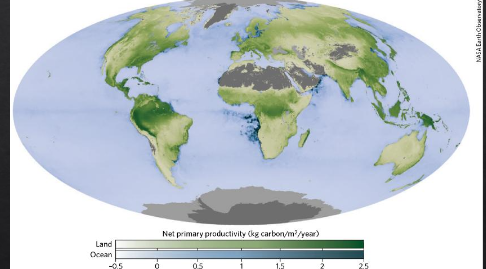
Explain…
Great production in more terrestrial and on the coast (bc of more nutrients)
Liebig’s Law of the Minimum
Populations increase until the supply
of the most limiting resource prevents it from increasing further
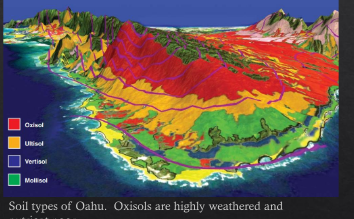
Explain…
Less reproduction at higher heights, bc there is more precipitation and colder climates
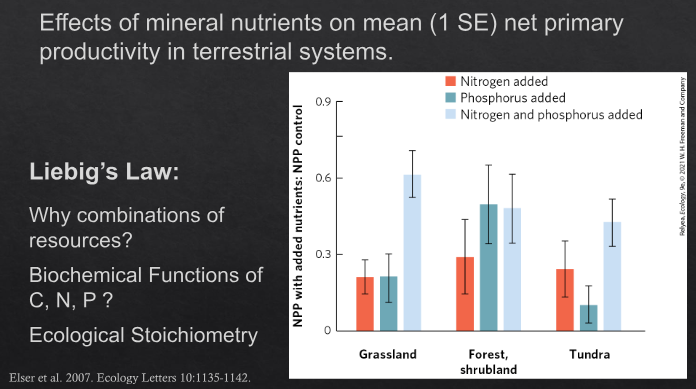
Explain…
Adding nutrients helps plants grow

Explain…
The more nutrients, the more algae in the epilimnion, allowing for no plants on the bottom of the water to get sunlight