CH9: Language Development in Sociocultural Contexts
 Call Kai
 Learn
 Practice Test
 Spaced Repetition
 Match
 Flashcards
 Knowt Play
1/58

Earn XP
Description and Tags
PSYC 207 Unit 3 exam material
59 Terms
language
Complex system of communication
Uses symbols in regular, creative, & self-perpetuating ways
Other components:
Phonemes
Morphemes
Syntax
Semantics
phonemes
The fundamental building blocks of language — smallest unit of sound
subject to perceptual narrowing

morphemes
The smallest unit of meaning in a language
Composed of one or more phonemes
Include prefixes and suffixes

syntax
Set of linguistic rules which determine sentence construction

semantics
The meaning attached to words
pragmatics
Facilitates effective, appropriate communication with others
Turn-taking, Staying on topic, Volume & tone, Maintenance of eye contact
contextual information
The surrounding circumstances that influence the meaning of words (particularly important)
Social cues
Shared knowledge
Nonverbal communication (facial expression, posture, gesturing)
Often absent in textual communication
linguistic development domains
Describes changes across multiple domains of language
Phonological Development: changes in physical properties of the sounds produced, perceived & recognized
Morphological Development: changes in the ways meaning is constructed within a language
Syntax Development: changes in use of rules in organizing language
Semantic Development: changes in the meaning attached to words
Pragmatic Development: changes in the social use of language
language in infancy
Specialization first 4 months — preference for mother’s own voice & discrimination between native/non-native morphemes
Speech is not processed in the same way as other auditory stimuli
Relies on development of intermodal perception
Requiring the integration of: auditory info, visual info, social context
Demonstrated by early preferences for facial synchrony
visual prosody
Visual information that accompanies speech
early vocalizations
Primarily composed of involuntary, physiological sounds
Emerge shortly after birth (crying, smacking lips, gurgling)
Accompanied by non-verbal communication (posture, facial expression, gesturing)
By 2mo. intentional vocalizations emerge
Cooing — 1 syllable combinations of consonants & vowel sounds
Opportunity to practice foundations of functional communication
Experiment w/ speech sounds
Differentiate own vocalization from others
protoconversations
Early caregiver infant vocal interactions
Rhythmic resemblance to native language
Pacing, pauses, turn-taking

infant directed speech
Orients infants’ attention toward caregiver
Facilitates both…
Protoconversation
Affective interactions
Culturally universal

babbling
Intentional vocalizations lacking specific meaning
Composed of repeated sequences of consonant vowel sounds (“ba-ba”, “ma-ma”, “da-da”)
By 4-6mo. vocalizations become more elaborate
Integrating native language-specific sounds
Reflecting perceptual narrowing
Practicing for later, functional language
By 10mo.
babbling is primarily composed of native speech sounds
adopts a conversational tone & cadence
receptive language
The capacity to comprehend and understand language
Precedes expressive language
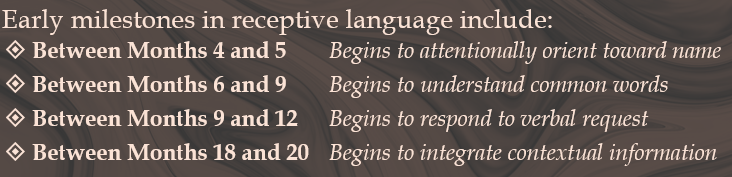
expressive language
The capacity to express oneself through language production
expressive; development
Early _______ Language _______
1st words typically emerge ~12mo.
Initially takes the form of holophrasic speech (1 word expressions)
Relational Relativity Hypothesis
relational relativity hypothesis
Nouns are more accessible to infants relative to relational terms such as verbs
Reflected in early errors in conjugation
Observed cross-culturally
Noun-friendly languages
Caregivers emphasize object labels & properties
Verb-friendly languages
Caregivers emphasizes object relationships — effect typically less pronounced

sentences; telegraphic
Two-Word ____ and _____ Speech
Vocabulary spurt occurs between months 18-24 mo.
Although rate varies at individual level
Sentence complexity develops as a function of vocabulary
Two word sentences emerge around 200 words
Telegraphic Speech
telegraphic speech
Composed of essential words, typically omitting objectives and articles
Signals healthy language development
Allows communication of thoughts
Fosters syntactic experimentation
Optimal caregiver responses affirm effort & progress
While modeling more complex, grammatical sentence structure

gestural communication
Relatively simple motor activity possessing symbolic meaning
General role in adult language — Enhances communicatory ability
Vital role in toddler language development
Supplements early holophrasic speech (single word + gesturing)
Steppingstone to greater sentence complexity
Predict later qualitative milestones
Can be leveraged by caregivers
Aids modeling of complex sentences
childhood language development
Vocabulary expansion continues through childhood
Between 2-6 years…
Vocabulary grows from 200 to 10,000 words
Builds on existing language through fast-mapping
Caregiver verbal interaction continues to play a role
Language development may be fostered through…
Modeling complex sentences
Open-ended questions
Reading & singing
Regularly exercising labeling abilities
fast mapping
Eases vocabulary acquisition by leveraging connections with existing concepts
Follows relational relativity hypothesis
Increased rate for nouns
critical periods
Developmental phase or time during which learning can easily occur
Sometime between infancy & adolescence for language
Case-studies of severely abused/neglected children
Poor understanding of nuance, grammar, & typically do not develop functional language
Hearing impaired children — timing of detection & intervention vital
Failure to intervene prevents vital language exposure
Often impairing development across several related domains (social, language, literacy)
linguistic; childhood
Common ______ Errors of ________
Phonological errors
Semantic errors
Grammatical & Syntactic errors
phonological errors
Errors of pronunciation
semantic errors
Errors related to the meaning attached to words
Underextension
Overextension
underextension
Overly specific use of a word as a label
overextension
Insufficiently specific use of a word as a label
grammatical/syntactic errors
Errors in sentence structure and organization
Overregularization
overregularization
Extension of a grammatical rule to a situation in which it does not apply
middle; adolescence
______ Childhood Through ______
By 8yrs. errors of early childhood become…
Increasingly uncommon
Spontaneously corrected
Notable aspects of linguistic development include…
Vocabulary spurt outpacing that of early childhood due to…
Continued fast mapping & greater conceptual sophistication
Metalinguistic awareness
metalinguistic awareness
Awareness of, and knowledge about, the nature & qualities of language
Greater intention in word choice
Language tailored to audience
sophisticated; syntactic
Middle Childhood — Adolescence (Cont.)
Notable aspects of linguistic development include…
More ______ sense of semantics, including recognition of…
Non-literal sense of words — occurs alongside increased use of wordplay
Nuanced differences in roughly equivalent words
Increasing ______ complexity
Greater use of passive voice
Increases in sentence complexity vary as a function of — native language & experimental exposure

pragmatic development
Increased recognition of dynamic nature of words…
Develops alongside opportunities chances for practical language use
Use & understanding of irony is an important milestone
Verbal Irony
Sarcasm
verbal irony
Communicates the opposite of what is said
Recognition of behavioral expectations & social conventions
Comprehension of pragmatic insincerity
sarcasm
Other-directed verbal irony with critical intent
Affective intent of the speaker toward the target
localizing pragmatic insincerity
Relevant processing networks include…
Verbal irony heavily implicates the prefrontal cortex
Mentalizing network
Involved in inferring mental states & forecasting behavior
Semantic network
Involved in attaching conceptual meaning to language
Sarcasm additionally recruits affective systems
Amygdala
Involved in ascribing emotional meaning & content
pragmatic; adolescence
________ Insincerity & Development
Considerable changes throughout childhood and __________
Cross-sectional research comparing 6,9, & 13 yr. olds
6yr. olds — tended to interpret all remarks as sincere
9-13yr. olds — increasing success discriminating pragmatic insincerity & genuine deception (although often with some difficulty)
Adults demonstrate greater competency — potentially reflecting…
Greater specialization in neural processing
More complex connections of the neural circuits involved
adult language development
Subtle changes in language are observed in adulthood
Gains…
Continued vocabulary expansion
Counterintuitive = increased risk of blocking
Maintenance…
Comprehension of spoken language
Losses…
Most pronounced for pragmatics
Inappropriate comments
Uncomfortable topics
Deviance from topic
Decreased comprehension of figurative speech
developmental language disorder
Impacts a person’s ability to learn, understand, & use language
Reading, Writing, Listening
Common & Heritable
Associated w/ poor academic performance

stuttering
Sounds, syllables, or words are repeated or last longer than typical
Most common fluency disorder
Impacts the flow, rhythm, & speed of speech
Further distinctions drawn between…
Developmental Stuttering
Neurogenic Stuttering

developmental stuttering
Most common
Occurs while learning speech & language skills
Resolves in 75% of cases
neurogenic stuttering
Occurs following stroke, head trauma, or other brain injury
No cure — requires treatment by speech pathologist
articulation disorders
Difficulty producing correct phonemes
Imprecise placement, timing, pressure, or speed of lips, tongue, & throat
Includes failure to use some or all speech sounds, as well as…
Substitutions, Omissions, Additions
Affected individuals may feel self-conscious
Social withdrawal
Avoiding speaking or reading aloud (avoiding certain words)
Typical during the course of language acquisition — cause for concern if errors persist past 6yrs.
autism spectrum disorder
Neurodevelopmental disorder impacting 3 domains
Communication — Complete lack of speech, Echolalia
Restricted/Repetitive Interests — Repetitive movement & interests, Distress from minor change
Social Function — Failure to initiate conversation, Avoidance of eye contact, Turning away when spoken to, Preference for solitary play
May impair functioning & capacity for independence — although highly heterogenous in expression
More recent discussions emphasize strengths over deficits
detecting autism
Examined as part of early wellness checks
Prompting follow-up diagnostic tests
In older children & adolescents
Common indicators include difficulty with…
Nonverbal cues, figurative speech, making friends (often initially observed by teachers or caregivers)
Difficult to diagnose in adulthood given symptom overlap
Some cues include…
Highly-attuned nervous system
Preference for predictability & structure
Hyperfocus on special interests
Causes of autism
Most prevalent among high SES nations
Highly heritable
More common among males
Risk factors include:
Advanced paternal age
Urban living
Insufficient sun exposure — Vitamin D Deficiency
Exposure to mutagens (environmental agents which trigger gene mutations)

language development theories
Popular theories of language development include:
Nativism
Social Learning
Cognitive Functionalist
Biologically-informed approaches emphasize neural structures
Emphasizing the neural basis of language development
nativism
Theory of language development emphasizing universal aspects of cognitive linguistic development
social learning
Theory of language development emphasizing associative learning processes
cognitive functionalist
Theory of language development emphasizing language creation as a collaborative endeavor
nativist; language
______ Perspective on _______
Frames language development in terms of universal grammar
Transformative-generative grammar
Proposes an innate cognitive capacity to understand one’s native syntax and apply it in generating an infinite class of potential sentences
Deep Structure
Surface Structure
Acquired unconsciously
deep structure
How an idea is represented in abstract terms of universal grammar — basis for universal grammar
surface structure
How an idea is actually expressed in any one language
criticisms of nativism
Initial studies supporting nativism examined
English & Related Western-European languages
False sense of consistency
Research on over 8,000 diverse languages
Greater structural diversity than predicted (ex. variation in noun-verb-object structure)
Others argue that developmental research more appropriate
Adult language already complex
Based in regular exposure to linguistic nuance and complexity
social learning/language
Implicates associationism principles in language acquisition
Builds on classical, observational & operant conditioning principles
Cognition, Imitation, Reciprocal determinism
Concerns how adults reinforce & model language for children
Criticisms include failure to account for:
Rapid pace of childhood language acquisition
Occurs through process of fast-mapping
Generative nature of language
Imitation cannot account for novel language use
Spontaneous language creation amongst children
grammar; constructions
Cognitive-Functionalism & Language
______ emerges as users co-create linguistic _______
Based on recurring sequences of symbols
Universal grammar not necessary
Social learning insufficient
Emphasizes social function of language
Evidence…
Use non-verbal communication by preverbal children to communicate
On-the-fly repairs when misunderstood during acquisition
Language skills develop through daily interaction alongside — social & pattern cognition
neural; language
_____ Substrates of Human _______
As per lateralization, localized to the left hemisphere:Frontal Lobe
Broca’s Area — expressive language & some aspects of language comprehension
Anterior = semantic expression
Posterior = phonological perception
Temporal Lobe
Wernicke’s Area — receptive language
