Final CHM 1045L: Prelab questions
 Call Kai
 Learn
 Practice Test
 Spaced Repetition
 Match
 Flashcards
 Knowt Play
1/31

There's no tags or description
Looks like no tags are added yet.
32 Terms
Define Standardization and state how you would go about performing it?
The process of determining a solution's exact concentration by titrating it against a primary standard substance using a known reaction and procedure.
Define the term Titration
The analytical technique of accurately measuring the volume of a solution needed to react with a known amount of another reagent.
Define the term Molarity
the number of moles of solute in a liter of a solution
what is the formula for molarity
M = moles of solute/liters of solution
why do you determine a mass by difference
because this is generally more accurate than determining the mass directly
what are equivalence points?
the point in a titration at which stoichiometrically equivalent amounts of the two reactants are brought together
what are end points?
the point in a titration where some indicator (such as a dye or an electrode) undergoes a discernable change and the titration is stopped
How do equivalence points and end points differ?
the primary importance is to minimize the difference of accuracy desired. The equivalence point is a theoretical point, whereas the endpoint is a physical point in the lab procedure
WHY SHOULD THE STANDARDIZED NaOH SOLUTION BE KEPT IN A STOPPER BOTTLE?
to prevent it from absorbing carbon dioxide and moisture from the air. Carbon dioxide reacts with NaOH to form sodium carbonate, while moisture can dilute the solution. it can also lead to inaccurate titration results
what is parallax?
It is the apparent change in an object's position or direction caused by viewing it from two distinct locations.
why should you avoid it?
it should be avoided in titrations because it introduces an error in the volume measurements
Why is it necessary to rid the distilled water of CO2?
it is an acid anhydride and reacts with water to produce carbonic acid according to the reaction. it is particularly deterimental to sodium hydroxide solutions as these absorbed carbon dioxide to produce sodium carbonate
why must the vinegar sample be obtained in a dry beaker?
the vinegar sample must be obtained in a dry beaker to prevent residual water from diluting the sample. This ensures that the original acetic acid concentration is maintained, allowing for accurate titration results
is it necessary for the Erlenmeyer flask to be dry before pipeting the 25.00 mL sample of vinegar in it? explain?
No, the Erlenmeyer flask does not need to be completely dry because any residual water will only dilute the vinegar sample without changing the number of moles of acetic acid present. Therefore, the same volume of NaOH will be required to reach the equivalence point, and the titration results will remain accurate
why is the buret rinsed with sodium hydroxide solution prior to filling with solution?
The buret is rinsed with NaOH solution before filling to remove residual water and contaminants. This prevents dilution of the standardized NaOH solution and ensures that its concentration remains accurate for reliable titration results
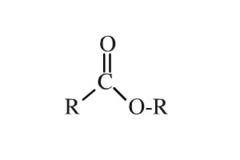
what are esters? what is their general structure?
derivatives of organic acids; their general structure is: R-COO-R
what is the role of inorganic acids in the esterification process?
it can either act as an acid catalyst (making the esterification reaction happen faster) or it can act as a dehydrating agent (removing water and helping increase the ester yield)
from what substances can esters be prepared?
prepared from a carboxylic acid and an alcohol through a chemical reaction called esterification;
Carboxylic acid: Contains the -COOH functional group.
Alcohol: Contains the -OH functional group.
what is one general physical property of esters
that they often have pleasant, fruity or sweet odors. Others include evaporate easily, colorless liquids, less soluble in water, and low boiling points
describe a test for phenols
Aqueous ferric chloride (FeCl3) can be used to test for the presence of phenols. Compounds containing phenols will cause the solution to turn a vivid purple, blue, green or red colour - depending on the nature of the phenol.
what is the carboxylic acid group?
a functional group in organic chemistry. it consists of two parts attached to the same carbon atom; carbonyl group (C=O) and a hydroxyl group (O-H)
what is the purpose of recrystallization?
to purify the aspirin that was produced by removing impurities and unwanted substances.
define endothermic reactions in terms of the sign ΔH
a reaction that absorbs heat energy from its surroundings. In terms of ΔH: ΔH>0 (the sign is +)
define exothermic reactions in terms of the sign ΔH
a reaction that releases heat energy into its surroundings. In terms of ΔH: ΔH
define the term heat capacity (C)
the amount of heat energy required to raise the temperature of an entire substance or object by 1°C (or 1 K). Formula: q=C(ΔT)
define the term specific heat (C)
the amount of heat energy required to raise the temperature of 1 gram of a substance by 1°C (or 1 K). The formula: q=mcΔT
describe how you could determine the specific heat of a metal by using the apparatus and techniques from the heat of neutralixation experiment (step 1)
Measure the mass of the metal using a balance.
describe how you could determine the specific heat of a metal by using the apparatus and techniques from the heat of neutralixation experiment (step 2)
Heat the metal: Place the metal in a container of boiling water and allow it to reach the temperature of the boiling water. Record the metal's initial temperature.
describe how you could determine the specific heat of a metal by using the apparatus and techniques from the heat of neutralixation experiment (step 3)
Prepare the calorimeter: Measure a known mass of water and place it inside the calorimeter. Record the water's initial temperature.
describe how you could determine the specific heat of a metal by using the apparatus and techniques from the heat of neutralixation experiment (step 4)
Transfer the metal: Quickly remove the heated metal from the boiling water, dry it, and place it into the calorimeter containing the cooler water.
describe how you could determine the specific heat of a metal by using the apparatus and techniques from the heat of neutralixation experiment (step 5)
Measure the final temperature: Cover the calorimeter, gently stir, and record the final equilibrium temperature once the metal and water reach the same temperature.
describe how you could determine the specific heat of a metal by using the apparatus and techniques from the heat of neutralixation experiment (step 6)
Calculate the specific heat: Use the heat gained by the water to determine the heat lost by the metal.