communication and nurse patient relationship WEEK 6
 Call Kai
 Learn
 Practice Test
 Spaced Repetition
 Match
 Flashcards
 Knowt Play
1/53

There's no tags or description
Looks like no tags are added yet.
54 Terms
Why is effective communication essential in nursing?
Promotes patient safety, builds trust, supports patient advocacy, and prevents healthcare errors
What are the three modes of communication?
Verbal
nonverbal
electronic communication.
What are examples of nonverbal communication?
Facial expressions, gestures, posture, eye contact, touch, personal space, and tone of voice
What is incongruent communication?
When verbal and nonverbal messages contradict each other, potentially creating mistrust.
What are the five components of the communication process?
Sender → Message → Channel → Receiver → Feedback.
Why is feedback important in the communication process?
It confirms whether the receiver understood the message as intended.
What factors can interfere with effective communication?
Physical impairments,
emotions,
culture,
language,
education,
developmental level,
situation,
environment.
What is therapeutic communication?
Patient-directed communication that promotes understanding and builds trust
how to listen and put patient first
What does S.O.L.E.R. stand for in therapeutic communication?
S – Sit squarely (face the person)
O – Open posture
L – Lean in
E – Eye contact
R – Relax
What is empathy in therapeutic communication?
The ability to understand a situation from another person's perspective.
What is positive regard?
Recognizing that every patient has value, dignity, and worth without unnecessary labeling.
What is self-awareness in therapeutic communication?
Understanding your own personality, values, culture, and communication style.
Why should nurses use open-ended questions?
They encourage patients to express their feelings, concerns, and experiences.
What is an example of an open-ended therapeutic question?
"Tell me about what is worrying you."
How should a nurse address a patient to promote therapeutic communication?
Use the patient's preferred name and avoid terms such as "honey" or "grandma."
What environmental interventions promote therapeutic communication?
Provide privacy,
reduce noise and distractions,
ask permission before entering,
and explain procedures before acting
How should a nurse communicate with a patient who is anxious or fearful?
Address the patient's emotions before providing complex information.
What is false reassurance?
Providing unrealistic reassurance that dismisses the patient's concerns, such as "Don't worry, everything will be fine."
Why is giving personal advice considered nontherapeutic?
It directs the patient's decisions instead of allowing the patient to make their own choices.
removes automy
Why should nurses avoid asking patients "why" questions?
They may make patients feel defensive or judged.
Why is changing the subject considered nontherapeutic?
It redirects the conversation away from the patient's concerns and discourages further expression.
What are three major barriers to therapeutic communication?
Failure to listen
improper decoding of messages
placing the nurse's needs before the patient's needs
What is improper decoding in communication?
Misinterpreting the patient's intended message.
Example: Assuming a patient who feels "funny" is anxious while overlooking signs of hypoglycemia.
How should a nurse communicate with an older adult?
Use short, simple, direct statements;
allow adequate response time;
consider sensory impairments;
avoid patronizing language.
What communication techniques should a nurse use with an angry patient?
Remain calm
validate feelings
monitor for escalating aggression
avoid touching the patient
maintain access to the exit.
What is aphasia?
Loss of the ability to communicate.

What is expressive aphasia?
Inability to formulate and/or send a message.
cannot talk
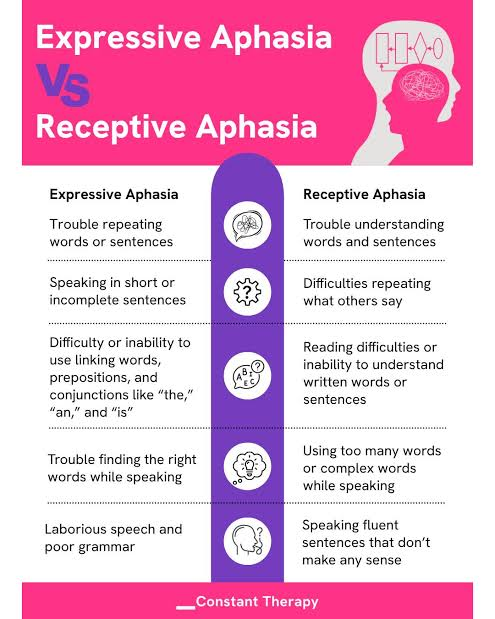
What nursing interventions are appropriate for expressive aphasia?
Ask questions requiring short responses, allow adequate time, avoid completing sentences, and use alternative communication methods.
What is receptive aphasia?
Inability to understand communicated information.

What nursing interventions are appropriate for receptive aphasia?
Use simple words and sentences, gestures, facial expressions, picture cards, and objects.
How should a nurse communicate with a confused patient?
Speak slowly,
use short sentences and concrete ideas,
give one-step instructions,
allow time to process information.
How should a nurse communicate with a hearing-impaired patient?
Face the patient
stand on the side of the better ear
speak clearly in a low tone
avoid yelling
use hearing aids or written communication as needed.
How should a nurse communicate with an unresponsive patient?
Assume hearing is intact
speak directly to the patient
explain procedures before touching them.
What interventions help a visually impaired patient communicate and navigate their environment?
Announce your presence,
explain procedures,
provide adequate lighting,
orient the patient to the surroundings,
obtain Braille materials if needed.
What is the appropriate nursing intervention when a patient does not speak English?
Use a professional interpreter and speak directly to the patient rather than the interpreter.
Why should family members, especially children, not be used as interpreters for health information?
A professional interpreter is needed to promote accurate communication of health information.
family could not be acting in pts best interest
How can a nurse establish trust with a patient?
Demonstrate caring, maintain consistency, respect the patient, and follow through on promises.
What does SBAR stand for?
S – Situation
B – Background
A – Assessment
R – Recommendation
What information belongs in the Situation component of SBAR?
The patient's current problem or reason for contacting the healthcare provider.
What information belongs in the Background component of SBAR?
Relevant patient history and clinical information related to the current problem.
What information belongs in the Assessment component of SBAR?
Current assessment findings and relevant clinical data, such as vital signs.
What information belongs in the Recommendation component of SBAR?
The action or intervention being recommended for the patient.
ex: i recommend you see the patient
What are the characteristics of assertive communication?
Honest, direct, respectful, appropriate, open to ideas, and protective of the rights of others.
Why should nurses use "I" statements instead of "you" statements?
"I" statements encourage discussion and express concerns without blaming others or making them defensive.
What are the advantages and disadvantages of electronic communication in nursing?
Advantages: Fast, efficient, provides a written record, and supports continuity of care.
Disadvantages: Confidentiality risks (HIPAA), potential misinterpretation, and loss of meaning.
What is the difference between verbal and nonverbal communication?
Verbal: Spoken or written words.
Nonverbal: Facial expressions, gestures, posture, eye contact, touch, personal space, and tone of voice.
What is incongruent communication, and how can it affect the nurse-patient relationship?
When verbal and nonverbal messages contradict each other, potentially creating mistrust.
Example: Saying "I have time to talk" while standing in the doorway with crossed arms.
What communication techniques should a nurse use to encourage patients to express their feelings?
Use open-ended questions, attentive listening, empathy, simple language, and adequate response time.
Example: "Tell me more about how you're feeling."
What does SBAR stand for when communicating with healthcare providers?
S – Situation: Current patient problem.
B – Background: Relevant patient history.
A – Assessment: Current assessment findings.
R – Recommendation: Recommended action or intervention.
A nurse contacts a healthcare provider using SBAR. What information should the nurse include in the Assessment and Recommendation sections?
Assessment: Current clinical findings, such as vital signs and patient symptoms.
Recommendation: The action or intervention the nurse recommends for the patient.