Unit 3 exam
 Call Kai
 Learn
 Practice Test
 Spaced Repetition
 Match
 Flashcards
 Knowt Play
1/48

Earn XP
Description and Tags
49 Terms
Twitch
A single action with a time delay from the neuron firing until the force increases (contraction)
Summation
The neuron fires the muscle relaxes, the neuron fires partially again adds force
Ex:picking up something you thought was light but is actually heavy
Tetanus
The neuron continues to fire contractions with no relaxation; sustained contractions Ex: carrying something
Isotonic contractions
Muscle belly shortens
Ex: picking up an object
Isometric contraction
Muscle belly stays the same length, force inside the muscle
Ex: posture pushing against a heavy object
Slow twitch
For endurance, long duration of contraction, contains myoglobin for more oxygen
Ex: running, swimming, biking
Fast twitch
For strength, powerful bursts of force, short duration of contraction, white muscle
Ex: weightlifting, sprinting, hitting a ball
Origin
The end of a muscle that is attached to the bone and doesn’t move during muscle contractions
Insertion
The end of a muscle that attaches to another bone across the joint and is pulled to the muscle’s origin when it contracts
Muscular dystrophy
It is genetic and has an X-linked inheritance, meaning males have a protein failure that causes muscle cell failure resulting in muscle death
Tetanus
Any puncture wound can introduce a bactaria that releases a toxin that won't let muscle relax if not treated every muscle will contract
Muscle cramps
Is caused by dehydration & aerobic respiration
Pulled muscle
Tearing the action and myosin filaments
Fasciitis
Swelling of the dense connective tissue wrapped around the muscle belly
Plasma
90% water, it is the transport method of blood cells and platelets it contains hormones, gases, proteins, electrolytes, nutrients, and waste
Red blood cells (RBCs)
They transport oxygen using hemoglobin and iron to grab it
White blood cells (WBCs)
They defend against invaders and abnormal cells
Platelets
They function in clotting the blood as a defense mechanism
Neutrophil
A granulocyte, it unctions as the first responder to the site of infection. Arrives in large numbers. Eats the invader in a process called phagocytosis
Eosinophils
A granulocyte they function in attacking allergens and parasites/phagocyte
Basophils
A granulocyte functions at the start of inflammatory reactions; it tells fighters where to go
Lymphocytes
It’s an agranulocyte; it creates your immunity and immune memory. B cell lymphocytes make antibodies that secrete chemical warfare that attacks invaders
Monocytes
It's an agranulocyte; it arrives in chronic infections lasting more than two weeks. If they enter a tissue, they stay and become macrophages, which eat the invaders in the tissue
Carbon monoxide poisoning
CO binds to hemoglobin, it won't let go, and suffocates
Anemia
Too few red blood cells/ low oxygen in the blood
Leukemia
Cancer of the white blood cell
Multiple myeloma
Cancer of bone marrow
Mononucleosi
Highly contagious attaches to the RBCs Liver & Spleen remove them and become enlarged, very sick aka Epstein-Barr virus
Septicemia
Bacteria in the blood can cause organ failure and death within hours
Sickle Cell Anemia
Malformed hemoglobin
Thrombocytopeni
Too few platelets that can't clot
Hemophilia
There is a lack of clotting protein blood can't clot
Atreries
Takes blood away from the heart has a thick layer of smooth muscle to withstand the pressure of the heart gives us our pulse
Veins
Takes blood to the heart, they have one-way valves to prevent backflow
Capillaries
The thinnest and smallest near every cell body, delivers O2 and nutrients, picks up CO2 and waste, the only place where gas exchange can occur
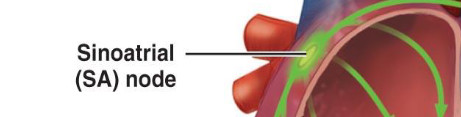
SA sinoartial node
pacemaker of the heart because they self-fire, creating an action potential action potential spreads between the 2 atria using intercalated disc gap junctions

AV atrioventricular node
Between the R.atria and R. ventricles, like speed bumps slows the signal; delays the impulse to the AV bundle in the septum
AV atrioventricular bundle
In the septum branches of to the left and right branches taking the signal to the apex

Purkinje fibers
Has neurons near every ventricle cell it carries the electrical impulse in the myocardium of the ventricles
Angina pectoris
Tight squeezing feeling around the chest warrning sign of a heart attack
Myocardial infarction
Heart attack: a blockage in the coronary artery
Congestive heart failure
Myocardium (heart muscle) is failing; it's not contracting well and not pumping blood well
DVT
Deep vein thrombosis
Embolism
A floating blood clot that was dislodged from the place it fromed
Stroke
A Blockage of blood flow to the brain
Hypertension
High blood pressure 140sys and 90dia the silent killer
Hypotension
Low blood pressure below the normal 120sys and 80dia
Normal blood pressure
Where blood pressure should be at 120sys and 80dia
Electrocardiogram (ECG)
A record of the electrical impulses in the cardiac conduction system