Chem test 2
 Call Kai
 Learn
 Practice Test
 Spaced Repetition
 Match
 Flashcards
 Knowt Play
1/30

There's no tags or description
Looks like no tags are added yet.
31 Terms
Ideal gas (formula)
PV = nRT
concentration (formula)
amount of solute/volume of soluton
Molarity (equation)
moles of solute/vol of solution (L)
the 2 ways to prepare a solution
dissolution of the solute and dilution of existing solution
dissolving/dissolution
particles dispersed in solution
disassociation
dissolution where the ions are dispersed throughout the solution
ionic compound (definition)
a metal cation bonded with a nonmetal anion, which may or may not be polyatomic
molecular compound (definition)
atoms held together in a molecule by covalent bonds. no ions involved, so no disassociation. Instead, molecules separate from each other and disperse.
Acid (definition)
held together by covalent bonds. No ions, but H+ always ionizes.
how does a strong acid act in a solution?
completely ionizes
Strong Acids (name all 6)
Hydrobromic Acid (HBr), Hydrochloric Acid (HCl), Hydroiodic acid (HI), Nitric Acid (HNO3), Perchloric Acid (HClO4), Sulfuric acid (H2SO4)
Strong bases (name group and 3 compounds)
Group 1 hydroxides, Calcium hydroxide (Ca(OH)2), Strontium hydroxide (Sr(OH)2), Barium hydroxide (Ba(OH)2)
dilution equation
M1V1 = M2V2
Precipitation reaction (definition)
soluble ions ionize to produce an insoluble precipitate and soluble spectator ions
Neutralization reaction (definition)
an acid and a base react in a solution and produce
products of acid ionization in a solution
H+ and H3O+
What do bases make in water?
Bases ionize in water and produce OH-
Titration (explain)
An acid/base (titrant) is slowly added, by burette, to an analyte base/acid so as to facilitate a neutralization reaction. An indicator fluid is added to the analyte to signal when the moles of the titrant are equal to the moles of the analyte. This is the equivalence point, and it is the end of the reaction.
Acid-Base titration problem:
use MV = moles
Dissolution equation
(M1)(V1) = (M2)(V2)?
1 atm is equal to
760 torr, 760 mmHg
Ideal gas
A category of behavior. When a gas exhibits linear relationships between P, V, n, T it is considered an ideal gas.
(STP) Standard Temperature and Pressure
P = 1 atm at T = 0 C/273K
Ideal gas law
PV = nRT. To be used when ¾ variables are known, able to be surmised, or remain constant. Solve for variable of interest. Can be set up as an equation with initial variables on the left and final variables on the right to find missing values.
R
a conversion factor for ((atm L) / (moles * Kelvin)). Equal to 0.0821.
Combined Gas Law
(Pi*Vi)/Ti = (Pf*Vf)/Tf
equation for density of a gas
d = (P*Mw)/(R*T)
Mw = molar mass
Partial pressure equation
PA = XA - PT
PA = partial pressure
XA = mole fraction
PT = total pressure
Association between gas mass and molecular speed?
Heavier gas = slower molecular speed
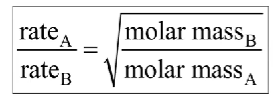
Graham’s Law of effusion
The rate of effusion of a gas is inversely proportional to the square root of its molar mass.
Strong bases
Group 1 hydroxides, Ca(OH)2, Sr(OH)2, Ba(OH)2