Biology Exam 2
 Call Kai
 Learn
 Practice Test
 Spaced Repetition
 Match
 Flashcards
 Knowt Play
1/54

There's no tags or description
Looks like no tags are added yet.
55 Terms
Structure of DNA..
contains a double helix model (two outer sugar backbones)
antiparallel strands (sub units run in opposite directions)
polymer made of of nucleotides
components are sugar, phosphate group, and nitrogenous base (sugar and phosphate stay the same)
Base pairing (Chargaff’s Rule)
base composition of DNA varies between species
the number of A=T and number of C=G
What is the role of hydrogen bonds in DNA?
nitrogen bases are held together by hydrogen bonds that maintain the shape of DNA
Antiparallel strands
sub units that run in opposite directions of each other
5’-3’ and 3’-5’
Base pairing
two strands of DNA are complementary, acting as a template for replication
ensures that genetic info is correctly copied
What is the composition of eukaryotic chromatin?
chromosomes have a linear double stranded DNA molecules with a large amount of proteins
DNA is precisely combined with proteins
histones are responsible for main level of DNA packing
What are homologous chromosome?
a pair of matching chromosomes from each parent, they are similar but not identical
What is a sister chromatid?
after DNA is replicated, there is now joined copies of the original chromosome.
What is the centromeres role in cell division?
the narrow waist of the sister chromatids where they are closely joined
attaches to kinetochores
What is the role of kinetochores in cell division?
protein complex associated with centromeres
spindle fibers attach to here
What is a diploid cell?
2n
somatic cells that contain two sets of chromosomes
non reproductive cells
What is a haploid cell?
n
gametes that contain one set of chromosomes
reproductive cells that contain half the number of somatic
produced by process of meiosis
What are autosomes?
non-sex chromosomes
What are sex chromosomes?
x and y determining biological sex
Why does DNA replication follow a semi-conservative model?
each strand of DNA will have one parent strand, and one completely new complementary strand
Watson and Crick
What does the helicase enzyme do?
unzips DNA at the replication fork
What does the primase enzyme do?
creates short RNA primers for DNA synthesis
What does the DNA polymerase I do?
removes RNA nucleotides and replaces with DNA
What does DNA polymerase III do?
synthesizes new DNA strands in the 5’-3’ direction
What does the ligase enzyme do?
seals okazaki fragments
What does the topoismerase enzyme do?
relives the strain of twisting by breaking and rejoining DNA strands
Leading strand
synthesizes DNA continuously in the same direction as replication
adds nucleotides to 3’ to travel towards 5’ end
Lagging strand
synthesizes DNA discontinuously in small pieces called okazaki fragments in the opposite direction of the fork
adds nucleotides towards 5’ end
What is the role of telomeres?
slow the erosion of genes near the end of DNA molecules
nucleotide sequence
shortening of telomeres is connected to aging
What occurs during the G1 phase of interphase?
“first gap” - metabolic activity and growth to prepare for mitosis
What occurs during the S phase of interphase?
inbetween the two gap phases, DNA replicates or synthesizes
What occurs during the G2 phase of interphase?
“second gap” more metabolic activity and growth, begins to prep for separation
What occurs during prophase of mitosis?
chromatin condenses down
nuclear membrane begins to break down
spindle fibers begin to form, and centrosomes begin to move to opposite poles
What occurs during pro-metaphase during mitosis?
nuclear envelope is fully gone
spindle fibers attach to kinetochores
chromosomes start to move towards center
What occurs during metaphase during mitosis?
chromosomes align along metaphase plate
each sister chromatid is attached to spindle fibers at opposite poles
What occurs during anaphase during mitosis?
sister chromatids are pulled apart towards opposite poles
each chromatid is now a daughter chromosome
What occurs during telophase during mitosis?
chromosomes reach the poles and condense into chromatin
nuclear membranes reform around the new chromatin
new nuclei
What occurs during cytokinesis during mitosis?
cleavage furrow is formed, cytoplasm divides
results in two separate daughter cells
Key differences between mitosis and meiosis
mitosis results in 2 daughter cells, meiosis results in 4
mitosis = 4 stages, meiosis = 8
meiosis purpose is sexual reproduction
mitosis purpose is growth, repair, and asexual reproduction
mitosis chromosome number stays the same, meiosis chromosome number is halved
mitosis is little to no genetic variation, meiosis has genetic variation
What is the function of the mitotic spindle fibers?
controls chromosome movement and separation
centrosome replicates during interphase
What occurs during prophase I of meiosis?
each chromosome pairs with its homolog and crossing over occurs
What occurs during metaphase I of meiosis?
pairs of homologs line up at the metaphase plate, with one chromosome facing each pole
microtubles are attached to kinetochores
What occurs during anaphase I of meiosis?
the pairs of homologous chromosomes separate
moving towards opposite poles
sister chromatids remain attached and move as one unit toward pole
What occurs during telophase I and cytokinesis of meiosis?
each half of cell has a haploid set of duplicated chromosomes
cytokinesis occurs at the same rate
in animal cells, a cleavage furrow forms
in plant cells, a cell plate forms
What occurs during prophase II of meiosis?
spindle apparatus forms
chromosomes move toward metaphase plate
What occurs during metaphase II of meiosis?
sister chromatids are arranged at metaphase plate
because of crossing over, each sister chromatid are no longer identical
microtubules are attached to kinetochores
What occurs during anaphase II of meiosis?
sister chromatids separate
two new individual chromosomes
What occurs during telophase II and cytokinesis of meiosis?
chromosomes arrive at opposite poles
nuclei form and cytokinesis separates the cytoplasm
each daughter cell is genetically unique
What is independent assortment?
each pair of chromosomes sorts and ensures both maternal and paternal homologs into daughter cells independently of the other pairs
What is crossing over?
combining DNA from each parent into a single chromosome
Which portion of meiosis reduces the chromosome number?
meiosis I - also known as reductional division
What portion of meiosis separates sister chromatids?
meiosis II - also known as equational division
Gamete formation
fertilized egg is called a “zygote” and contains DNA from one parent
sperm produced in massive quantities
only type of human cells produced by meiosis
Diagram of the cell cycle

Diagram of mitosis
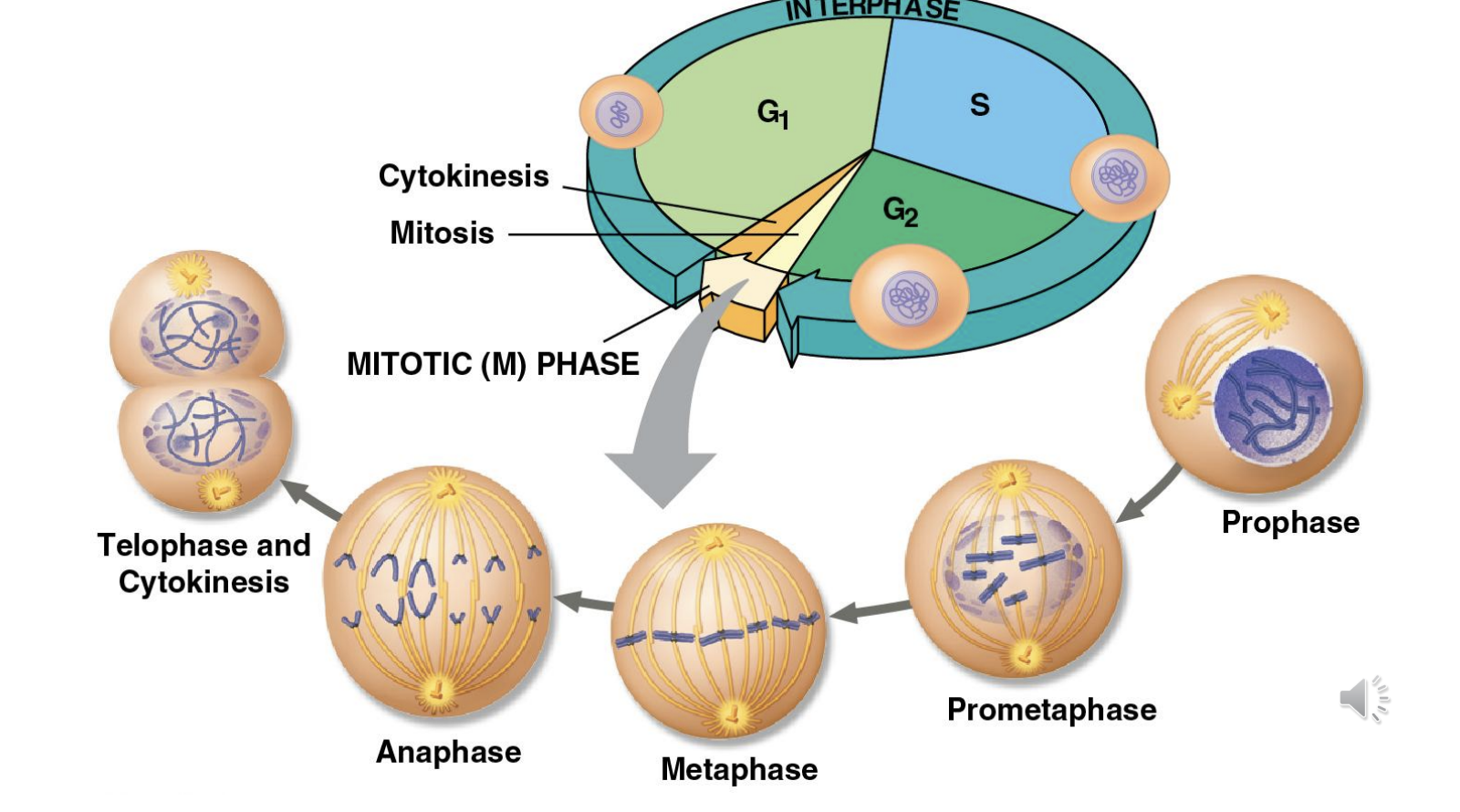
Diagram of meiosis I
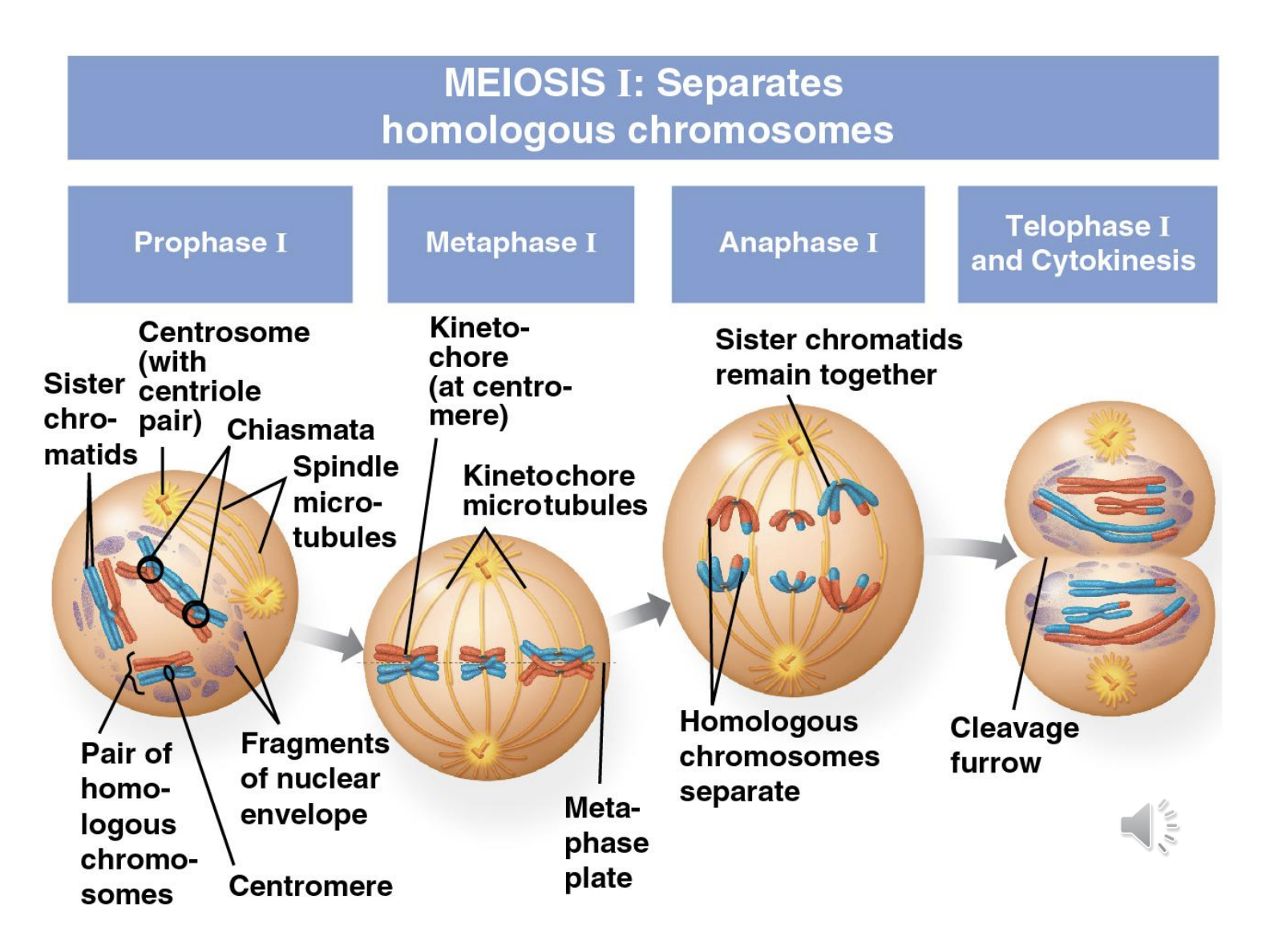
Diagram of meiosis II

Diagram of replicated chromosome

Diagram of crossing over in prophase I
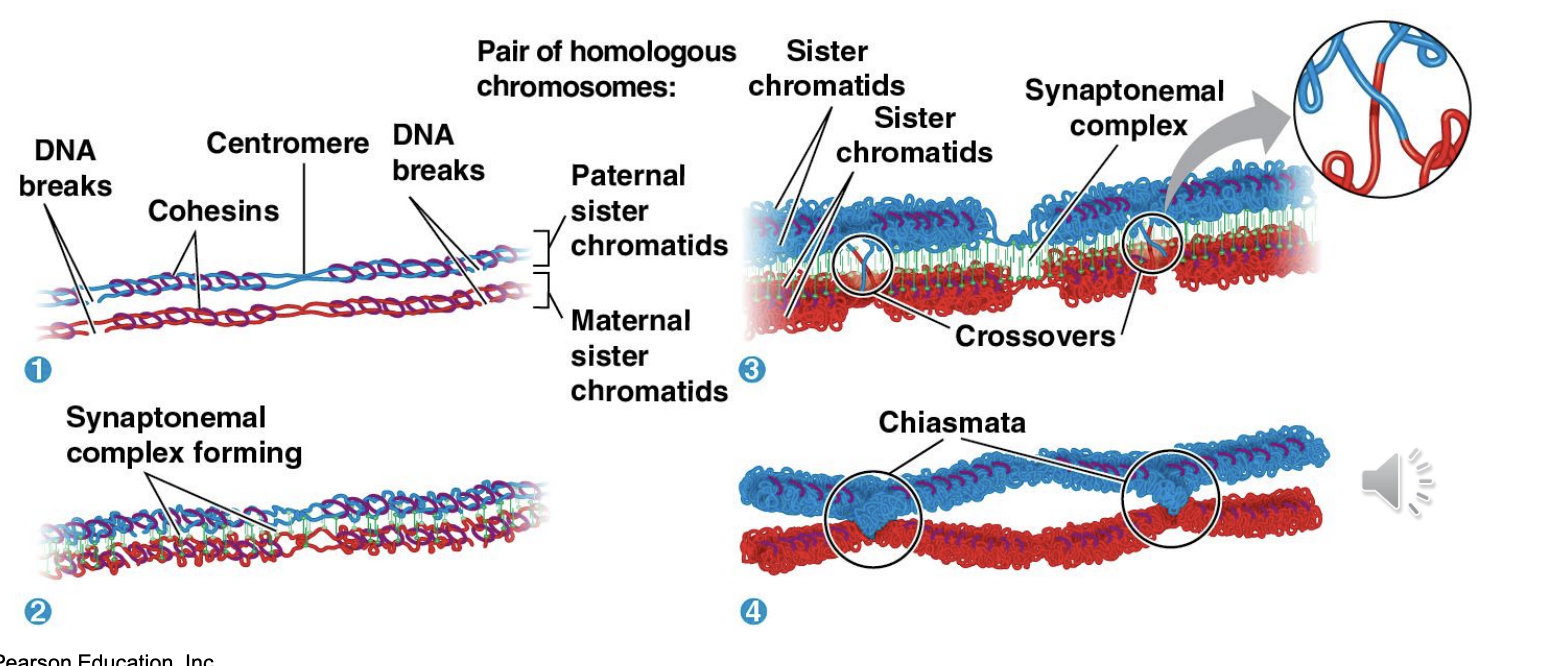
Diagram of karyotype - ordered display of pairs of chromosomes
