Bio.B8 unit 3
 Call Kai
 Learn
 Practice Test
 Spaced Repetition
 Match
 Flashcards
 Knowt Play
1/87

There's no tags or description
Looks like no tags are added yet.
88 Terms
Staple food crops
Main source of dietary energy in the human diet: e.g. rice, wheat, sweet potatoes, corn, and cassava
Not food availability, but what is the major driver of food insecurity?
Poverty
Food security
Ample quality of food & requires the 4 pillars:
Availability: crop production to feed the population
Access: malnutrition caused by poverty
Utilization: hidden hunger & obesity
Stability: stable food supply
Chronically food insecure
Insufficient quality of food
Food security is determined by what?
Availability, access, and utilization
Food availability is what?
Refers to whether enough food is produced globally to feed the world’s population
Undernourishment and malnutrition are what?
Lack of essential nutrients
What is obesity?
Excess body fat reaching 30 BMI or higher
Overweight
BMI of 25 or higher
How can obesity occur?
Through undernourishment and malnutrition
What is industrial agriculture?
A method of farming that involves the use of synthetic fertilizer, synthetic pesticides, and machinery
Pests
Unwanted organisms that cause damage to crops, humans, and animals
Pesticide
Intended to prevent, destroy, repel, or mitigate any pests
Herbicides
pesticides that are weed killers
Monoculture
Growing only one species of crop in a large area
HYV
High yield variety: selectively breeding each plant with desirable traits
What are the advantages of industrial agriculture using synthetic pesticides?
Increased food production, prevents crop blemishes, improve poor soil fertility, & irrigation systems support agriculture productivity
What are the disadvantages of industrial agriculture?
Low income farmers, agribusiness control, relies on fossil fuels (machinery, synthetic fertilizers, and pesticides), runoff water contamination from fertilizer and groundwater, deplete soil quality, excessive fertilizer becomes toxic, decreases diversity of soil ecosystem
Why is soil important for climate change?
Organic molecules store carbon that could otherwise be in the atmosphere as carbon dioxide or methane
Eutrophication
Bloom of algae or photosynthetic bacteria in lakes, rivers and bays and block aquatic plants from accessing light
Hypoxia
Low levels of dissolved oxygen
Desertification
Land becomes desert
Salinization
Irrigation increases salinity, remains in the soil after water evaporates, causing accumulation of minerals that is toxic for most plants
A farmer may use one pesticide to kill of specific pathogens, but…
A larger generation can involve a mutation that resists against the pesticide
Superweed
A species that is unaffected by herbicides, thus its rampant growth displaces other wildlife and inflicting ecological harm
GMO (Genetically modified organisms)
Organisms that been modified or changed genetically through human activity
Selective breeding
Selecting desirable traits to achieve a desired organism by humans
Mutation breeding
To create new genetic variants by exposing plant material to physical agents such as gamma rays or x rays or to chemical mutagens
What are the pros of mutation breeding?
Improved disease resistance, enhanced nutritional value, increased production, tolerance to weather like drought, reduced seed size, and increased earlier maturity
Genetic engineering
Replacing a gene to an organism and possibly taking away a gene
What is CRISPR?
Clustered Regularly Interspaced Short Palindromic Repeats, a defense mechanism that bacteria use to protect themselves from viruses, usually inserting a new gene that cuts DNA
Pros of CRISPR
Blocks unsupported genes and replaces them with better versions to fight certain diseases
Cons of CRISPR
May inflict reproduction and lack of consent to the child
Subsidence
Land sinking due to pumping groundwater and air pockets collapse when water is depleted
Lithosphere
The crust of Earth including the ocean and land
Asthenosphere
Pushes the lithosphere; includes solid and the hot mantle with the movement of magma
Earth’s layer includes the:
The crust, the mantle, and the core
When lava cools,
It becomes igneous rock
After weathering,
Rock becomes sediment
After sediment rock goes through heat and pressure,
Rock becomes sedimentary
After sedimentary rock goes through more heat and pressure,
Rock becomes metamorphic
Sedimentary rock could either turn into…
magma or metamorphic rock
Metamorphic rock could either turn into…
Magma or igneous rock
Igneous rock could either turn into…
Metamorphic or magma (like sedimentary rock)
Pangaea
Continents altogether formed 250 million years ago (but is now continues separation)
Fault
Where two plates meet
Transform Fault
Sliding two plates against each other
Convergent Fault
Two plates running into each other (one crust dives under while the other is pushed upward, forming mountains or volcanoes as a result)
Trench
A deep, middle narrow depression in the seafloor formed at convergent boundaries
Subduction Zone
The crust that flows underneath in a convergent fault
Divergent
When two tectonic plates move away from each other, forming a new crust in the middle with rising magma pushing upward
Tsunamis
Giant waves in result of an earthquake
How do Tsunamis form?
lifting of the crust in the fault line
pushes up a wave
a wave forms dividing into two, flowing in opposite directions
the wave moving towards offshore also takes in the offshore water
wave gets taller and wipes the offshore
Tephra
Ash fall from a volcano eruption
Pyroclastic Flow
Heat gases that are thousands of degrees hot speed down on the ground level after a volcanic eruption
Hotspot volcanoes
Volcanoes that form far from tectonic plate boundaries where an unusually hot mantle plume rises through the crust, often producing volcanic island chains as the plate moves over it.
Flood plain
Beneath ground level, usually where the river is, and is caused by lake erosion
River channel
Where the river flows
Levee
An area above the river channel, the two lumps caused by flooding rivers dropping an accumulation of pebbles
The deeper the water,
The faster the water travels, and the larger the particle size it carries
Deposition & Erosion
Occurs when the water slows down, losing energy, then drops the sediment it is transporting. And fast-moving water wears away and carries rock and soil, making the river more wider and curvier.
Aggradation
River overflowing due to the increase of height
Subsurface mining
mining for minerals underground to the source, although arsenic heavy metals can contaminate the water source
Surface mining
Scraping the tops of the surface layer of land, strip mining, and pit mining
Hydraulic Mining
Spraying water pressure against soil to make water flow and slow down to drop the heaviest material, which is Gold
What are the negative consequences of mining?
loss of habitat
tailings (by-product of mining)
erosion/sedimentation of streams
acid drainage (naturally occurring acids)
toxins released (arsenic)
sinkholes
health impacts
Soil is made up of…
45% mineral
25% water
25% air
5% organic
Topsoil
Organic matter; the O-Horizon: the first surface layer; the most biologically productive layer of all living organisms breaking down organic matter
Subsoil
The B-Horizon: rich in clay with roots extending to this layer
Bedrock
The C-Horizon: weathering of bedrock and mostly rock deep underground
Temperate soil
Includes all layers of soil (good for farming)
Tropical Soil
So wet and humid that bacteria breaks down fast and rarely has an O layer
Desert Soil
Has no O layer due to its dry region
How much of the water in Earth can actually be used?
<1% rivers, lakes, aquifers/groundwater
Glaciers
Freshwater that is frozen for thousands of years
Permafrost
Freshwater that is trapped and frozen in soil
watershed (AKA drainage basin)
smaller sub-watersheds join to form larger sub-watersheds
Wetlands
saturated wet soil that is seasonal
What is the importance of wetlands?
filters pollutants
biodiversity
lot of vegetation
absorbs precipitation
What is California Venal Pools
a “pool” located in a grassland area where tiny organisms tend to grow
Sustainable Groundwater Management Act (2014)
Agencies formed for each basin at risk, planning to prevent undesirable results, while managing to aim a recovery in 2040
Saltwater Intrusion
The movement of dense, salty ocean water into freshwater aquifers or surface waters. Artificial channels can alter water flow and create pathways for saltwater to move inland.
Reservoirs
An artificial or modified lake used to store water
Aqueducts
An engineered watercourse built to carry and transfer water from a distance to a source
What are the two sources of pollution?
Point source: Know exactly where the pollution is coming from
Nonpoint source: Pollution that is coming from a variety of sources
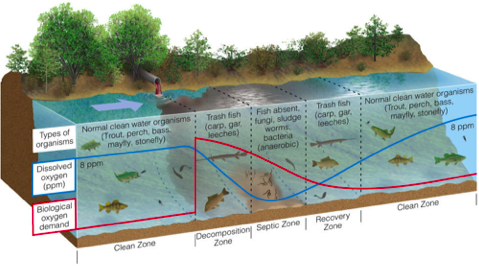
Oxygen Sag Curve
Shows how dissolved oxygen (DO) levels in a river or a stream drop after organic pollution enters the water and then recover downstream. It results from a tug-of-war between oxygen consumption by microbes breaking down waste and natural oxygen replenishment from the air and aquatic plants.
Wastewater Treatment
Preliminary, primary, secondary, and tertiary (using micro-bacteria organisms to break down organic waste and filtering the waste water)
What are the major types of water utilization?
irrigation sources
power generation (like electricity)
public cities