suture patterns
 Call Kai
 Learn
 Practice Test
 Spaced Repetition
 Match
 Flashcards
 Knowt Play
1/15

There's no tags or description
Looks like no tags are added yet.
Name | Mastery | Learn | Test | Matching | Spaced | Call with Kai | Chat |
|---|
No analytics yet
Send a link to your students to track their progress
16 Terms
appositional pattern characteristics
tissue effect: brings two cut surfaces of the tissue into direct approximation
common uses: for anatomically precise closure
inverting pattern characteristics
tissue effect: turn tissue edges inward
common uses:
enclose a contaminated edge
for fascial imbrication
everting pattern characteristics
tissue effect: turn tissue edges outward
common uses:
eliminate dead space
counteract tendency of wound edges to invert during healing
tension-relieving pattern characteristics
tissue effect: redistribute the tension across the wound edges
draw wound edges together while minimizing marginal strangulation and necrosis
common uses:
wounds
following mass removal
skin closure over implants
simple interrupted
appositional
excessive tension when tied may cause inversion
cruciate pattern
appositional
advantages:
stronger closure than simple intrrupted
increased efficiency
gains more space per suture than SI
mild tension relief

interrupted vertical mattress (IVM)
tension-relieving
appositional to everting
advantages
stronger under tension than SI
less interference with vascular supply than other mattresses

interrupted horizontal mattress (IHM)
tension-relieving
everting
degree depends on suture tension & distance to wound margin
more everting than vertical mattress
comparison to IVM
distributes tension over wider area
weaker under tension
higher potential for tissue strangulation / interference with blood supply

near-far-far-near
far component: tension relief
near component: apposition
advantages / disadvantages
higher resistance to tension
more suture material in the wound than other patterns

simple continuous
maximal tissue apposition
advantages / disadvantages
time/material saving
relatively air / fluid tight closure
excessive tension can cause strangulation of wound edge
anatomically less precise than SI pattern
ford interlocking
continuous pattern where each loop is locked by the succeeding pass
appositional
advantages / disadvantages
precise adaptation
greater security in the event of a partial failure
may be difficult to remove
may cause pressure necrosis & become buried when placed under tension
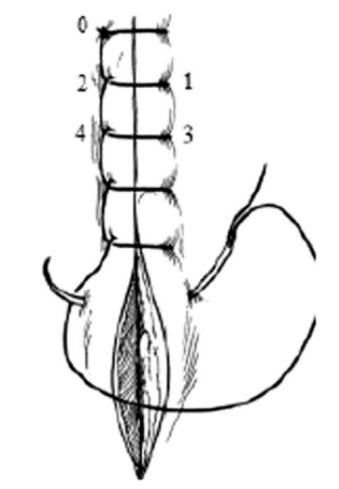
intradermal pattern
appositional
advantages / disadvantages
superior cosmetic outcome
no need for suture removal
provides less strength than percutaneous skin closure
cushing pattern
inverting
formed by taking a bite parallel to incision before crossing the incision to repeat
bites go into the submucosa
do NOT enter the lumen
used for closure of hollow viscera
results in watertight seal
advantage
less luminal reduction than Lembert pattern

utrecht pattern
modified cushing pattern
inverting
bites are taken diagonally rather than parallel to line of incision
most commonly used to close ruminant uteruses

connell pattern
similar to cushing pattern BUT
bites penetrate all layers of bowel
DO enter lumen
inverting
disadvantages
subject to wicking of visceral contents

lembert pattern
wide bite & exiting near to incision on one side before crossing incision to take near-to-far bite on other side
bites penetrate submucosa
do NOT penetrate lumen
can result in considerable inversion
edges can continuously roll more and more inward if not careful when taking bites
can be used for imbrication procedures
