Exam Bank Pt 2
 Call Kai
 Learn
 Practice Test
 Spaced Repetition
 Match
 Flashcards
 Knowt Play
1/14

There's no tags or description
Looks like no tags are added yet.
15 Terms
Describe Systemic Lupus Erythematosus (SLE) and its immunological features
Body immune system produce antibodies against itself (own proteins in cell nucleus and DNA)
the antibodies form immune complexes that dmg blood vessels in various organs
Ex. Glomeruli in kidney
Triggered by environmental factors (unknown)
Sun exposed vessels dmged rapidly (UV dmgs skin cells which causes abnormal immune rxn)
Explain the pathogenesis of Mul-ple Sclerosis (MS)
Myelin sheath of nerves are attacked
Pathophysiology:
Self-reactive T cells + monocytes → attack CNS white matter → demyelination of axons
Attacks the antigen which is myelin basic protein
Prevents nerve impulses from passing thru


Identify and explain the four types of hypersensitivity reactions, including key immune
components in each
Go into the flashcards from Lecture 8
Describe idiopathic aplastic anemia and its immunological basis.
What it is:
Reduction/destruction of RBCs
Pts have pancytopenia (lower than normal RBCs & platelets)
Idiopathic= unknown origin/why
Pathophysiology:
In bone marrow, myelomonocytic stem cells give raise to megakaryocytes that give rise to RBC & platelets
In idiopathic aplastic anemia, this process is blocked BUT bone marrow production is fine

Tx: Pt supported w/ RBC transfusion + platelet transfusions & antibiotics

Explain and give examples of the two categories of autoimmune diseases: organ-
specific and systemic
Systemic
Caused by immune complexes
Molecular complex formed when antibody binds to an antigen, too many of them can overwhelm the body
Example: Systemic Lupus Erythematous
Organ-specific
Caused by autoantibodies or…
T cells against self antigen
Ex. Myaesthesia Gravis, MS
Identify the four systems or cell types in which immunodeficiencies may occur.
Components of the immune system that fail to function
Occur in 4 major systems/cells
RBC
Phagocytes
T cells
B cells
Describe the main types or categories of immune deficiencies.
Go to lecture 8 for all the conditions!
Explain hemolytic disease of the newborn (Type II hypersensi-vity) and its treatment
Rh (-) women & Rh (+) man have child
Rh (-) women has bb who is Rh (+)
Cells from Rh (+) fetus enter mother’s bloodstream
Women becomes sensitized and antibodies are formed to fight the Rh (+) cells BUT NEVER TARGETS FIRST PREGNANCY since it is first exposure
Upon second Rh (+) pregnancy, maternal antibody attack fetal RBC which causes anemia
Treatment: Anti-antibody to destroy the antibodies the mother created

Describe Severe Combined Immunodeficiency (SCID) and available treatment options OR
Explain the cause of “bubble boy disease” and how it is managed or treated.
Pt lacks immunoglobulins
Primary + secondary lymphoid organs lack lymphocytes
X-linked/hereditary
Onset of infections by 6 months of age (Death by 1 year)
Mechanism
Failure of differentiation of stem cells
Management: IPC, reducing exposure to pathogens
Tx: Bone Marrow Transplant

Describe the pathogenesis and treatment of rheumatoid arthri-s.
IgM & IgG form complex → deposited into joints → activates complement system + mast cells → release inflammatory chemicals → inflammation of joint
Mainly B-cell mediated but T-cells help activate macrophages and antibodies
The chronic inflammation is then self-perpetuated by macrophages + fibroblasts which can occur independently w/out involvement of T-cells
Treatment: Anti-inflammatory drugs
Ex. Advil/Tylenol

What are the clinical methods used to evaluate allergic sensitivites?
Skin prick test
Small amnt of allergen introduced into superficial skin
Type I
Intradermal
Small amnt of allergen injected into dermis
Type I
Serum
Checking for IgE lvls
Type I
Patch test
Allergen applied to skin using adhesive patch ~48 hrs
Type IV
Define autoimmunity
Failure of normal mechanism of self tolerance → response against own cells/tissues
Reacting to own self antigens
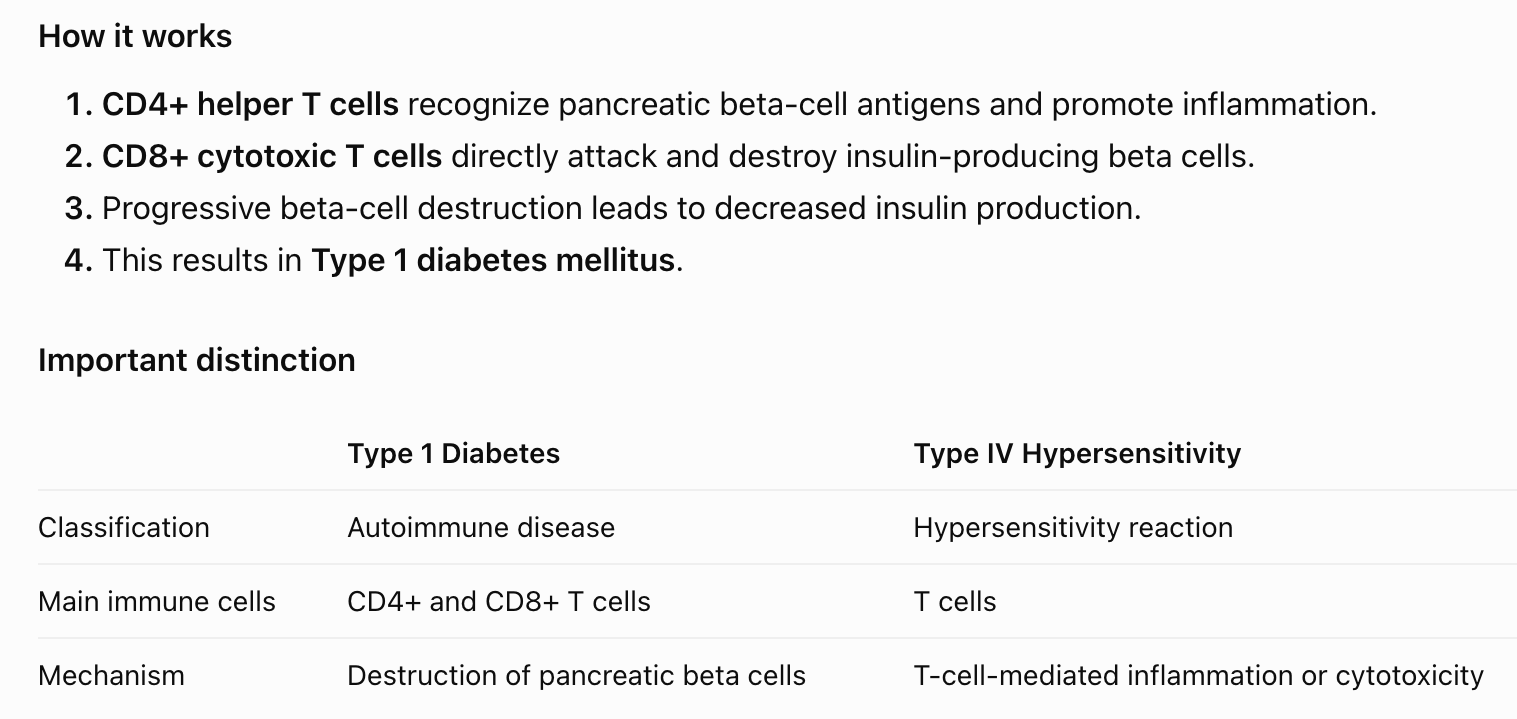
Describe Type I hypersensitivity in Insulin-Dependent Diabetes Mellitus (IDDM).
Is Type I diabetes systemic or organ-specific autoimmunity? Explain.
Type I diabetes mellitus is associated with Type IV hypersensitivity bcs it involves T-cell mediated destruction of pancreatic beta cells
Type I diabetes is organ-specific because immune cells are reacting to a specific organ antigen which is the insulin-producing beta cells of the pancreas, it does not attack the whole body.
***T-cell mediated destruction of insulin-producing beta cells of pancreas
Immune system is not attacking w/ antibodies, it is attacking directly w/ cells!
Occurs due to post-translational modification of islet autoantigens to “not self anymore”
protein in pancreatic beta cells → changes so immune system recognizes them as foreign
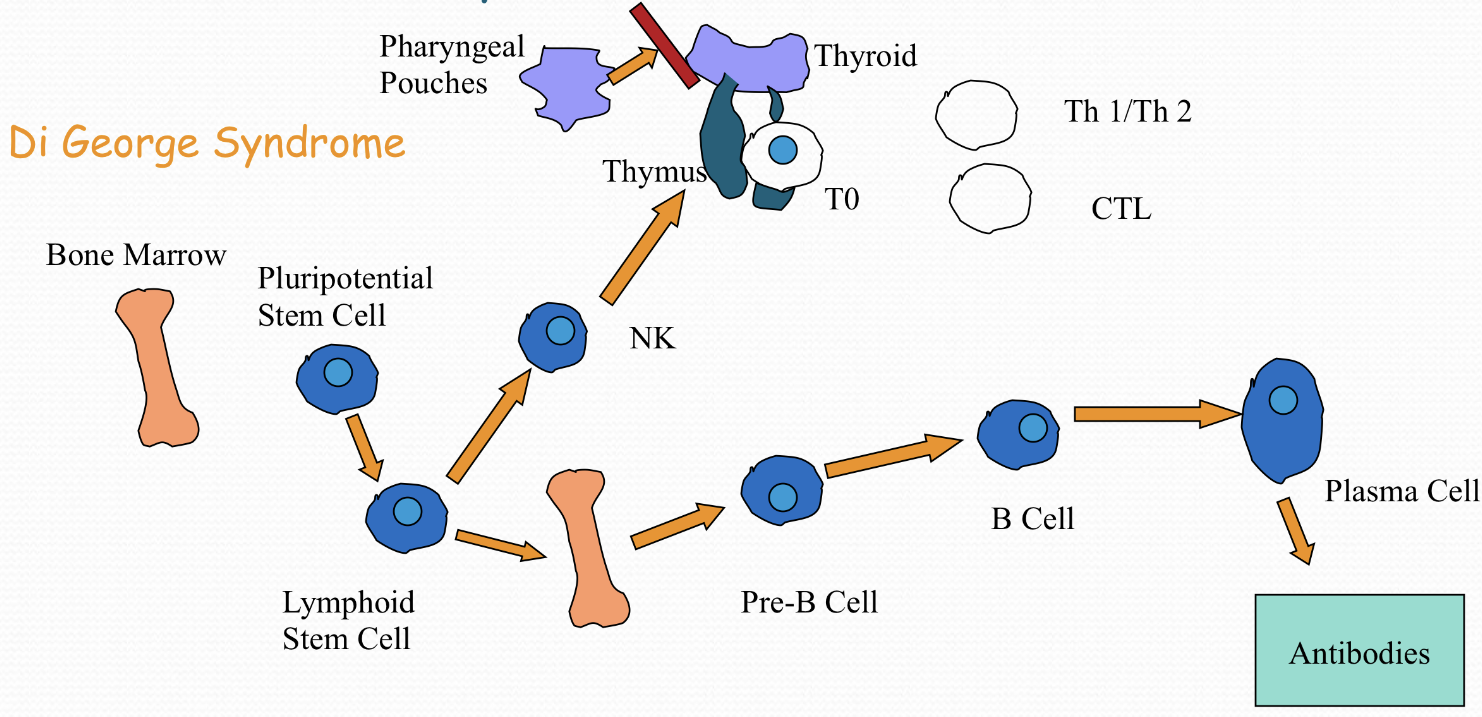
What is DiGeorge Syndrome, and what are the treatment approaches?
Lack of thymic microenvironment → thymus not developed → no T cell development
T-cells = vv imp for antigen presentation, activating immune system and cell-mediated IR so pts can die from viral infection and experience recurrent infections
***Die from viral infections not bacterial bcs viruses= intracellular and T-cells are responsible for controlling them but are not, BUT the innate system is still functional
Tx: Fetal thymus transplant
Explain Myasthenia Gravis, including its pathogenesis and treatment
Neuromuscular disease → muscle weakness
Pathophysiology:
Weakness caused by circulating antibodies, block Ach receptors at post-synpatic neuromuscular junction (NMJ)
So nerve cells release Ach which tells the muscle cell to move, on the muscle cell there are receptors, in myaesthenia gravis, antibodies block the receptors
***Primarily associated w/ B-cell/humoral immunity

Treatment: Immunosuppressants
Regulate the immune system, tells IS to stop producing so many antibodies
Because it is general suppression, the person is prone/susceptible to infections like oral thrush
