History Exam 2 Buddhist and Hindi Art
 Call Kai
 Learn
 Practice Test
 Spaced Repetition
 Match
 Flashcards
 Knowt Play
1/12

There's no tags or description
Looks like no tags are added yet.
13 Terms
Buddha
Siddharta Gautama; the founder of buddhism who acheived enlightenment
Stupa
A domed shaped buddhist monument that holds sacred relics used for worship
Torana
Decorative walkway that that marks the entrance of a sacred buddhist or Hindu site
Pradakshina
Ritual of walking clockwise around a scared object like a stupa as an act of devotion
Bodhisattva
An enlightened being who helps other through enlightenment before entering final nirvana
Mudra
Symbolic hand gesture used in buddhist and hindi art communicating teaching protecting or meditation
Aniconic
Representing a sacred figure through symbols rather than showing the figure itself, Buddha is shown through a wheel, footprints, or a throne, not through a human image.
Linga
Representation of Hindu god Shiva (divine creative power)
Lion capital from Ashokan pillar
Sarnath, India, Mauryan period, c. 250 BCE. Polished Sandstone Commissioned by Ashoka, the Mauryan emperor who converted to Buddhism. Four lions back to back on a circle abacus. Carvings of elephant, horse, bull and lions separated by the “wheel of dharma.” Sarnath is where the Buddha delivered his first sermon after achieving enlightenment. Ashoka sponsored Buddhist monuments and spread Buddhist teachings throughout his empire.

The Great Departure
On an architrave of the eastern torana, Great Stupa, Sanchi, India. Shunga period Stone relief sculpture. Early Buddhist artists' preference for symbolic rather than human representations of the Buddha. A parasol above him and a riderless horse, carved in relief and filled with narrative detail that adds to the story of Buddhas journey towards enlightenment.
The Buddha
Mathura, India, Kushan period, early second century CE, Red sandstone. Earliest human-form representations of the Buddha. In the distinctive red sandstone, the Buddha stands upright, facing forward, with a powerful, idealized body and a halo behind his head, symbolizing spiritual enlightenment. The display's elongated earlobes are a sign of his former life as a wealthy prince who wore heavy jewelry.

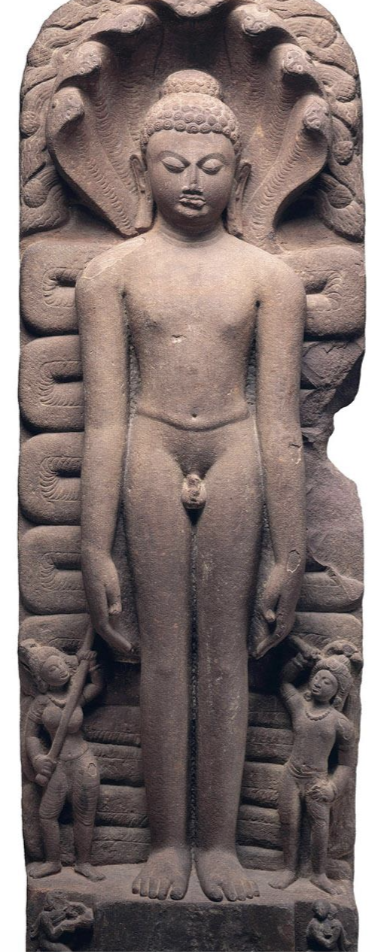
Jain Tirthankara Parshvanatha, India
Gupta period, sixth century CE. Depicts Pashvantha the 23rd spiritual teacher of Jainism, minimal clothing the Jain rejection of worldly attachments and the facial expression conveys inner peace and enlightenment.
Eternal Shiva (three-faced linga)
Flanked by guardian figures,Shiva Cave temple, Elephanta, India, Kalachuri kingdom, sixth century CE.*Shiva the principle deity of Hinduism, features a monumental three-faced image emerging from a linga-like form. The cave temple served as a place of worship and pilgrimage. Shiva’s role as an eternal and cosmic deity: the middle focal face is calm and serene.
