Audiology Test One - Week Six
 Call Kai
 Learn
 Practice Test
 Spaced Repetition
 Match
 Flashcards
 Knowt Play
1/26

Earn XP
Description and Tags
27 Terms
What is Paediatric Audiology?
Paediatric audiology includes the use of those tests and diagnostic procedures designed especially for children who cannot be tested by conventional audiometry. Approaches vary with both the chronological and mental ages of children.
Speech and language, and overall development in normally hearing children
Approximate timeline of development for a NH child.
n.b. growth and development is a continuous process (we just use milestones as a guide)
There are individual rates of growth and development. It isn’t necessarily a fixed rate.
1-2 months
Movements are dominated by primary reflexes:
pulled-to-sit
automatic walking
Startle/Moro reflex elicited by head-drop, sound, touch or other
Stimuli
Age and stage at 3-6 months
Visually alert, especially to faces
Visually alert to near and far
Recognises things like feeding and familiar situations
Smiles, coos, laughs/chuckles
Responds happily to almost everyone friendly (little caution)
Sits with some support, turns head
Rolls over (front to back) about 6 months
Rolls over (back to front) a little afterwards
Takes object to mouth
Noisy protesting cries when distressed
Vocal emissions include basic vowel type sounds/combinations
A child will make the same vocal sounds as a reflex even if they are deaf
Babbling seems to represent reflexive preadaptive behaviour unique to human infants. It is the earliest function in the pre-programmed schedule of linguistic activities and can be described as being innate process.
Babies learn the specific sounds of the language to which they are exposed by 6 months of age (Kuhl et al., 1992)
Now identifying children have a hearing issue when it is not noticeable to the whānau, therefore it can come as quite a shock for parents because they haven’t come to the conclusion yet
Age and Stage at 6-9 months
Pulls themselves to sit [7 mo]
Sits unsupported [8 mo]
Picks up toys
Attempts to crawl [looks like an army crawl] Stands, holding on
Visually attentive, looks for toys [9 mo]
Babbles away e.g. for amusement
Double babble [dad-dad, mamama, abababa]
Understands e.g. bye-bye
Peek-a-boo
Imitates voice with non-speech sounds
Sometimes imitation precedes understanding
But from around 8 months, spontaneous vocalisations become noticeably different in deaf and hearing infants [quality and quantity]
Age and stage at 15 months
Walks alone, pushes a baby walker about
Start to tackle steps (up, but later down)
Builds a tower or manipulates small objects
Spontaneous use of a single word in context.
Age and stage at 18 months and onwards
Approx 10 Word Vocab(18mo)
Approx 20 Word Vocab(24mo)
Starting to string words together e.g. speak in 2-word phrases (24 mo)
Speech Errors Reduce
Final consonant deletion
Unstressed syllable deletion
More Speech Sounds Added Some Errors In Speech
Sound substitution: “tank oo” for “thank you”
Consonant cluster reduction: “tuck” for “truck” Consonant cluster substitution: “bwu” for “blue”
By age 3, most people understand ~ 50% of what child says
Impact of early identification of hearing loss
evidence for early intervention (and therefore, identification via screening and assessment) and how they link with these developmental milestones
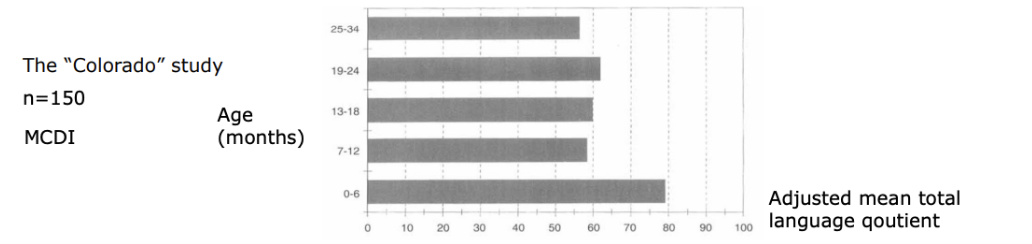
A basic premise with respect to earlier intervention: it results in improved language outcomes
The earlier we can diagnose a child with a hearing condition, the better their hearing will be and outcomes will be
Cohort of children with hearing impairments, older children are born after the implementation of the hearing screening, therefore their hearing impairment was diagnosed later, the younger children were screened at birth and have therefore been diagnosed earlier
Early intervention is good no matter the degree or severity of hearing loss, upward trend of people with late intervention. If we miss the window of opportunity to help the child, will always struggle and have Compounding issue
When hearing impairment is identified and action initiated by 6 months of age, children show significantly better language scores (both receptive and expressive)
Yoshinago-Itano et al. (1998): Early identified hearing impairment group had language scores within normal range when 1-5 years old.
With late intervention there is nothing wrong with a child’s intelligence the issue is that the brain hasn’t been stimulated by language
Window of opportunity is six months and earlier, hope to find hearing loss early to give the child the best chance of meeting milestones, six months is when ideally a child will get hearing aids if they need them
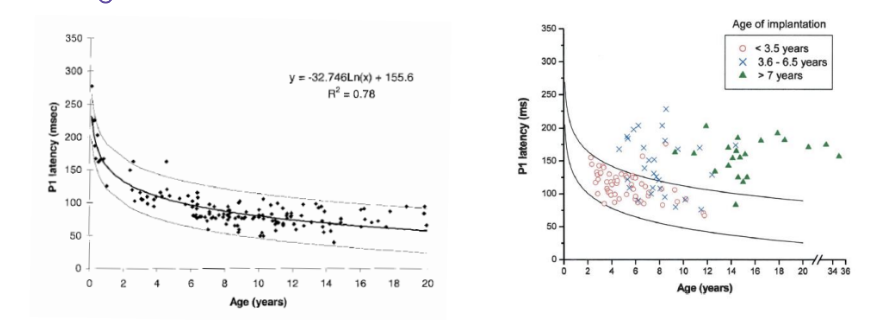
Physiological evidence of behavioural/language outcomes of hearing vs. non hearing children
Children who have early intervention have better chances of succeeding, children who had early identification and intervention, their latency develops relatively similar to someone who doesn't have a hearing issue
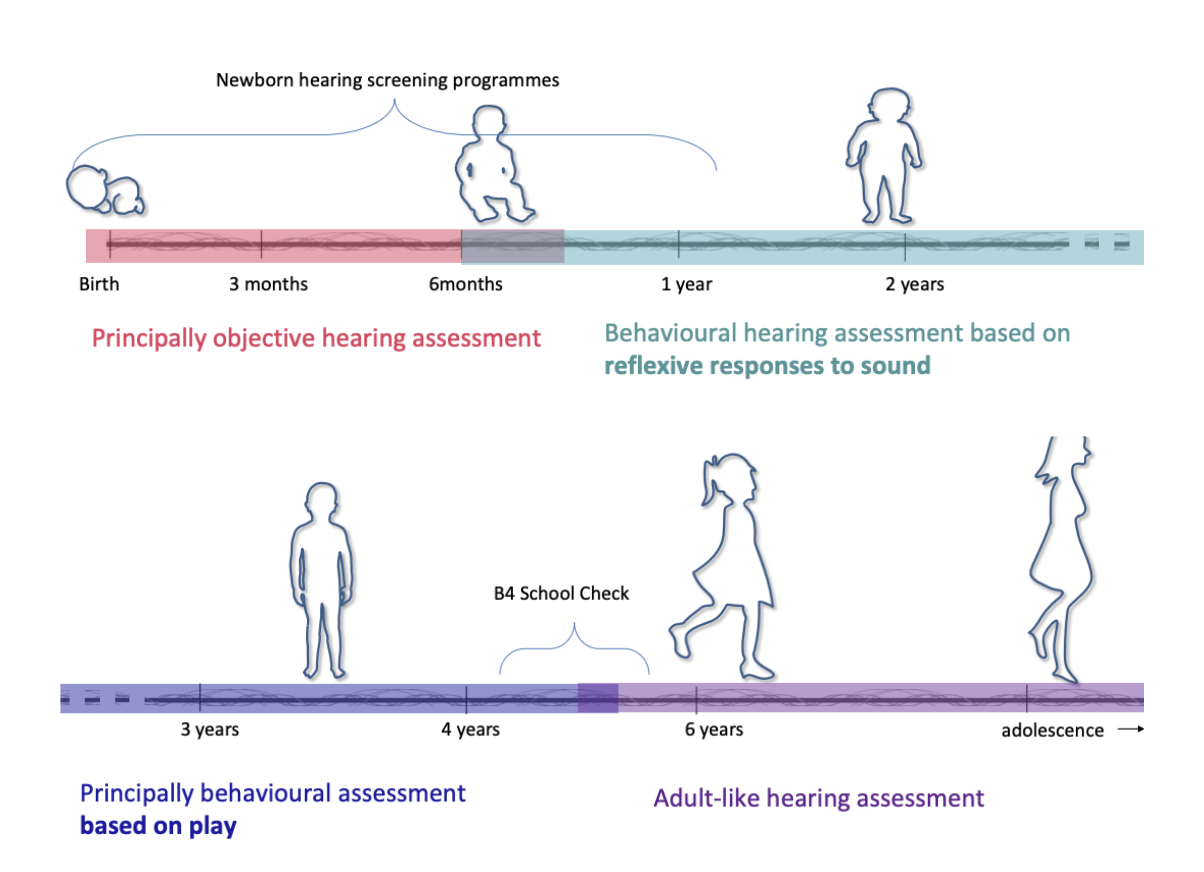
Timeline of milestones based on developmental trajectory
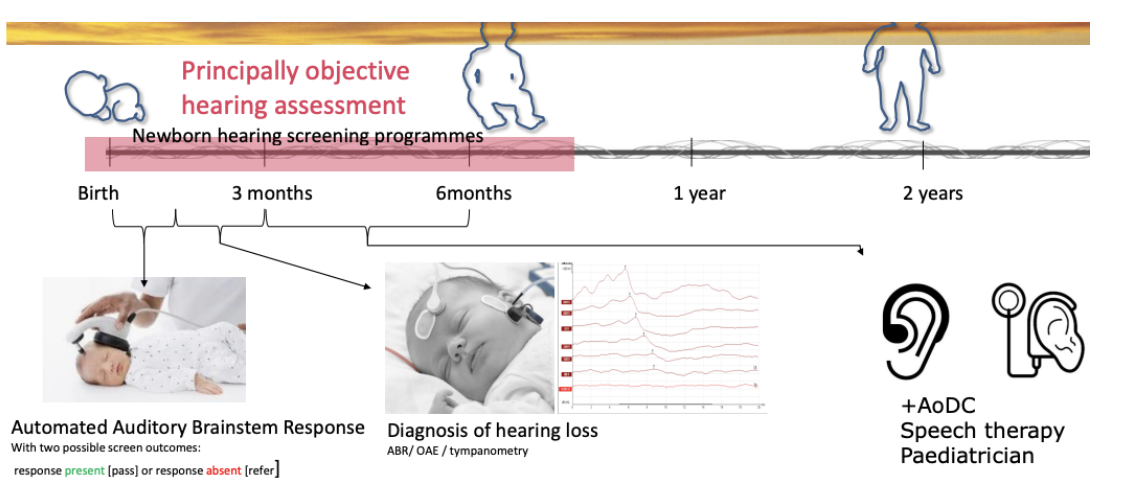
Objective Hearing Assessment
Behavioural Observational Audiometry
1. An infant is observed in a quiet state 2. Then during presentation of sounds
The objective is to watch for any behavioural signs that seem to correspond with the sound presentation
e.g. eyes widening, blinking, altered facial expressions, attempting to move eyes (or head) towards the sound, or more overt signs such as starting to cry or showing surprise/shock.
A key component of interpretation is that behavioural changes are time-locked to the stimulus presentation
High face validity
BOA is an unconditioned response
Offers an excellent indication of responsiveness/awareness of sounds measured at particular
levels
Has excellent face validity to parents/caregivers (who often may have only previously been able to observe ABR-related procedures...)
BOA is used frequently in the aided condition after initial fitting of hearing aids (often around 3 months of age) following an ABR-based diagnosis of PCHI
(but note, lack of sound exposure can impact upon unconditioned responses)
Broadband stimuli (such as NB noise or speech sounds) are most effective but are not frequency specific. Warble tones or ‘ped noise’ may also be used
It is sound field based, with typically NBN presented at 60-80 dB A
Can be used in older children and adults with developmental delay or learning difficulties
Types of stimuli you would use within Behavioural Observational Audiometry
/mumumumu/producednasally
500 Hz Chime
1000 Hz Chime
/S/
/s/
Manchester Rattle
Common responses to stimuli within behavioural observational audiometry
Easier to see:
stilling (from mild activity)
arousal (from quiet or light sleep) eye widening
blinking/startle
Harder to see:
limb movement
sucking
grimacing
breathing change
Visual reinforcement Audiology
VRA is the most commonly used type of audiometry that follows on from BOA by using conditioning to develop repeatable behavioral responses.
Response is clearly defined (e.g. a head turn) which is involuntary in response to a sound (or tactile) stimulus
But this response is strengthened through reinforcement i.e. a visual and/or tactile (and social) reward
It naturally follows on from BOA in developmental trajectory, primarily because the type of behavioural response is a head turn (or similar), therefore the patient requires head control and to be awake & alert
Conditioning can be further described by the type of reinforcement (e.g. visual, social, tangible)
Used with children from 6-9 months to 2-3 years
Steps of Visual Reinforcement Audiology
Step 1: the distractor holds the child’s interest to their front
Step 2: At the right moment, the second audiologist presents the sound. If heard, this will trigger a reflexive head turn
Step 3: Reinforce
Step 4: Reset
Paediatric Speech Audiometry
The six sounds /a/, /u/, /il, /S/, /s/, and /m/ are representative of the speech energy contained within all the speech sounds of English.
Many, but not all, authorities believe that pure tones are probably not the ideal stimuli because they are not meaningful to children. Pure tones have the obvious advantage of supplying information about children's hearing sensitivity at specific frequencies
Reinforcers used in visual reinforcement audiology
Complex: colour, movement, 3D / animated
Visually obscured: it is important that the child can’t see the reinforcer all the time, or she will gaze at it all the time, resulting in a lot of false positive responses
Traditional toy cabinets are a box covered with smoked glass, and only becomes visible when a light comes on inside the box
Variety: the reinforcer may have to maintain a child’s interest for a long time, especially if the baby comes to the audiologist often (which hearing impaired children do). Also, some puppets scare a child, so we need a variety to choose from. So e.g. 3 stacked cabinets
Animated reinforcers allow a lot of variety but don’t have the 3D element
Should be boosted with social reinforcement by the distractor
Responses evoked from visual reinforcement audiology
Head turn (half or full)
Eye turn (perhaps too much distraction – they want to watch the distractor)
Other – listening, pointing, smiling, vocalising, naming
We are looking for a head-turn (or other) that is time-locked to the sound stimulus
Usually it is the tester (not distractor) who decides whether to accept a head-turn as genuine, and reinforce. The distractor then cues their response accordingly (but it can be the other way around...distractor led. Teamwork is key)
A key role of both in the team is to differentiate false and true responses, and only reinforce the true ones
“check” turns or glances are a common false positive, as differentiated from a more sustained head turn in true cases
We usually only use one speaker and reinforcer combo so the child will tend to look one way.
A second speaker can be used to gauge localisation (binaural) abilities in sound field. Then a response may still be towards the reinforced side, or to the other side. Hence if doing this then two sets of speaker and reinforcer combos are required
Common downfalls of visual reinforcement audiology
Inadequate test set-up and communication between testers
Attempting to condition to subthreshold stimuli
Not establishing clear responses before proceeding to test trials
Counting a checking response as a true response
Parents cueing the child (often subconsciously)
Too little or too much activity by distractor with the child
Overemphasis on quantity of data rather than quality
Inefficient use of time [it is better to do all AC points, or go quickly to BC?]
Vibrotactile – sometimes a lack of a headturn can be because the child has not heard the sound, or there is simple a lack of headturn e.g. due to too much distraction or developmental inability. BC raised to high levels to produce a vibrotactile response can be used to differentiate these circumstances – are they “conditionable”?
Operant Conditioning Audiology
conditioning phase :
sound + visual reward = head turn [classical conditioning]
and:
testing phase:
sound then head turn - > reinforced by visual stim. [operant conditioning] NO reinforcement
sound then NO head turn - > NO reinforcement
No-sound trial:
No sound then NO head turn - > No reinforcement
[but increased confidence that a head turn to sound was an sound-related response]
Operant conditioning audiometry requires much time and patience if it is to work. Often, many trials are required before the child begins to understand the task. As in other audiometric procedures, it is essential that the signals be introduced aperiodically because the child may learn to predict a signal and to respond to a sound that has not been heard. Often operant conditioning audiometry can be successful when other procedures have failed
Play Audiometry
Note also the video in AKO/LEARN showing the B4S check procedures
Moving forward from VRA, the nuts and bolts pre-requisites of play audiometry are:
When a child can be taught (conditioned) to wait for a sound and then respond with some play activity
Can be conditioned to the task with little or no verbal instruction, instead a simple and game activity demonstrated by the tester
Kendall Toy Test (KTT) or McCormick Toy Test
Kendall toy test is the more commonly test used in aus and nz
Speech Materials of KTT
+ 5 distractors (but these are said not to be used commonly in NZ)
Words are selected based on vocabulary of typical 2.5 yr olds
Pairs are matched for vowel/dipthong but differ in consonants
The words of each pair
sound similar when heard near threshold
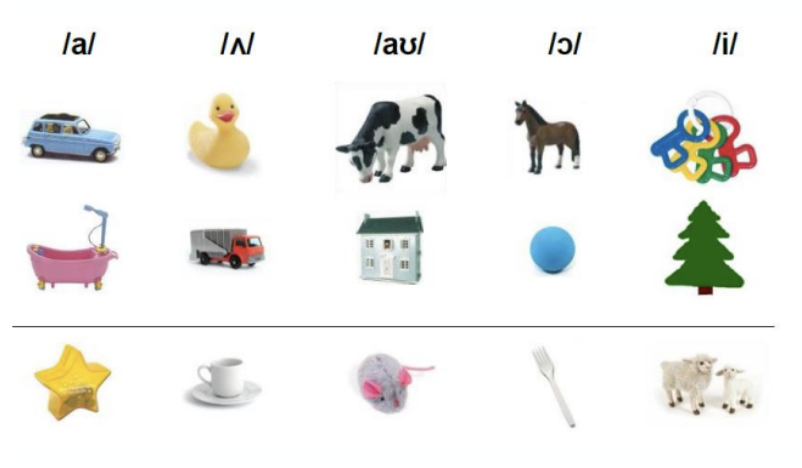
Key Principles of KTT/MTT
A closed-set test...1 word is spoken. With KTT there are 10 possible words/toys that could have been spoken (or 15 if using the additional 5 distractors with KTT, or 14 if using MTT).
Because the 10 words are made up from similarly sounding pairs, the KTT/MTT is often described as a test of word discrimination i.e. which one of the two was it?
But a discrimination task would usually involve presenting both sounds in the pair (e.g. via a 2-alternative or 3-alternative paradigm).
In KTT/MTT the child is simply given a single word, so to perform the task they must have recognised that word and attached meaning by linking it to the associated toy.
Hence arguably the test is more one of word recognition not discrimination.
Toy discrimination test
Phase 1 of KTT
Introduce each toy, encouraging the child to name it.
If you ask the child to point to the cow and they point ot the house you realise that they are not discriminating the lower sounds
Demonstrate task by saying word (with carrier phrase) at a conversational level, typically about 60 dB A, with visual cues.
Encourage the child to point to the corresponding toy, then reward that response.
Repeat several times until you are happy with the reliability of the response, then move to the testing phase.
Phase 2 of KTT
Present words while covering your mouth to remove lip-reading cues.
Begin to adaptively find the word discrimination threshold
Alter level adaptively to seek word discrimination threshold (90% correct usually), simultaneously monitoring level on-the-fly via SLM.
Interact with child: continue to reward/reinforce correct responses but not incorrect ones.
Keep track of score.
Keep track of which words have been presented, making sure to randomise the words as the test progresses
Occasionally reshuffle toys.
Interact with whānau if necessary.