3.3b Natural Selection and its effects on Populations
 Call Kai
 Learn
 Practice Test
 Spaced Repetition
 Match
 Flashcards
 Knowt Play
1/15

There's no tags or description
Looks like no tags are added yet.
16 Terms
How does natural selection affect populations of organisms?
Natural selection at the population level can have a variety of effects. One effect could be directional selection
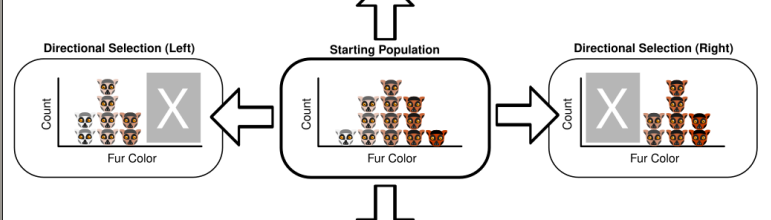
What is directional selection?
a type of natural selection in which one extreme phenotype is favored over both the other extreme and moderate phenotypes
Under what circumstances would directional selection occur? Could the opposite also happen in a population?
light fur color in dark colored setting which makes yoou easily seen by predator

What is stabilizing selection?
Intermediate phenotypes are favored – with natural selection removing more extreme phenotypes from the population (on both sides of the distribution)

what is disruptive selection
extreme values for a trait are favored over intermediate values
Where has such population-level effects of directional selection been documented?
Finch beak size – see video on the work of Peter and Rosemary Grant (coming up shortly)
Peppered moths: Depending the level of air pollution either dark pigmented or light pigmented moths are favored to survive.
And many other examples in such animals as salmon, cats, and African cichlids (to name a few)
Where has such population-level effects of stabilizing selection been documented?
‘Birth Weight − A classic example of this is human birth weight. Babies of low weight lose heat more quickly and get ill from infectious diseases more easily, whereas babies of large body weight are more difficult to deliver through the pelvis. Infants of a more medium weight survive much more often. For the larger or smaller babies, the baby mortality rate is much higher. The bell curve of the human population peaks at a birth weight that the newly born babies exhibit the minimum death rate.’
Where has such population-level effects of stabilizing selection been documented?
May be an important force in sympatric speciation and niche diversification
Classic example - apple flies.

what is a summary of Peter and Rosemary Grant’s discoveries
The Galapagos finches have adapted to a number of ecological roles (or niches) on the islands
The Grants have shown that the effects of natural selection can be observed directly in real world populations within a single human lifetime (and indeed within a few years in some cases).
Ecological conditions set the stage for the effects of natural selection – with the average body size and shape of the finches shifting over time in response to this natural selection.
These same processes could eventually result in other speciation events (a subject we will discuss in later lectures – the question of speciation).
what is heritability?
a statistic used in the fields of breeding and genetics that estimates the degree of variation in a phenotypic trait in a population that is due to genetic variation between individuals in that population
Why do individuals vary in their phenotypic traits?
genetic variations; variation in genes
environmental effects; nutrition, predation, healthy conditions
Heritability measures …
how well we can predict a trait from genetics
how is heritability estimated?
Heritability may be estimated by comparing parent and offspring traits (as above). The slope of the line approximates the heritability of the trait when the offspring values are regressed against the average trait of the parents.
What does a high heritability indicate?
A high heritability, close to 1, indicates that genetic factors explain much of the variation in a trait between different individuals
What does a low heritability indicate?
A low heritability score, close to 0, indicates that genetic factors contribute little to the variation between individuals
Does context matters when measuring heritability?
Context matters when measuring heritability – we should be careful when interpreting the results