7.0 Neuropsychology of language
 Call Kai
 Learn
 Practice Test
 Spaced Repetition
 Match
 Flashcards
 Knowt Play
1/39

Earn XP
Description and Tags
Neuropsychology of language
40 Terms
Models of Language
WERNICKE’S MODEL
ELLIS & YOUNG MODEL
LEVELT’S MODEL
DUAL STREAM MODEL
Different theoretical frameworks to understand how language is produced & comprehended in the brain
WERNICKE’S MODEL
Early model proposing distinct sensory & motor centers.
Sensory Center → (Wernicke’s area)
Association fibers
Motor Center → (Broca’s area)
Wernicke’s area: language comprehension.
Broca’s area: language production.
Connection allows repetition and fluent communication.

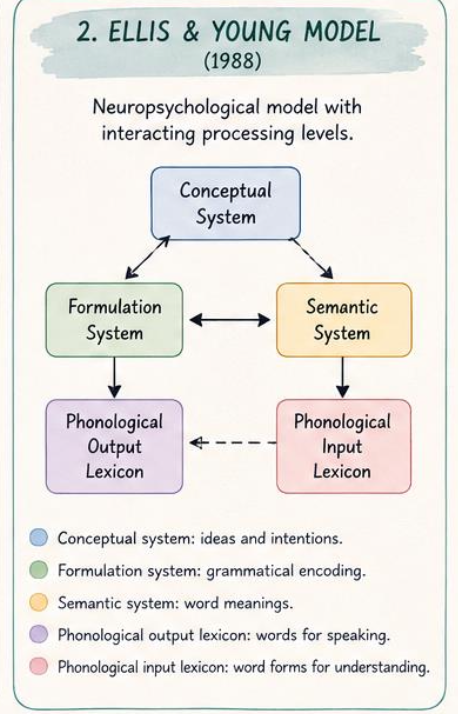
ELLIS & YOUNG MODEL
Neuropsychological model with interacting processing levels.
Conceptual System
↓
Formulation System ↔ Semantic System
↓ ↓
Phonological Output Lexicon ↔ Phonological Input Lexicon
Conceptual system: ideas & intentions.
Formulation system: grammatical encoding.
Semantic system: word meanings.
Phonological output lexicon: words for speaking.
Phonological input lexicon: word forms for understanding.
LEVELT’S MODEL
Psycholinguistic model of speech production.
Conceptualization (communicative intention)
→
Formulation (grammatical encoding)
→
Lemmatization (lexical selection)
→
Phonological Encoding (phoneme selection)
→
Articulation (motor execution)
Self-monitoring & repair

DUAL STREAM MODEL
Two main pathways for language processing.
Dorsal Stream
(Where / How) →Maps sounds to articulation.
Important for repetition and speech production.
Ventral Stream
(What)Maps sounds to meaning.
Important for comprehension.
Dorsal stream: phonological processing.
Ventral stream: semantic processing.

Why so many models?
Language is complex and involves multiple components & processes that interact in dynamic ways.
COMMON ELEMENTS ACROSS MODELS
From intention to expression
Multiple processing levels
Specialized but interconnected systems
Ongoing monitoring and feedback
Remember ☆
No model explains everything, but each helps us understand the remarkable system we call language.
What is language?
Comes from the word "langue” for tongue” → Language described as the combination of sounds for communication
This use of sounds guided by rules
STRUCTURE of language
Phonemes
Morphemes
Lexicon
Syntax
Semantics
Prosody
Discourse
Phonemes
Fundamental language sounds that form a word
Morphemes
Smallest meaningful units of words
Lexicon
Collection of all words in a given language
Syntax
Rules of grammar
Semantics
Meaning of words and sentences that correspond to all lexical items
Prosody
Vocal intonations “tone of voice”
Discourse
Stringing sentences together to form a meaningful narrative
Wernicke-Geschwind Model
Word sounds are sent to the → Primary Auditory Cortex
Word meaning is represented in → Wernicke’s area
Word meaning is sent to Broca’s area via the arcuate fasciculus
Broca’s area sends instructions for speech articulation to the motor cortex
To read (comprehension-speech pathway), visual areas send information to the angular gyrus & to Wernicke’s or Broca’s area

Words sounds are sent to
PRIMARY AUDITORY CORTEX
Words meaning is represented in
WERNICKES AREA
Words meaning is sent to
BROCA´S AREA VIA THE ARCUATE FACICULUS
Ellis & Young model (1992) says that language processing consists of
different processing components, & different tasks use different routes through those components.
Ellis & Young model TASK
Oral expression
Oral comprehension
Naming an object
Reading aloud
Repetition of a pseudoword
Repetition of a word (known meaning)
Repetition of a word (no meaning)
Writing
Oral expression
Object → Visual analysis → Semantic system → Lexical access → Phonemes → Speech

Oral comprehension
Heard word → Auditory analysis → Phonological lexicon input → Semantic system

Naming an object
Repeat a word (no meaning)

Reading aloud
Written word → Visual analysis → Orthographic lexicon input → Semantic system → Lexical access → Phonemes → Speech

Repeat a pseudoword
Heard word → Auditory analysis → Acoustic-phonological conversion → Phonemes → Speech

Repetition of a word (known meaning)
Heard word → Auditory analysis → Phonological lexicon input → Semantic system → Lexical access → Phonemes → Speech

Repeat a word (no meaning)
Heard word → Auditory analysis → Phonological lexicon input → Lexical access → Phonemes → Speech

Writing
Heard word → Auditory analysis → Phonological lexicon input → Semantic system → Orthographic lexicon → Graphemes → Writing

Semantic system
meaning / concepts
Phonological lexicon input
stored sound forms of familiar words
Orthographic lexicon input
stored written forms of familiar words
Lexical access
retrieving the word you want to produce
Phenomes
sounds of language
Graphemes
written letters/letter combinations
Auditory analysis
analysing what you hear
Visual analysis
analysing what you see/read
Acoustic -phonological conversion
converting heard sounds directly into phonemes without accessing meaning
Phoneme–grapheme conversion
converting sounds → written letters