LIFESCI 7A AOL 2 Learning Life Objectives
 Call Kai
 Learn
 Practice Test
 Spaced Repetition
 Match
 Flashcards
 Knowt Play
1/64

There's no tags or description
Looks like no tags are added yet.
65 Terms
Define and relate oxidation and reduction as they relate to chemical reactions.
Oxidation: Loss of electrons; often involves losing hydrogen or gaining oxygen.
Reduction: Gain of electrons; often involves gaining hydrogen or losing oxygen.
They always occur together in redox reactions (REDOX).
Remember: OIL RIG (Oxidation Is Loss, Reduction Is Gain).
Describe the energy changes associated with oxidation-reduction reactions.
When a molecule is oxidized, it generally loses potential energy as its electrons are transferred.
When a molecule is reduced, it gains electrons and generally gains potential energy.
Electrons moving from high-energy donors to more electronegative acceptors release energy that cells can capture.
Discuss what happens to matter and energy through the overall process of cellular respiration.
Overall equation: Glucose + Oxygen → Carbon dioxide + Water + ATP.
Matter: Glucose is broken down, its carbon atoms become CO₂, and oxygen is reduced to water.
Energy: Chemical energy stored in glucose is transferred to NADH and FADH₂ and ultimately used to produce ATP.
Most energy is released during oxidative phosphorylation.
Discuss what happens to matter and energy through glycolysis.
Occurs in the cytoplasm.
One glucose (6 carbons) is split into two pyruvate molecules (3 carbons each).
Uses 2 ATP and produces 4 ATP, resulting in a net gain of 2 ATP.
Produces 2 NADH.
Does not require oxygen.
Discuss what happens to matter and energy through the different stages of cellular respiration.
Stage | Matter changes | Energy products |
|---|---|---|
Glycolysis | Glucose → 2 pyruvate | 2 ATP net, 2 NADH |
Pyruvate oxidation | 2 pyruvate → 2 acetyl-CoA + 2 CO₂ | 2 NADH |
Citric acid cycle | Acetyl-CoA completely oxidized into CO₂ | 2 ATP, 6 NADH, 2 FADH₂ |
ETC/oxidative phosphorylation | Oxygen accepts electrons and forms water | Approximately 26–28 ATP |
Identify where the different stages of cellular respiration occur in the eukaryotic cell.
Glycolysis: Cytoplasm (cytosol).
Pyruvate oxidation: Mitochondrial matrix.
Citric acid cycle: Mitochondrial matrix.
Electron transport chain: Inner mitochondrial membrane.
ATP synthesis: Inner mitochondrial membrane, with ATP released into the matrix.
Describe the structure and function of ATP synthase.
ATP synthase is a protein complex embedded in the inner mitochondrial membrane.
It contains a channel that allows H⁺ ions to flow down their electrochemical gradient.
The movement of protons causes part of the enzyme to rotate, providing energy to combine ADP and inorganic phosphate (Pi) into ATP.
This process is called chemiosmosis.
Compare and contrast the generation of ATP in the presence or absence of oxygen.
With oxygen (aerobic respiration): ETC operates, oxidative phosphorylation occurs, and approximately 30–32 ATP are produced per glucose.
Without oxygen (fermentation): ETC cannot operate normally, so cells rely on glycolysis, producing only 2 ATP per glucose.
Fermentation regenerates NAD⁺ so glycolysis can continue.
Both processes use glycolysis.
Relate the metabolism of different molecules (i.e., sugars and fats) to cellular respiration.
Sugars enter glycolysis as glucose or related intermediates.
Fats are broken into glycerol and fatty acids.
Glycerol can enter glycolysis.
Fatty acids undergo beta-oxidation, producing acetyl-CoA, NADH, and FADH₂.
Acetyl-CoA enters the citric acid cycle.
Fats generally contain more energy per gram than carbohydrates.
Connect redox reactions to the energy transformations that occur throughout cellular respiration.
Glucose is oxidized, and oxygen is reduced.
NAD⁺ and FAD accept electrons and become NADH and FADH₂.
These electron carriers transport high-energy electrons to the ETC.
As electrons move through the ETC, energy is released and used to pump H⁺ across the inner mitochondrial membrane.
The resulting proton gradient powers ATP synthase.
Predict which agents serve as reducing and oxidizing agents.
Reducing agent: Donates electrons and becomes oxidized.
Oxidizing agent: Accepts electrons and becomes reduced.
NADH is a reducing agent because it donates electrons.
NAD⁺ is an oxidizing agent because it accepts electrons.
Oxygen is an oxidizing agent because it accepts electrons at the end of the ETC.
Relate the movement of electrons through the ETC to the production of ATP by ATP synthase.
NADH and FADH₂ donate electrons to the ETC.
Electrons move through a series of protein complexes.
Energy released pumps H⁺ from the mitochondrial matrix into the intermembrane space.
This creates an electrochemical proton gradient.
H⁺ flows back into the matrix through ATP synthase.
ATP synthase uses this energy to produce ATP.
Predict how introducing changes in one stage of cellular respiration will affect components upstream and downstream.
A change in one stage can affect the availability of reactants and products in other stages.
Blocking an enzyme causes its substrate to accumulate and its product to decrease.
Downstream reactions may slow because they lack necessary reactants.
Upstream reactions may also slow if products accumulate and inhibit earlier reactions.
Example: Blocking the ETC prevents NADH oxidation, causing NADH to accumulate and NAD⁺ to decrease. This can slow the citric acid cycle and eventually glycolysis.
Evaluate how changes in one metabolic pathway (i.e., fatty acid synthesis) affect other integrated metabolic pathways.
Metabolic pathways share intermediates and energy sources.
Increasing fatty acid synthesis consumes more acetyl-CoA, ATP, and NADPH.
This can reduce the availability of these molecules for other pathways.
Decreasing fatty acid synthesis can make more acetyl-CoA and NADPH available for other processes.
Changes in one pathway can alter reaction rates in connected pathways through substrate availability, product accumulation, and enzyme regulation.
Assess the role of redox potentials in electron flow.
Redox potential measures how strongly a molecule tends to accept electrons.
Molecules with more positive reduction potentials have a greater tendency to accept electrons.
Electrons spontaneously flow from lower (more negative) reduction potentials to higher (more positive) reduction potentials.
Electron flow in the ETC releases energy that powers proton pumping.
Connect redox reactions to energy transformations that occur throughout photosynthesis.
Water is oxidized, losing electrons and producing oxygen.
NADP⁺ is reduced to NADPH by accepting electrons.
Light energy excites electrons in chlorophyll.
Electron movement through the ETC creates a proton gradient that powers ATP synthesis.
ATP and NADPH provide chemical energy and reducing power for the Calvin cycle.
Identify where the different stages of photosynthesis take place.
Light-dependent reactions: Thylakoid membrane of chloroplasts.
Proton accumulation: Thylakoid lumen.
ATP and NADPH production: Associated with the thylakoid membrane; ATP and NADPH become available in the stroma.
Calvin cycle: Chloroplast stroma.
Explain how the Calvin cycle transforms carbon dioxide into sugar and where the energy comes from.
CO₂ enters the Calvin cycle and is attached to RuBP by Rubisco.
The resulting molecules are converted into 3-PGA.
ATP provides energy, and NADPH provides electrons to reduce 3-PGA into G3P.
Some G3P leaves the cycle and can be used to make sugars.
The remaining G3P regenerates RuBP.
Energy comes from ATP and NADPH produced during the light-dependent reactions.
Describe the role of Rubisco in photosynthesis.
Rubisco is an enzyme that catalyzes carbon fixation.
It attaches CO₂ to RuBP (a 5-carbon molecule).
This produces an unstable 6-carbon intermediate that splits into two 3-PGA molecules.
It is the enzyme responsible for introducing inorganic carbon into the Calvin cycle.
Explain how light energy reaches photosystem reaction centers and what happens when it gets there.
Pigment molecules in light-harvesting complexes absorb photons.
Energy is transferred between pigment molecules until it reaches the reaction center.
Chlorophyll in the reaction center becomes excited.
An electron is transferred to a primary electron acceptor.
The electron enters the ETC, allowing light energy to be converted into chemical energy.
Predict how introducing changes in one stage of photosynthesis will affect NADPH, ATP, and sugar production.
Blocking electron transport can decrease NADPH and ATP production.
Decreasing NADPH limits the Calvin cycle's ability to reduce 3-PGA into G3P.
Decreasing ATP limits the energy available for carbon fixation and RuBP regeneration.
Both can decrease sugar production.
Blocking the Calvin cycle can cause ATP and NADPH to accumulate because they are not being consumed as quickly.
Discuss what a plant cell can do with the products of photosynthesis once they are produced.
G3P can be used to produce glucose and other carbohydrates.
Glucose can be used in cellular respiration to produce ATP.
Sugars can be stored as starch.
Sugars can be transported as sucrose.
Carbon compounds can be used to build cellulose, lipids, amino acids, and other molecules.
Oxygen can be released into the atmosphere or used in cellular respiration.
Relate photosynthesis to cellular respiration.
Photosynthesis stores energy by converting light energy into chemical energy in sugars.
Cellular respiration releases energy from sugars to produce ATP.
Photosynthesis consumes CO₂ and H₂O and produces glucose and O₂.
Cellular respiration consumes glucose and O₂ and produces CO₂ and H₂O.
The products of one process are the reactants of the other.
Describe the process of photosynthesis with the aid of a model/illustration.
Light reactions: Light excites electrons in photosystems II and I.
Water is split at photosystem II, releasing O₂, H⁺, and electrons.
Electrons travel through an ETC, creating a proton gradient.
ATP synthase produces ATP.
Photosystem I re-excites electrons, which ultimately reduce NADP⁺ into NADPH.
Calvin cycle: CO₂ is fixed by Rubisco, then ATP and NADPH are used to produce G3P.
G3P is used to make sugars.

Interpret data to determine the impacts of various herbicides on different steps in photosynthesis.
Examine changes in oxygen production, NADPH, ATP, and sugar production.
Reduced oxygen production may indicate disruption of water splitting or electron transport.
Reduced NADPH may indicate disruption of electron transfer to NADP⁺.
Reduced ATP may indicate disruption of the proton gradient or ATP synthase.
Reduced sugar production may indicate disruption of the Calvin cycle or insufficient ATP/NADPH.
Relate experimental results to a model of photosynthesis to determine which step is most directly impacted by herbicides.
Identify which measured products change.
Compare those changes to the expected products of each stage.
For example:
Decreased O₂: Possible disruption of photosystem II or water splitting.
Decreased NADPH: Possible disruption of photosystem I or electron transfer to NADP⁺.
Decreased ATP: Possible disruption of electron transport, proton gradients, or ATP synthase.
Decreased G3P/sugar: Possible disruption of the Calvin cycle.
Look for the earliest affected step rather than assuming every decreased product is directly affected.
Relate mechanisms of action to predicted experimental results for various herbicides.
Photosystem II inhibitors: Block electron transfer, potentially decreasing oxygen production, NADPH, ATP, and sugar.
Photosystem I inhibitors: Disrupt electron transfer toward NADP⁺, decreasing NADPH production.
Electron transport inhibitors: Reduce proton pumping, potentially decreasing ATP and NADPH.
ATP synthase inhibitors: Decrease ATP production and can cause H⁺ to accumulate in the thylakoid lumen.
Calvin cycle inhibitors: Decrease carbon fixation and sugar production; ATP and NADPH may accumulate.
Discuss the central dogma of molecular biology.
DNA → RNA → Protein.
Replication: DNA makes a copy of itself.
Transcription: DNA is used as a template to produce RNA.
Translation: Ribosomes read mRNA to produce a protein.
Describe the structure and organization of DNA.
DNA is a double helix consisting of two antiparallel nucleotide strands.
Each nucleotide contains a phosphate group, deoxyribose sugar, and nitrogenous base.
Bases: Adenine (A), Thymine (T), Cytosine (C), and Guanine (G).
A pairs with T using 2 hydrogen bonds.
C pairs with G using 3 hydrogen bonds.
The sugar-phosphate backbone forms the outside, and the bases face inward.
Compare and contrast the structures of DNA and RNA.
DNA | RNA |
|---|---|
Usually double-stranded | Usually single-stranded |
Deoxyribose sugar | Ribose sugar |
Uses A, T, C, G | Uses A, U, C, G |
More chemically stable | Less chemically stable |
Stores genetic information Longer | Functions in gene expression and other cellular processes Shorter |
Provide the complementary sequences of a given sequence of DNA.
A pairs with T.
C pairs with G.
The strands run antiparallel.
Example:
Original: 5'-ATGC-3'
Complement: 3'-TACG-5'
If writing the complementary strand in the 5' → 3' direction: 5'-GCAT-3'.
Describe how gel electrophoresis separates nucleic acid fragments based on size.
DNA and RNA have negatively charged phosphate backbones.
An electric field pulls them toward the positive electrode.
Smaller fragments move through the gel more easily and travel farther.
Larger fragments move more slowly and remain closer to the wells.
A DNA ladder provides known fragment sizes for comparison.
Describe how Southern blots allow specific genes or DNA sequences to be visualized on a gel.
DNA is cut into fragments using restriction enzymes.
Fragments are separated using gel electrophoresis.
DNA is transferred onto a membrane.
A labeled, complementary DNA probe is added.
The probe hybridizes to the matching DNA sequence.
The labeled probe reveals the location of the specific DNA fragment.
Assess the chemical composition of a DNA molecule given information about some of its constituents.
Chargaff's rules: A = T and C = G.
Total purines (A + G) = total pyrimidines (C + T).
Total percentage of A + T + C + G = 100%.
If A = 30%, then T = 30%, C = 20%, and G = 20%.
Each nucleotide contains one phosphate, one deoxyribose sugar, and one nitrogenous base.
Predict whether two nucleic acid molecules will hybridize based on their sequences.
Two nucleic acid strands hybridize when their sequences are complementary and antiparallel.
A pairs with T in DNA or U in RNA.
C pairs with G.
More complementary base pairs generally produce stronger, more stable hybridization.
Mismatches can reduce hybridization.
Interpret results from experiments using gel electrophoresis or Southern/Northern blots.
Gel electrophoresis: Smaller fragments travel farther than larger fragments.
Southern blot: Detects a specific DNA sequence.
Northern blot: Detects a specific RNA sequence.
A visible band indicates that the targeted sequence is present.
Band position indicates fragment size; band intensity can provide information about relative abundance, depending on the experiment.
Label the promoter, transcription start site, and terminator on a gene model.
Promoter: Region before the gene where transcription machinery binds.
Transcription start site (+1): First DNA nucleotide transcribed into RNA.
Terminator: Sequence or region that signals the end of transcription.
The promoter is upstream, and the terminator is downstream in the direction of transcription.

Define the role of promoters and terminators in transcription of eukaryotic and prokaryotic genes.
Promoters: DNA sequences where transcription factors and/or RNA polymerase bind to initiate transcription.
Terminators: Sequences or signals that cause transcription to stop.
Prokaryotes commonly use specific termination sequences or proteins.
Eukaryotic RNA polymerase II transcription involves termination associated with RNA cleavage and processing signals, including the polyadenylation signal.
Compare and contrast transcription in prokaryotes and eukaryotes.
Prokaryotes | Eukaryotes |
|---|---|
Occurs in cytoplasm | Occurs in nucleus |
No nucleus | Have a nucleus |
Transcription and translation can occur simultaneously | Transcription and translation are separated |
Little RNA processing | Extensive RNA processing |
Usually one main RNA polymerase | Multiple RNA polymerases |
State the function of eukaryotic mRNA modifications.
5' cap: Protects mRNA from degradation and helps ribosomes recognize and bind it.
Poly-A tail: Increases stability, protects against degradation, and assists nuclear export and translation.
Splicing: Removes introns and joins exons.
Together, these modifications produce mature mRNA ready for translation.
Describe the process of splicing and the role of the spliceosome in eukaryotic gene expression.
Pre-mRNA contains exons and introns.
Introns are noncoding regions removed from the pre-mRNA.
Exons are joined together to produce mature mRNA.
The spliceosome, made of proteins and small nuclear RNAs (snRNAs), recognizes splice sites and carries out splicing.
Alternative splicing allows one gene to produce multiple mRNA and protein variants.
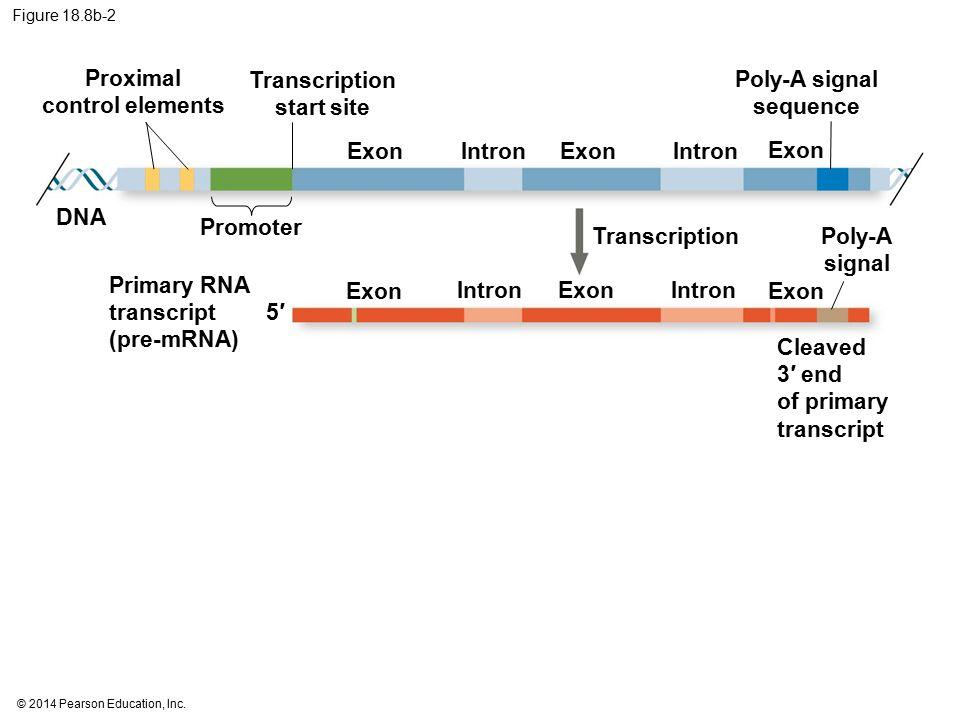
Label the promoter, transcription start site, exons, introns, and poly-A signal sequence on a model of a eukaryotic gene.
Promoter: Upstream region where transcription machinery binds.
Transcription start site: First nucleotide transcribed.
Exons: Regions retained in mature mRNA.
Introns: Regions removed during splicing.
Poly-A signal: Sequence in the RNA (typically AAUAAA) that signals cleavage and polyadenylation.
Important: The poly-A signal is transcribed from a corresponding DNA sequence, but the poly-A tail itself is added after transcription.
Identify the template strand given an mRNA or protein sequence.
The template DNA strand is complementary and antiparallel to the mRNA.
RNA uses U instead of T.
Example:
mRNA: 5'-AUGC-3'
Template DNA: 3'-TACG-5'
The coding DNA strand matches the mRNA sequence except it has T instead of U.
Predict the direction of transcription given information about the template strand, mRNA sequence, or protein sequence.
RNA polymerase reads the template DNA strand 3' → 5'.
RNA is synthesized 5' → 3'.
The mRNA matches the coding strand (with U replacing T).
Translation also reads mRNA 5' → 3'.
Determine the product of transcription given the DNA sequence of a gene.
Find the template strand.
Read it 3' → 5'.
Build complementary RNA 5' → 3'.
Base-pairing rules:
DNA A → RNA U
DNA T → RNA A
DNA C → RNA G
DNA G → RNA C
If given the coding strand, simply replace T with U.
Evaluate how transcription factors bind to promoter sequences and their effect on transcription.
Transcription factors are proteins that bind specific DNA sequences.
They help recruit or position RNA polymerase.
Activators increase transcription.
Repressors decrease transcription.
Changes in transcription factor binding can increase or decrease gene expression.
Predict how changes to DNA sequences and/or proteins involved in transcription and mRNA processing alter final transcription products.
Promoter mutations can change how efficiently transcription begins.
Mutations in transcription factor binding sites can increase or decrease transcription.
Mutations at splice sites can cause incorrect splicing or intron retention.
Mutations can create premature stop codons or alter the mRNA sequence.
Defective capping or polyadenylation can reduce mRNA stability.
These changes can alter the amount, length, or sequence of mature mRNA.
Interpret gel electrophoresis results and how mutations may affect transcription products and their relative location on a gel.
Smaller RNA fragments travel farther down the gel.
Larger RNA fragments stay closer to the wells.
Insertions generally increase fragment length.
Deletions generally decrease fragment length.
Abnormal splicing can produce shorter or longer RNA.
Increased transcription can produce a stronger band, while decreased transcription can produce a weaker band.
Predict whether a DNA/RNA sequence will hybridize with another DNA/RNA sequence.
Complementary, antiparallel sequences can hybridize.
DNA A pairs with DNA T or RNA U.
DNA T pairs with RNA A.
C pairs with G.
More complementary bases generally produce stronger hybridization.
Interpret experimental results from a Northern blot analysis.
Northern blots detect specific RNA molecules.
RNA is separated by gel electrophoresis and transferred to a membrane.
A labeled complementary probe identifies the target RNA.
Band position indicates RNA size.
Band intensity indicates relative RNA abundance.
Missing bands indicate the target RNA was not detected.
Discuss the four levels of protein structure and relate them to protein function.
Primary: Linear sequence of amino acids connected by peptide bonds.
Secondary: Local folding into alpha helices and beta sheets through hydrogen bonding.
Tertiary: Overall three-dimensional shape of a single polypeptide, formed by interactions between amino acid side chains.
Quaternary: Arrangement of multiple polypeptide subunits into one functional protein.
Protein structure determines its function; changes in structure can alter or destroy function.

Define "denatured" as it relates to protein structure.
Denaturation occurs when a protein loses its normal three-dimensional shape.
Caused by factors such as extreme temperature, pH changes, or chemicals.
Usually disrupts secondary, tertiary, and/or quaternary structure.
Often results in loss of function.
Primary structure generally remains intact.
Describe the structure and function of the ribosome.
Ribosomes are made of ribosomal RNA (rRNA) and proteins.
They consist of a small and large subunit.
The small subunit binds and reads mRNA.
The large subunit catalyzes peptide bond formation.
Ribosomes contain three tRNA binding sites:
A site: Aminoacyl-tRNA enters.
P site: Holds the growing polypeptide.
E site: Empty tRNA exits.
Ribosomes translate mRNA into proteins.
Explain the major events that occur during initiation, elongation, and termination of translation.
- Initiation:
Small ribosomal subunit binds mRNA.
Initiator tRNA recognizes the start codon (AUG).
Large ribosomal subunit joins.
- Elongation:
tRNAs bring amino acids to the ribosome.
Anticodons pair with mRNA codons.
Peptide bonds form between amino acids.
Ribosome moves along mRNA 5' → 3'.
- Termination:
Ribosome reaches a stop codon (UAA, UAG, or UGA).
A release factor binds.
Polypeptide is released, and the ribosome separates.
Define codon, anticodon, and reading frame as they relate to translation.
Codon: Three-nucleotide sequence on mRNA that specifies an amino acid or stop signal.
Anticodon: Three-nucleotide sequence on tRNA complementary to an mRNA codon.
Reading frame: The way nucleotides are divided into consecutive groups of three during translation.
Changing the reading frame can drastically change the amino acid sequence.
Discuss the role of tRNAs in translation.
Transfer RNA (tRNA) carries specific amino acids to the ribosome.
Each tRNA has an anticodon that pairs with an mRNA codon.
Its amino acid is attached by an enzyme called aminoacyl-tRNA synthetase.
tRNAs ensure that the correct amino acids are added to the growing polypeptide.
Compare and contrast translation in prokaryotes and eukaryotes.
Prokaryotes | Eukaryotes |
|---|---|
Occurs in cytoplasm | Occurs in cytoplasm |
Can occur simultaneously with transcription | Separated from transcription |
70S ribosomes | 80S ribosomes |
mRNA usually undergoes little processing | mRNA undergoes capping, splicing, and polyadenylation |
Often have polycistronic mRNA | Usually have monocistronic mRNA |
Evaluate how changes in particular amino acids of a protein may affect protein structure and function.
Amino acid substitutions can change the chemical properties of a protein.
Changes in charge, polarity, or size can affect folding and interactions.
Some mutations have little effect, while others drastically change protein function.
Example: Replacing a charged amino acid with a nonpolar amino acid may alter protein folding or stability.
Define the term "open reading frame" (ORF) as it relates to translation.
An ORF is a continuous sequence of codons that can potentially be translated into a protein.
It typically begins with a start codon (AUG) and ends with an in-frame stop codon.
It contains no in-frame stop codons between the start and stop.
Predict the anticodon given an mRNA sequence or the amino acid associated with the anticodon.
Anticodons are complementary and antiparallel to mRNA codons.
Example:
mRNA codon: 5'-AUG-3'
tRNA anticodon: 3'-UAC-5'
Amino acid: Methionine.
Remember that anticodons are written opposite the direction of the codon.
Predict how changing tRNAs or other components of translation machinery could alter translation.
Mutated tRNAs may recognize incorrect codons or carry incorrect amino acids.
Defective aminoacyl-tRNA synthetases may attach incorrect amino acids.
Ribosome mutations may disrupt translation accuracy or efficiency.
Changes to initiation factors can affect translation initiation.
These changes can produce incorrect proteins, reduce protein production, or prevent translation.
Use a codon table to translate a nucleotide sequence into an amino acid sequence.
Identify the mRNA sequence.
Read it 5' → 3'.
Find the start codon AUG.
Divide the sequence into groups of three nucleotides.
Use the codon table to identify each amino acid.
Stop when you reach UAA, UAG, or UGA.
Example:
mRNA: 5'-AUG-GGU-UUU-UAA-3'
AUG = Methionine
GGU = Glycine
UUU = Phenylalanine
UAA = Stop
Protein: Methionine–Glycine–Phenylalanine.
Relate the length of a gene to its primary and mature mRNA.
A gene contains both exons and introns, along with regulatory regions.
Primary mRNA (pre-mRNA) contains both exons and introns.
Mature mRNA has introns removed and exons joined together.
Therefore, mature mRNA is generally shorter than primary mRNA.
The gene's total genomic length is generally longer than its mature mRNA because of introns and other nontranscribed regions.
Relate the number of nucleotides in an ORF to the number of amino acids in a protein produced from it.
Every 3 nucleotides form one codon.
Each amino-acid codon specifies one amino acid.
The start codon codes for methionine.
The stop codon does not code for an amino acid.
Formula: Number of amino acids = (Number of ORF nucleotides ÷ 3) − 1, if the ORF length includes the stop codon.
Example: 303 nucleotides, including a stop codon = 100 amino acids.
Transcribe and translate a gene based on a given DNA sequence.
Step 1: Identify whether the DNA sequence is the template or coding strand.
Step 2: Transcribe DNA into complementary mRNA (5' → 3').
Step 3: Identify the AUG start codon.
Step 4: Divide mRNA into codons.
Step 5: Use a codon table to identify amino acids.
Step 6: Stop at the first in-frame stop codon.