CLST 131
 Call Kai
 Learn
 Practice Test
 Spaced Repetition
 Match
 Flashcards
 Knowt Play
1/29

There's no tags or description
Looks like no tags are added yet.
30 Terms
Typology- Dating technique. The systematic organization of artifacts into types because of their shared attributes. A type of relative dating.
What is this?

Frequency seriation. Measuring changes in the porpotional abundance frequency. A relative dating technique chronologically ordering a group of artifacts.
What is this?

Ice cores. Frozen ice cores from permanently frozen regions of the atlantic. Layers depict annual accumulation of snow. Ice layers provide relative dating of years.
What is this?

Dendrochronology. Tree-Ring Dating. Regional Master Sequence- These techniques assist archaeologists who use them to precisely date archaeological sites that have timber used in construction.
What is this?

Carbon-14 (RadioCarbon Dating) Dating an organisms death. A scientific method that can accurately determine the age of organic materials as old as approximately 60,000 years. Based on the decay of the Carbon-14 Isotope. Developed in the late 1940s
What is this?

The Shroud of Turin. RadioCarbon Dating. Thought to be the burial shroud of Jesus, debunked by 3 separate labs of archaeologists who used Carbon 14 dating to date the shroud to the years 1260-1390.
What is this?

Thermoluminescence (TL Dating). Used to date materials using crystaline minerals to a specific heating event.hat is this?
What is this?

Ethnographic Comparisons and consultations with similar modern peoples. Comparative method of archaeological analyzation.
What is this?

Natural material used or transported by humans relevant for understanding their activities
Ecofact
Anything made or modified by human agency
Artifact
Experimental Archaeology. Attempts to recreate past artifacts and past behaviour by experimenting with tools/techniques. ROMAN MARITIME CONCRETE STUDY. Reconstruction based on Vitruvius' description.
What is this?
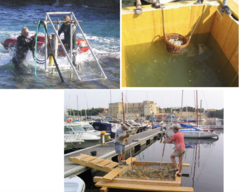
Microscopic Thin-Section Analysis. Method of analyzing artifacts.
1. Take a very thin slice of your artifact
2. Polish the surface flat
3. Put it under a glass slide
4. the observe the slice under a microscope.
THIS IMAGE SPECIFICALLY DEPICTS CERAMIC PETROLOGY (using ceramics from the Greek island of Kythera)
What is this?

Characterization Studies. Neolithic sites with Obsidian.
What is this?

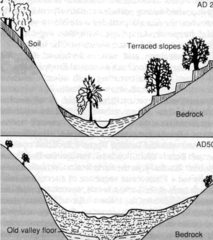
Analyzing plant and animal remains. Terracing and erosion on an italian valley. First IMAGE 200 CE (Roman)
Second Image 500 CE
What is this?
Paleoentomology. The study of insects in archaeological contexts.
What is this?

Different Pollen concentrations at different depths.
What is this?

Diatoms. microscopicsingle-cell algaewith silica cellwalls. They tell us where a lake, river or seaonce existed* inform us about nature of the watersource they lived in (salty or fresh,nutrient levels)
What is this?

Archeobotinist. Can identify specific plants for charred plant remains.
What is this?

Flotation (immersing a soil sample in water toseparate sinking mineral grains from floatingplant remains)
What is this?

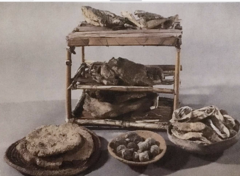
Meal from an Egyptian tomb. Over 3000 years old. Evidence of ancient diets.
What is this?
Coprilites. Human coprolites. Preserved feces, when dissected can give insight to an ancient human's diet and the vegetation of the area.
What is this?

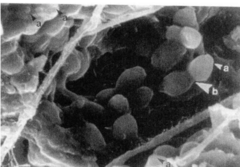
Residue analysis on food containers. Yeast cells on an Egyptian pottery vesselsuggest it contained beer or bread.
What is this?
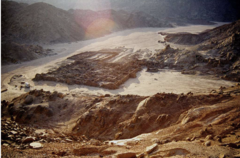
Mons Claudianus: Roman quarry in Egyptian desert
What is this?
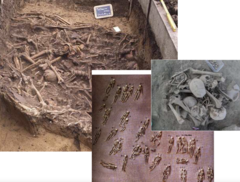
Mass graves. Human remains. Discuss the ethics of digging up human remains and displaying them. We excavate human remains of the more distant past. BIOARCHEOLOGY.
What is this?
Bog Bodies. The decomposition of human remains can be slowed down depending on the environment. from peat bogs in northwest Europe, have been preserved by a combination of very wet conditions and a natural tanning process fromnatural conditions in the bog
What is this?

Wet, Extreme Cold, Dry, Cold, Wet
What conditions cause human remains to be better preserved?
Extremely dry conditions help preserve human remains. Bodies buried in the extremely dry Egyptian desert.
What is this?

Arthritis in the knees examined by human remains could show a significant agricultural population.
What is this?

The ancient one, 7500 BCE. Scientific reconstruction & study of the skullsuggested the individual was not typical of theancestors of Native Americans. This was proven false in 2015.
What is this?

DESALINATION TANK After excavation, exposure to a new environment makes them unstable: e.g. objects submerged in saltwater for a long time cannot survive on dry land without treatment in a desalination tank to reduce their salt content.
What is this?
