L13: Energy for thermoregulation
 Call Kai
 Learn
 Practice Test
 Spaced Repetition
 Match
 Flashcards
 Knowt Play
1/23

There's no tags or description
Looks like no tags are added yet.
24 Terms
Thermoneutral zone
environmental temperature range where endotherms do not warm/cool themselves
means that basal metabolic heat production = heat lost to the environment

When equilibrium cannot be attained:
basal metabolic heat production ≠ heat lost to then environment so energy must be used to ↑ or ↓ body temperature
Thermoregulation
a balance between heat gained and heat lost
Heat exchange with the environment can occur through
radiation
convection
conduction
evaporation
Evaporation
Heat transfer required for a phase change to occur
depends on a vapor pressure gradient
latent heat flow
energy loss occurs with a phase change
e.g. can’t lose heat at 100% humidity (air is fully saturated)

Examples of evaporation and what animals
- sweating (equids, ungulates, primates)
- panting (canids)
- gular fluttering (birds)
- saliva spreading (rats, marsupials)
- mucus secretions (frogs)
What is common between radiation, convection and conduction
- depends on a temperature gradient
- sensible heat flow
- heat flows from warmer body → cooler body
e.g. can’t lose heat if the environment is warmer than the animal
Radiation
Heat transfer (warm → cool) via electromagnetic waves
All animals radiate heat = infrared/longwave radiation
Animals absorb ~95% of infrared/longwave radiation
Black animals absorb up to 90% of solar/shortwave radiation
*White animals only absorb up ~50% of solar/shortwave radiation
The sun radiates heat = solar/shortwave radiation:
infrared radiation (some)
visible radiation
ultraviolet radiation
*All radiation can be absorbed or reflected

Convection
heat transfer through moving air (or water)
When air/water moves more rapidly, the rate of heat loss by convection
increases

Conduction
heat transfer between animals and contact surfaces
Conduction on land
When on land rate of heat loss/gain comes down to surface area:
perching
standing
incubating eggs
lying down

Insulative layers include
Boundary layer = Air
Cover layer = Pelage/plumage (and trapped air)
Tissue layer = muscle, fat, blood, skin
Body core = visceral organs = metabolic heat production

Boundary layer
still air surrounding an animal
affected by air movement
approximately 0.35 cm
(still animal, no air movement)
Cover layer
- pelage or plumage
- trapped still air
Effectiveness of cover layer depends on
a) hair/feather type
b) hair density
c) cover length
d) shedding/molting
e) pilo/ptero-erection
f) wind/water
Cover layer: hair/feather type
guard hairs (moisture protection, longer, colored) vs. underfur (insulative, shorter)
contour feathers (moisture protection, surface layer, flight) vs. down feathers (insulative, under layer, shorter)

Cover layer: hair density
# of hairs per cm²
more dense = better insulation
differs by species (horses vs cows: 1,250 vs 700 hairs/cm2)
differs by breed

Who has the densest fur
The smallest marine mammal also has the densest fur of any species
(more than 150,000 hairs/cm²) - sea otter

Cover layer: cover length
longer cover traps more air = better insulation

Cover layer: shedding/molting
a response to seasonal day length changes
not a response to changes in ambient temperature
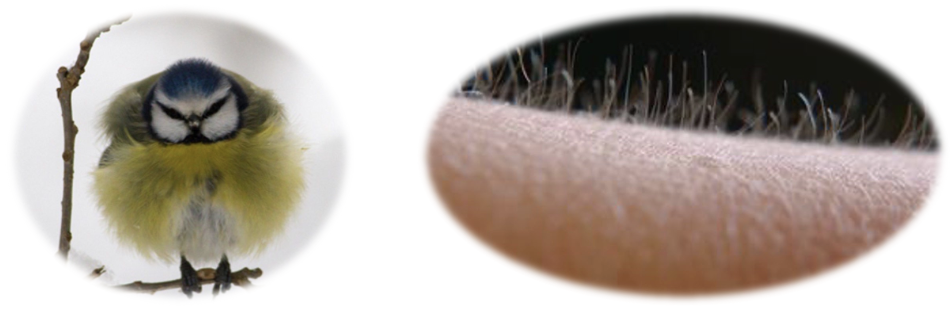
Cover layer: pilo/ptero-erection
increases the trapped air = better insulation
air is a poor heat conductor (so a good insulator)
Cover layer: wind/water
wind/water will reduce the depth of pelage/plumage
trapped air can be replaced with water
water is a better heat conductor (so a worse insulator)
Tissue layer
muscle, skin, fat, blood vessels
insulation affected by blood flow; body core heat gets to skin via circulatory convection

Body core
site of metabolic heat production
when you’re hot = ↓ appetite
when you’re cold = ↑ appetite