chapter 7
 Call Kai
 Learn
 Practice Test
 Spaced Repetition
 Match
 Flashcards
 Knowt Play
1/18

There's no tags or description
Looks like no tags are added yet.
19 Terms
Substitution and Elimination Reactions
Both rxn pathways can compete with each other, but have patterns to which is chosen.
Alkyl halide is called substrate, but substitution and elimination rxns can occur for substrates that are not alkyl halides.
Substitution rxn: Alkyl halide attacked by nucleophile, which replaces the halogen. Results in a leaving group. 2 possible mechanisms:
Concerted (Sn2) mechanism: nucleophilic substitution, bimolecular.
Stepwise (Sn1) mechanism: nucleophilic sub, unimolecular.
Elimination rxn: Alkyl halide attacked by a base/nucleophile, resulting in leaving group to form an alkene. Two possible mechanisms:
Take a hydrogen from carbon, use electons to make double bond, which kicks out leaving group.
Concerted (E2) mechanism
Stepwise (E1) mechanism
2 and 1 match the rate expression

Alkyl halides
Focus of chapter 7
Compounds where halogen (Cl,Br, or I) is connected to sp3 hybridized C atom.
Steps for Reaction
When you get a reaction:
First identify base and nucleophile (usually same, just two labels).
Classify basicity: strong base or weak base.
Classify nucleoephility:
Strong nucleophile: has a charge, smaller size/has very reactive head, is very polarizable (can shift its e- density/shape to attack different sites).
Polarizable: is smaller size, has a small group on them, or can be shaped uniquely. Cylindrical shape.
Amine: can be strong base, weak nucleophile.
Categorize substrate: substrate is something with leaving group onit.
Usually alkyl halides.
Can be primary, secondary, or tertiary which affects outcome.

Cause of alkyl halides having substitution and elimination rxns
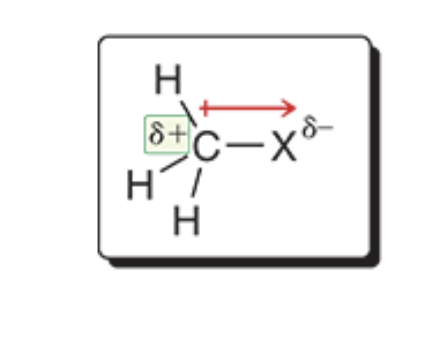
Halogen is electron withdrawing, and creates partial positive charge on adjacent carbon, so the carbon becomes electrophilic and wants to be attacked by nucleophiles.
Halogen withdraws e- density with inductive effect.
Carbon is electrophilic, is the reactive site.
Halogen acts as leaving group. For substrate to undergo rxn, it must have a giid leaving group.
Halogen is Cl, Br, or I.
Good leaving groups are either neutral molecules or very stable anions when they leave.
Stable anion (weak base), ARIO rules chapter 3. Strong acid means weak base.
Good leaving groups (also have separate knowt for it)
Stable anions (strong base) are good leaving groups because we need structure that can receive electron density, has cleavable bond.
Strong base holds onto electrons, and original bond won’t break.
Good leaving group is conj base of an acid with pka<0.

Sn2 mechanism (concerted)
Concerted: Breaking of bond to leaving group, makes bond with nucleophile at same time.
Stepwise: occur separately. First the leaving group leaves to give an intermediate carbocation, and then a nucleophile attacks the carbocation in a separate step.
Concerted rate law: Rate = k[alkyl halide][nucleophile]
Alkyl halide is substrate.
Second order rate law.
Sn2: both alkyl halide and nucleophile species in rate law (because both involved in the singular step).
