Foundations - Nursing Practice
 Call Kai
 Learn
Learn Practice Test
 Spaced Repetition
 Match
Match Flashcards
 Knowt Play
1/108

There's no tags or description
Looks like no tags are added yet.
Name | Mastery | Learn | Test | Matching | Spaced | Call with Kai | Chat |
|---|
No analytics yet
Send a link to your students to track their progress
109 Terms
What is the NCSBN
National Council of State Boards of Nursing
What is the nursing process?
A multi-step, systemic, problem-solving process that guides all nursing actions.
What are the steps of the nursing process? Explain each.
ADPIE.
Assessment: Collect patient information; symptoms, history, vitals, labs, physical findings.
Diagnosis: Analyze information to identify the patient’s actual or potential health problems.
Planning: Set priorities and patient-centered outcomes; decide which interventions will help achieve them.
Implementation: Carry out the planned intervention; e.g. giving medications, providing care, teaching, monitoring, etc.
Evaluation: Determine whether the patient’s goals/outcomes were met. Modify or stop care plan based on results.
What is professionalism?
The conduct, aims, or qualities that characterize or mark a profession or a professional person.
What does it mean to attest?
To authenticate officially.
What is Data?
Factual information (measurements or stats) used as a basis for reasoning, discussion, or calculation.
Who was Florence Nightingale?
First nurse theorist.
What did Florence Nightingale do?
Provided and promoted quality care; mortality dropped.
HYGIENE.
Nurses are recognized as…
Competent.
Healthcare requires nurses to…
Think critically.
Communicate.
Be a leader.
Provide safe and effective care.
How did nursing definition change from 1980 to 2010s?
1980: diagnosis and treatment.
2010s: focused on care, diagnosis, advocacy, prevention, and promotion of health and abilities.
Nursing is an occupation, profession, and discipline. Explain why.
Occupation: hourly pay; employer decides conditions.
Profession: technical and scientific knowledge required.
Discipline: theoretical (current research) and practical boundaries (questions that arise from clinical practice).
What is an interprofessional healthcare team?
A team made up of various healthcare professionals that work together.
3 traditional types of healthcare services?
Primary: prevention.
Secondary: early diagnosis and treatment.
Tertiary: long-term rehab/care for dying.
Purpose of nursing care?
Health promotion.
Illness promotion.
Health restoration.
End-of-life care.
T or F: purpose of care influences location of care.
True.
Acute care vs. long-term support services.
Acute: prevent deterioration and restore health.
Long-term: assist on a regular basis.
Models of nursing care? Explain each.
Case method (1 to 1)
Functional (tasks assigned to diff. staff)
Team (nurse and assistant work w/ a group of clients)
Primary (nurse responsible for a group).
Differentiated practice (identifying type of expertise needed to require care).
Factors that influence what type of model of nursing care a client receives?
Purpose, cost, staff, efficiency.
Direct vs. Indirect nursing care.
Direct: nurse to patient in-person.
Indirect: working on behalf of client (advocacy, ordering supplies).
What trends influence nursing?
Women’s movements, changes in healthcare consumer, economy, legislation, more retiring adults.
Professional organizations mentioned in the slides?
ANA (American Nurse Association).
NLN (National League for Nursing).
ICN (International Council of Nurses).
What does the ANA do?
Sets nursing standards, advocates for nurses, and influences healthcare legislation.
What does the NLN do?
Sets nursing education standards, supports educators, workforce policy, and research.
What does the ICN do?
Promotes quality nursing care, global health policy, and better working conditions worldwide.
What are nurse practice acts?
State laws that govern nursing practice and protection of public.
What is licensure?
State-issued permission to practice nursing; requires an approved program + passing the NCLEX.
What are professional standards?
Define the knowledge, skills, and attitudes (KSAs) nurses need for safe, quality care.
What are the four types of nursing knowledge?
Self (awareness of your beliefs, values, and biases).
Ethical (code of ethics).
Practical (knowing what to do / decision-making).
Theoretical (knowledge; understanding of treatment, medicine, equipment, etc.).
What is a theory?
A way of viewing phenomena; theories define and illustrate concepts and explains how they are related or linked.
What are the components of a theory?
Assumptions: presumed to be true.
Phenomena: the unique subjects a discipline focuses on.
Concepts: mental image of a phenomenon.
Definitions: meaning.
Statement: linking and interactions among concepts.
make up the theory.
Define theory, model, and paradigm.
Theory: organized set of related ideas and concepts. [HIGHER LVL OF RESEARCH]
Model: symbolic representation of a framework or concepts.
Paradigm: worldview or ideology.
What is nursing theory?
Organized ideas that help nurses understand experiences and guide nursing practice.
How is a nursing theory developed?
Nurse has an idea worth exploring → evidence collected to verify → valid ideas developed into a theory.
Logical reasoning.
What are the types of logical reasoning?
Inductive and deductive.
Inductive vs. deductive logical reasoning…
Inductive: reasoning goes from specific to general.
gather info, recognize patterns, and form generalizations.
Deductive: reasoning goes from general to specific.
“big picture” of what’s true generally → deduce what is likely true for the individual.
Nursing theory addresses what 4 basic and essential concepts?
Person.
Environment.
Health.
Nursing.
Tell me about Florence Nightingale.
Founder of modern nursing.
Aimed to provide and promote quality care to soldiers.
Air, light, nutrition, ventilation for recovery.
Encouraged hygiene and sanitation.
Opened the first nursing program.
Who is Ida Jean Orlando?
First generation nurse theorist.
Deliberate nursing process theory (Nurses should confirm their observations with the patient before acting to meet their needs.).
2 Books.
Tell me about Joyce Travelbee
First generation nurse theorist.
5 phase human-to-human relationship model.
Communication is a reciprocal process.
Name the 5 phases of the human-to-human relationship model.
Original encounter → Emerging identities → Empathy → Sympathy → Patient Rapport Nurse
Who is Sister Callsta Roy? (CSJ).
Second generation nurse theorist.
Published the Roy Adaptation Model.
People adapt to internal and external environmental changes.
Tell me about Martha Rogers.
Third generation nurse theorist.
Science of unitary human beings (1970).
UH: A whole, indivisible person who constantly interacts with their environment.
One of the most influencial theorists.
Who is Patricia Benner?
Fourth generation theorist.
Theory of novice to expert:
Novice → Advanced beginner → Competent → Proficient → Expert.

Describe the 5 stages of the theory of novice to expert.
Novice: no experience; rigid adherence to rules; minimal judgment.
Advanced Beginner: Care from drawing some practical experience; can perform tasks but difficulty prioritizing.
Competent: Efficient, organized.
Proficient: Decision-making and prioritizing is easy; holistic perspective.
Expert: Intuitive grasp of broader situations; analyze and critical thinking for creative solutions.
Name other nurse theorists…
Virginia Henderson Theory: The nurse’s ultimate function is to help patients meet 14 basic needs they cannot meet independently.
Hildegard Peplau’s Theory: Effective nurse-patient relationships and communication improve patient care, especially in psychiatric patients.
Madeleine Leininger’s Theory: Nurses provide culturally competent care based on each patient’s culture.
Jean Watson’s Theory: Science of Human Caring explains what caring means in nursing.

What is Maslow’s Hierarchy of Basic Human Needs?
8 different levels of needs. Those on the lower levels must be met to some degree before those on higher levels can be achieved.
Explain each level of Maslow’s Hierarchy of Basic Human Needs.
Physiological needs: Basic survival needs like food, water, sleep, breathing, and shelter.
Safety needs: Feeling safe, secure, and protected from harm.
Social belonging: Having love, friendships, family, and relationships.
Esteem: Feeling confident, respected, valued, and accomplished.
Self-actualization: Reaching your full potential and becoming the best version of yourself.
Other historical figures.
Dorothea Dix: Superintendent of the U.S. Army.
Clara Barton: American Red Cross.
What are clinical practice theories?
Theories that guide what you do each day; human-interaction; nurse-patient communication.
What is a grand theory?
A broad, abstract theory about nursing that does not give specific interventions; relationships among nurse, person, health, and environment.
Theories are used in…
Nursing practice, education, and research (constructing studies).
How do nurses gain nursing knowledge?
Trial and error (try what makes sense to do, then try something else).
Authority and tradition (rely on an expert to do what has already been done).
Intuition and inspiration (knowing what to do because of an inner “feeling,” sudden insight).
Logical reasoning (Using knowledge and available facts to make safe care decisions).
Scientific method.
Nursing research.
What are the steps of the research process?
Select and define the problem.
Search for information on the topic.
Formulate a research question, hypothesis, or problem statement.
Select a research design.
Collect data.
Analyze data.
Report the research findings.
Two types of research design?
Quantitative and qualitative.
Quantitative vs. qualitative…
Quantitative: focus on reported numbers / statistics. Results generalized to population.
Goal: Gather enough data to make a generalization on a group of people.
Qualitative: focus on lived experiences of people. Data collected from interviews, journals, observations, etc.
Goal: Describe the experiences of the person or people in the study.
Ethics, Research participants have the rights of…
Informed consent.
No harm.
Full disclosure. (right to get answers to any questions).
Self-determination. (they can say no / withdraw).
Privacy.
What are Institutional review boards (IRBs). What do they do?
Healthcare professionals that review and critique research proposals. Aim to protect participants and ensure the research is of value.
Purpose of nurse research?
To develop knowledge about issues that are important in nursing.
What is PICOT?
A format for creating a focused clinical research question.
What does PICOT stand for?
Patient/population; intervention; comparison intervention; outcome; time.
Why is some research not good?
Bias, flaws in design, and inaccurate analysis.
What is clinical judgment?
The process of carefully analyzing a patient’s condition (current state, medications taken, etc.) to identify problems, decide what to do, take action, and evaluate the results to see if change occurred.
Clinical judgment is the outcome of…
Critical thinking and decision making.
Clinical judgment is an…
Iterative (involving repetition) decision-making process.
T or F: Clinical judgment requires a nurse to integrate various types of knowledge (e.g. theoretical, practical, ethical, self-knowledge).
True.
What are some models of clinical judgment?
Tanner (2006): Interpreting a patient’s needs or health problems and deciding what action to take based on their condition and response.
Benner, Tanner, Chelsa (2009): How nurses gather, analyze, and use important information to understand and respond to a patient’s needs.
NCSBN (2019): Using critical thinking and decision-making to identify priority patient concerns and choose safe, evidence-based solutions.
What is common factor?
The utilization of processes that promote safe client care.
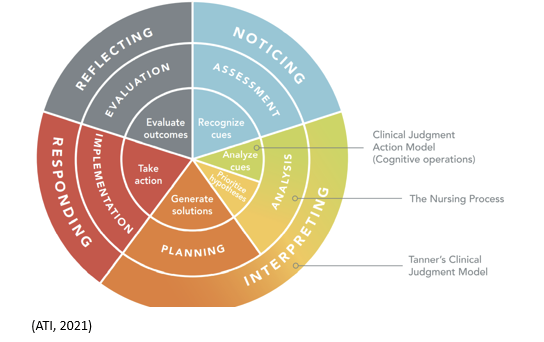
What are the four aspects of the Tanner Model of Clinical Judgement? Explain each.
Noticing (Forming an initial impression of the patient's situation using knowledge, experience, and environment).
Interpreting (Reasoning process to make sense of initial clinical situation).
Responding (Course of action taken).
Reflections (Process of examining actions implemented).
Reflection-in-action.
Reflection-on-action.
Reflection-in-action vs. reflection-on-action.
Reflection-in-action: Used during implementation. evaluate results and determine if different action is needed.
Reflection-on-action: self-evaluation to learn and refocus actions in the future.
What are the layers of the NCSBN CJ Model? Explain each.
Layer 0: Clinical decisions made by nurse to address client needs.
Layer 1: Outcome / Clinical judgment.
Layer 2: forming, refining, prioritizing, evaluating hypotheses to achieve goals.
Layer 3: Use nursing knowledge to recognize/analyze cues → prioritize hypotheses → generate solutions → take action → evaluate outcomes [clinical judgment tasks].
Layer 4: Identifies the individual and environmental factors that can impact a nurse’s reasoning or cognitive processes.
What is the purpose of the NCSBN CJ model?
To measure whether a test-taker has established a degree of clinical judgment.
Why is CJ so important?
Most errors in entry-level nursing come from poor decision-making.
T or F: The nursing process is part of the NSCBN CJ model.
True.
Clinical judgment comes from…
Clinical reasoning and critical thinking.
What is clinical reasoning?
Using knowledge, information, and experience to assess a patient, consider options, and choose the best action.
Why is clinical judgment important?
It helps nurses make safe choices, manage complex patients, and respond to patient deterioration.
What is critical (reflective) thinking?
Collecting and analyzing information to determine its accuracy and carefully consider possible actions.
T or F: Critical thinking requires a patient situation.
False.
critical (reflective) thinking can yield…
more than 1 correct answer or response.
Why do nurses need to be critical-thinkers?
Fast-paced.
Complex situations.
Care for unique and diverse populations.
Evidence-based practice is constantly changing.
Applied discipline.
Discipline has two domains, explain each.
Practical boundaries: current state of knowledge and research that dictates safe practice.
Theoretical boundaries: questions that arise from clinical practice and are investigated through research.

What is the critical thinking model?
Five step process.
Contextual awareness → Analyzing assumptions → Exploring alternatives → Using credible sources → Reflecting & deciding.
What differentiates the nursing process from critical thinking?
Nursing process: problem-solving process.
Critical thinking: decisions other than direct patient care (e.g. staffing).
What is the scope of one’s practice?
What nurses are legally allowed and qualified to do based on state law, education, and experience.
What is Bloom’s Taxonomy?
A model that categorizes learning objectives; outlines a progression from basic knowledge to higher-order thinking skills.
Remember → Understand → Apply → Analyze → Evaluate → Create.
What is an evidence-based practice?
Using best current research, clinical expertise, and patient preferences to make care decisions and improve outcomes.
What does TREND stand for?
Time (vital changes, timing of manifestations); Relationships; Evidence; Needs; Diagnosis. (For analyzing data).
What is cultural humility?
Ongoing self-reflection on your biases, background, and beliefs, and how they affect your interactions with others.
What is cultural competence?
learning about and embracing culture differences.
What is a Nurse Licensure Compact (NLC)?
An agreement by state licensing boards that allows a nurse to practice in any state that has adopted the compact (one license).
What is the ABCDE approach? What does it stand for?
Used to quickly assess and prioritize a patient’s immediate needs: Airway, breathing, circulation, disability, exposure.
TREAT in ABCDE order! A comes first!
Explain each letter of ABCDE.
Airway: is the airway open or clear?
Breathing: is the patient breathing adequately?
Circulation: Is blood circulating properly? Check pulse, bleeding, BP.
Disability: check neurological status, consciousness and responsiveness.
Exposure: Examine the whole patient for injuries or other problems while maintaining privacy.
Explain the safety and risk reduction priority-setting framework.
Prioritize patients with the greatest risk of harm or complications, even if problem hasn’t appeared yet.
Patient at risk of falling > patient with minor, stable problem.
Explain the least restrictive/least invasive priority-setting framework.
Choose the safest intervention that restricts or invades the patient the least.
Verbal warning → bedsitter → wrist restraints.
What is the survival potential framework?
Prioritize clients who are more likely to survive with immediate treatment, especially for mass casualty events.
Person with limb GSW and still responsive > person with head GSW.
What is triage?
Ranking patients according to the urgency of their need for care.
What is research allocation?
The distribution of resources to a service or department.
Acute vs. chronic priority framework?
A framework where acute conditions are prioritized over chronic ones.
heart attack > hypertension.
What is the urgent vs. nonurgent priority framework?
Priority given to client who has an urgent need over nonurgent need.
high fever > mild cold.