CHEM 51C 18-19 Chapters
 Call Kai
 Learn
 Practice Test
 Spaced Repetition
 Match
 Flashcards
 Knowt Play
1/47

There's no tags or description
Looks like no tags are added yet.
48 Terms
Hydration Reaction:
Aldehyde or Ketone + H2O
-makes Geminal diol (adds two alcohols) and reduces the double-bonded O
-can be reversed back to aldehyde or ketone

Base-catalyzed Hydration Mechanism:
Aldehyde or Ketone + H2O (OH- present)
-Only negative charges in the mechanism

Acid-catalyzed Hydration Mechanism:
Aldehyde or Ketone + H2O (H3O+ present)
-Only positive charges in the mechanism


Factors that Favor Addition (formation of hydrate)
1) The more stable the carbonyl compound, the less favorable the addition
2) The more sterically hindered the carbonyl compound the less favorable the addition
For electrophilicity/hydrate formation: -More electrophilic = faster addition = favored hydrate formation -More stable = less electrophilic = slower addition = less favored or disfavored hydrate formation -More sterically hindered = less electrophilic (harder to attack) = slower addition = less favored or disfavored hydrate formation -EWGs make the carbonyl more electrophilic, EDGs make it less electrophilic -In order of electrophilicity: 2 EWGs (most electrophilic & hydrate favored) > 1 EWG > no EWGs or EDGs > 1 EDG & 1 EWG > 1 EDG > 2 EDGs -CF3 (EWG, makes carbonyl more electrophilic) > H (neither EDG or EWG) > CH3 (EDG, makes carbonyl less electrophilic) > Ph (also EDG, worse than CH3 because it's resonance-stabilized)

Aldehyde or Ketone + NaBH4, HOCH3 OR 1) LiAlH4 2) H2O
-Reduces double bonded O to add an OH and an H bond
-racemic mixture

Base-catalyzed Addition of Alcohols:
Aldehyde or Ketone + CH3OH
-only negative intermediates
-makes a hemiacetal product

Acid-catalyzed Addition of Alcohols:
Aldehyde or Ketone + H3O+
-only positive intermediates
-makes a hemiacetal that can become an acetal

Hemiacetal Rules:
1) Hemiacetals cannot be converted to acetals with Base!! (can only use acid catalysis to go to acetal)
2) Hemiacetals are difficult to isolate unless the hemiacetal is part of a 5 or 6 membered ring
3) The same factors that govern equilibrium in hydrate formation also govern equilibrium in hemiacetal and acetal formation
4) The reaction must generally be driven to completion using Le Chatelier’s principles
5) Since acetals can be hydrolyzed under very mild conditions regenerate og carbonyl compound often used as protecting groups for aldehydes and ketones

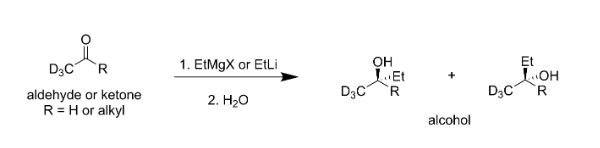
Aldehyde or Ketone + 1) EtMgX or EtLi 2) H2O
-reduces double bonded O and adds and alcohol and Etyl group -CH2CH3

Aldehyde or Ketone + NaCN and HCl
-reduces double bonded O to add OH and CN

Aldehyde or Ketone + secondary Amine and mild acid
-replaces O for double bonded N with H3O catalyst
-makes an imine: a functional group with C=N

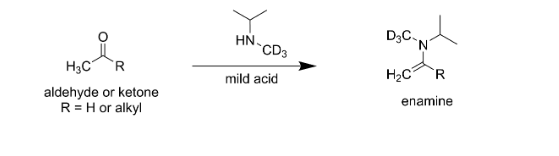
Aldehyde or Ketone + CD3 Amine
-replaces O for double bonded H2C and added the amine and D3C
-makes an enamine: C-C with an amino group
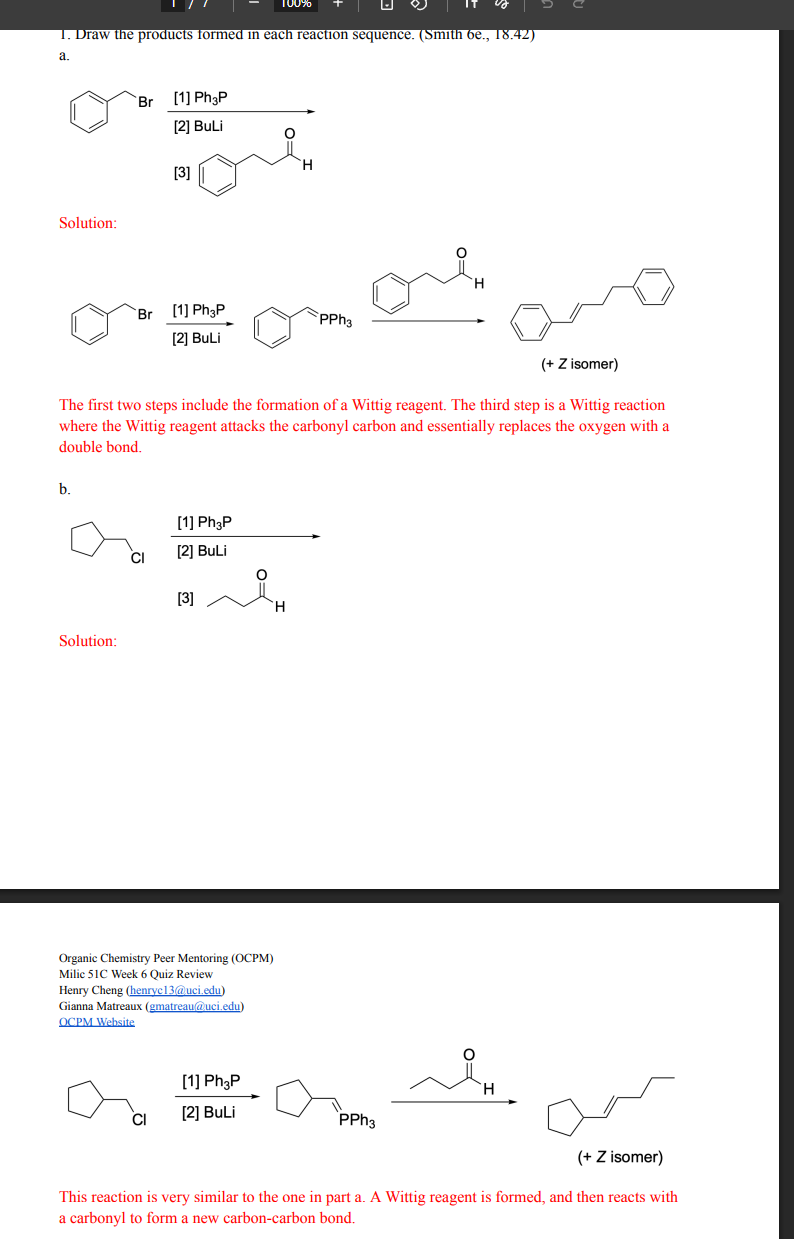
Aldehyde or Ketone + Wittig Reagent
-Reduces the double bonded O to make an alkene with Et, CD3, and R
Aldehyde or Ketone + ETOH (2 eq.) and pTsOH
-makes an acetal: adds two OEt
-and creates H2O
-can be reversible

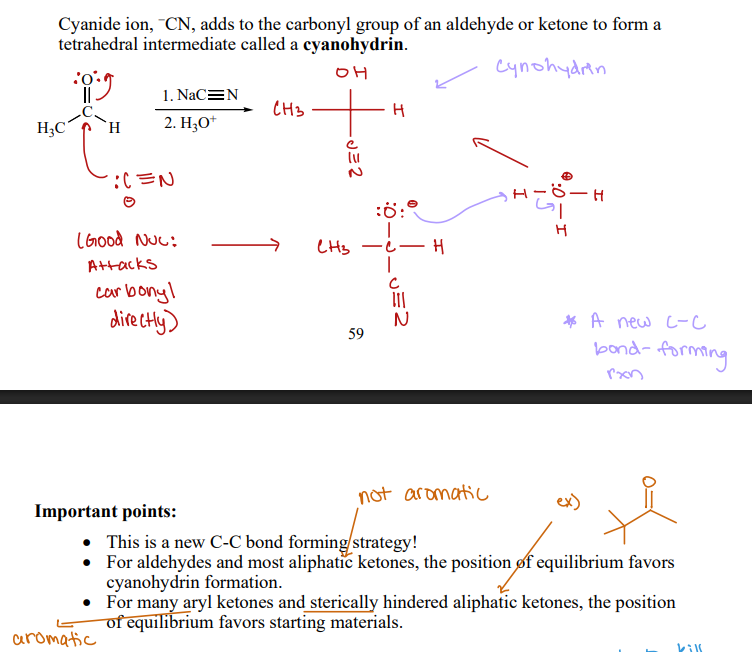
Addition of HCN:
Aldehyde or Ketone 1) NaCN (triple bond) 2) H3O+
-makes a cyanohydrin intermediate
Addition of Primary Amines to give Imine:
Aldehyde or Ketone + CH3NH2, acid or base, or heat
-addition first step then second step is dehydration to make an imine (double bonded N)
-under acid catalysis the amine attacks the neutral carbonyl

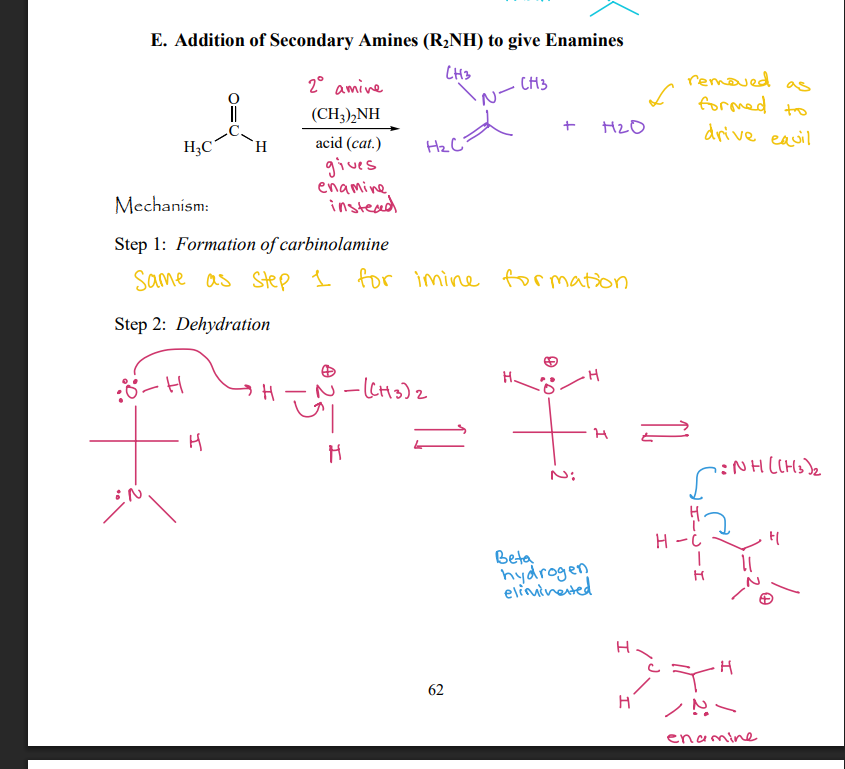
Addition of Secondary Amines to give Enamines:
Aldehyde or Ketone + (CH3)2NH, acid catalyst
-Takes H from (CH3)2NH and makes H2O leaving group to make enamine
Summary Of Addition Reactions of Aldehydes and Ketones

Alkyl Halide + 1) Ph3P 2) Bu-Li
-Makes Witting reagent or ylide

Cyanohydrin: OH, CN, carbons + NaOH (elimination)
-Makes an aldehyde or Ketone + H2O and CN

Cyanohydrin: OH, CN triple bonds, Carbons + H3O+
-CN triple bonded leaves and carboxylic acid substitutes in carboxylic acid
-makes an alpha-hydroxycarboxylic acid

Cyanohydrin: OH, CN triple bonds, Carbons + OH-
-CN triple bonded leaves and carboxylic acid substitutes in carboxylate (O-)
-makes an alpha-hydroxy carboxylate

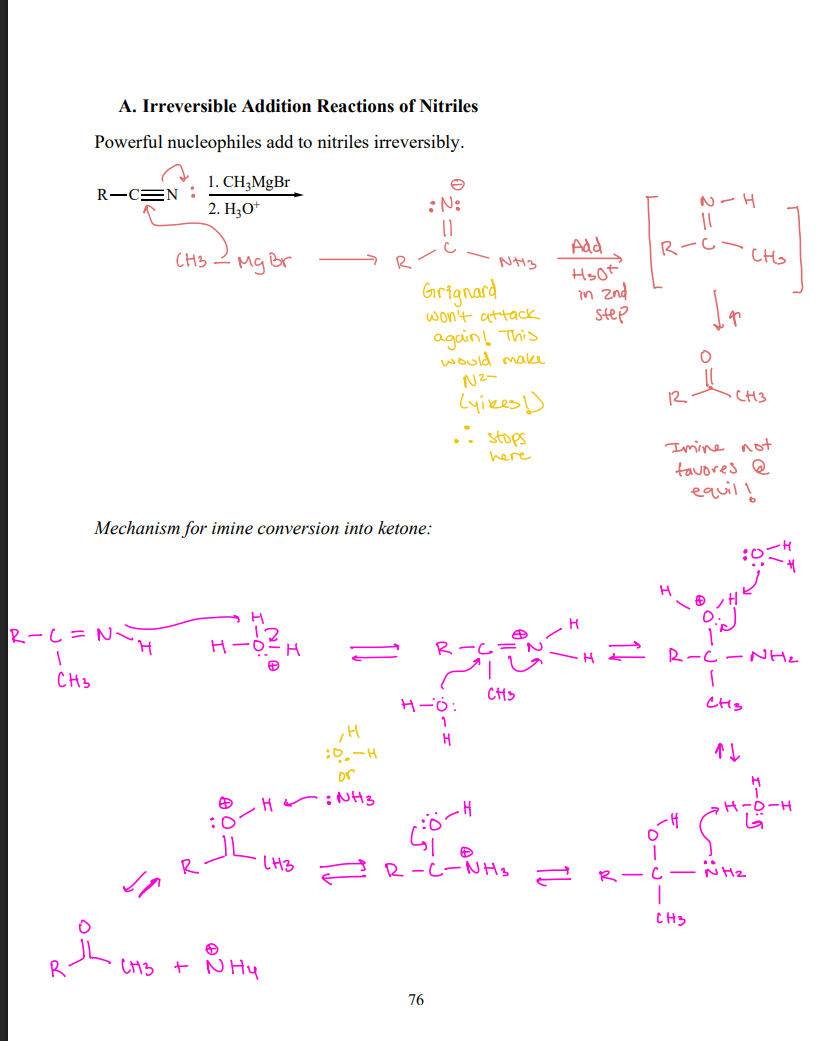
Imine (N=H3C) + H3O+
-makes a ketone and amine
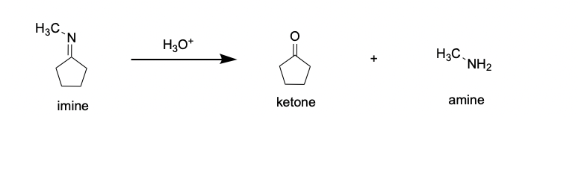
Enamine (N-CH3) + H3O+
-Makes a ketone and amine

Nitrile Synthesis:
Alkyl Halide + NaCN (sn2)
-the leaving group X substitutes to CN

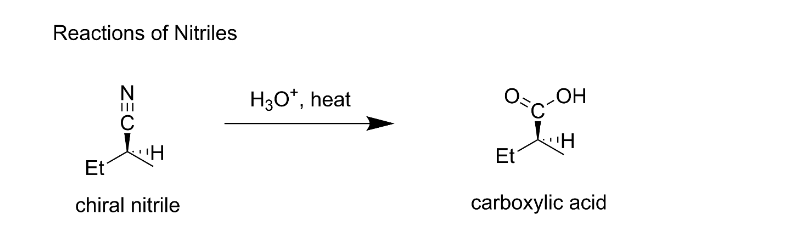
Chiral Nitrile (Et, CN trible bonded, H) + H3O+ and heat
-Makes a carboxylic acid (substituting it into the chiral nitrile)
Nitrile + OH- and heat
-makes a carboxylate (O-)

Nitrile + 1) LiAlH4 2) H2O (2 eq)
-Makes a primary amine

Nitrile + 1) EtMgX or EtLi 2) H3O+
0makes a carboxylic ketone (O=Et)

Witting Reaction:
Aldehydes or Ketones +Ph3P=CH2 (Witting Reactant)
-removes the O

Witting Reaction in Synthesis

Synthesis Example 1)


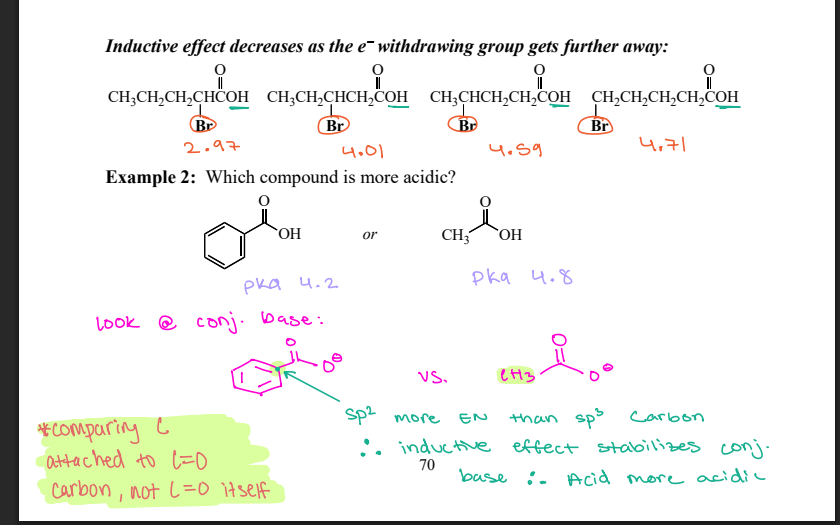
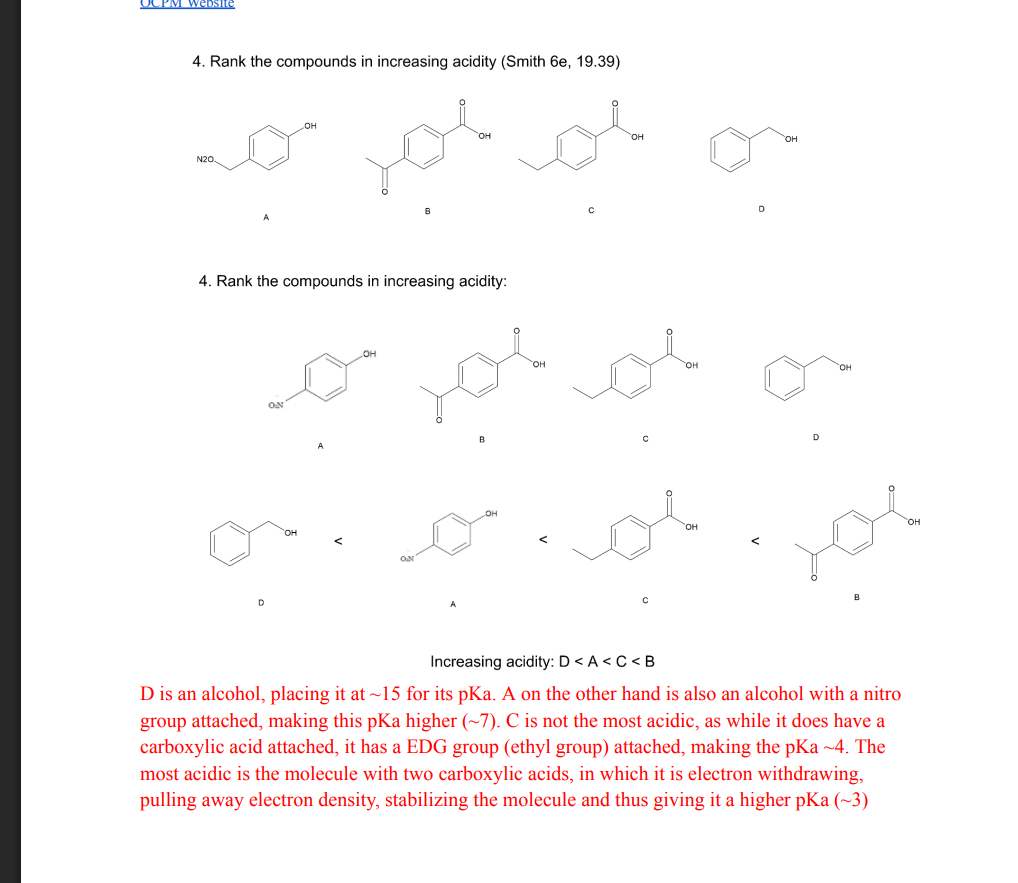
Which Carbon is more Acidic?
-For acidity:
-More stabilized conjugate base = more acidic carboxylic acid
-EWGs inductively stabilize the conjugate base -- for single atoms, the more EN they are, the more acidic the carboxylic acid is (F > Cl > Br > I)
-Benzenes have an sp2 C which is slightly more EN than sp3 Cs, inductively stabilizing the carboxylate and making the carboxylic acid more acidic
-Inductive effects get weaker the further away the EWG is from the carbonyl
-EWGs (by most to least acidic): NO2 (most acidic) > CN > F > Cl > Br > I > OH > H (not an EWG, just here for reference) > CH3 (EDG, makes the carboxylic acid less acidic)
ELECTROPHILICITY DOES NOT EQUAL ACIDITY! As an example, benzenes make carbonyls less electrophilic but makes carboxylic acids more acidic!
Oxidation of Aldehydes to Primary Alcohols:
Aldehydes + H2CrO4
-do not use PCC

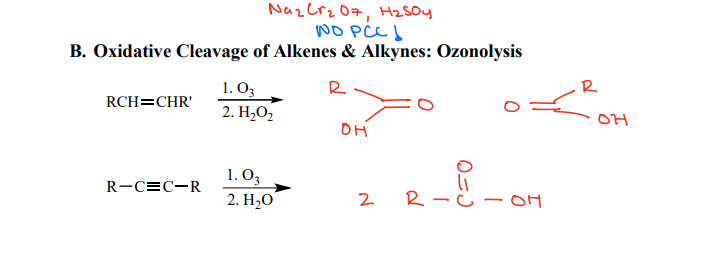
Oxidative Cleavage of Alkenes and Alkynes: Ozonolysis
Alkene + 1) O3 2) H2O2 or H2O
Oxidation of Alkyl Groups Bonded to Aromatic Rings:
Aromatic Ring + 1) KMnO4, heat, NaOH, H2O 2) H3O+
-makes CO2H substituent on aromatic ring

Nitrile Acid catalyzed Reaction
R-CN (trible bonded) + H3O+, H2O, heat

Nitrile Base catalyzed Reaction
1) CH3CH2Br + CN 2) HCl, H2O, heat

Mechanism ex: chap 19 1)
Mechanism ex: chap 19 2)
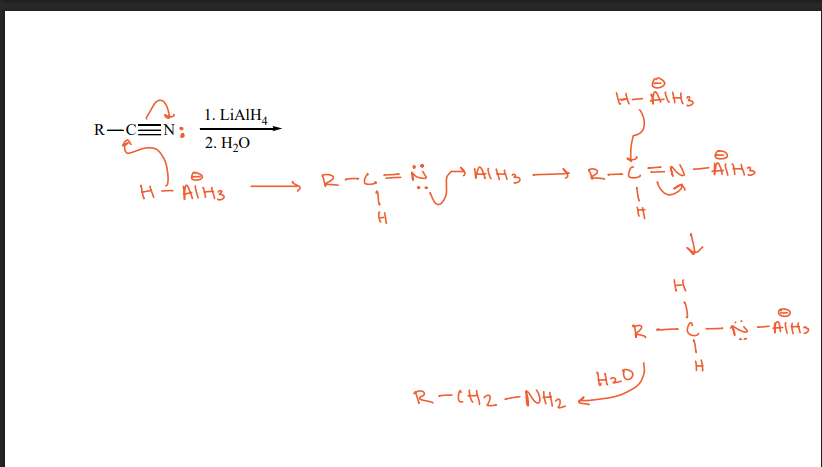
Nitrile Mechanisms stopping at 1 addition

Witting Reaction Synthesis Ex 2)
Witting Reaction Synthesis Ex 3)

Summary of Nitrile Reactions

Ranking Compounds by Acidity
Hydrolysis Ex mechanism
-But instead of TsOH use H3O+


Discussion example problems 1)


Discussion example problems 2)
