COMM-100 Exam 2
0.0(0)
Studied by 0 people Call Kai
 Learn
Learn Practice Test
 Spaced Repetition
 Match
Match Flashcards
 Knowt Play
Card Sorting
1/61

Earn XP
Description and Tags
Last updated 1:14 PM on 10/17/22
Name | Mastery | Learn | Test | Matching | Spaced | Call with Kai | Chat |
|---|
No analytics yet
Send a link to your students to track their progress
62 Terms
1
New cards
Why did Attachment Theory emerge?
attempts to explain/predict how we connect with other people
2
New cards
What did Ainsworth and colleagues learn from their strange situation experiment? What styles of attachments were evident as a result of the experiment?
Children display different types of attachment to their primary caregivers: resistant-avoidant, secure, and anxious-ambivalent
3
New cards
What percentage of children exhibited secure attachment styles?
Secure: 60-70%; Resistant: 15-20%; Anxious: 15-20%
4
New cards
What does a secure attachment look like in a child?
Free to explore environment, anxious when along w/ stranger but friendly when mom is present, shows some distress but calms down as rxn to separation, and they are happy when reunited with mom
5
New cards
What are the 4 adult attachment styles and what does each entail?
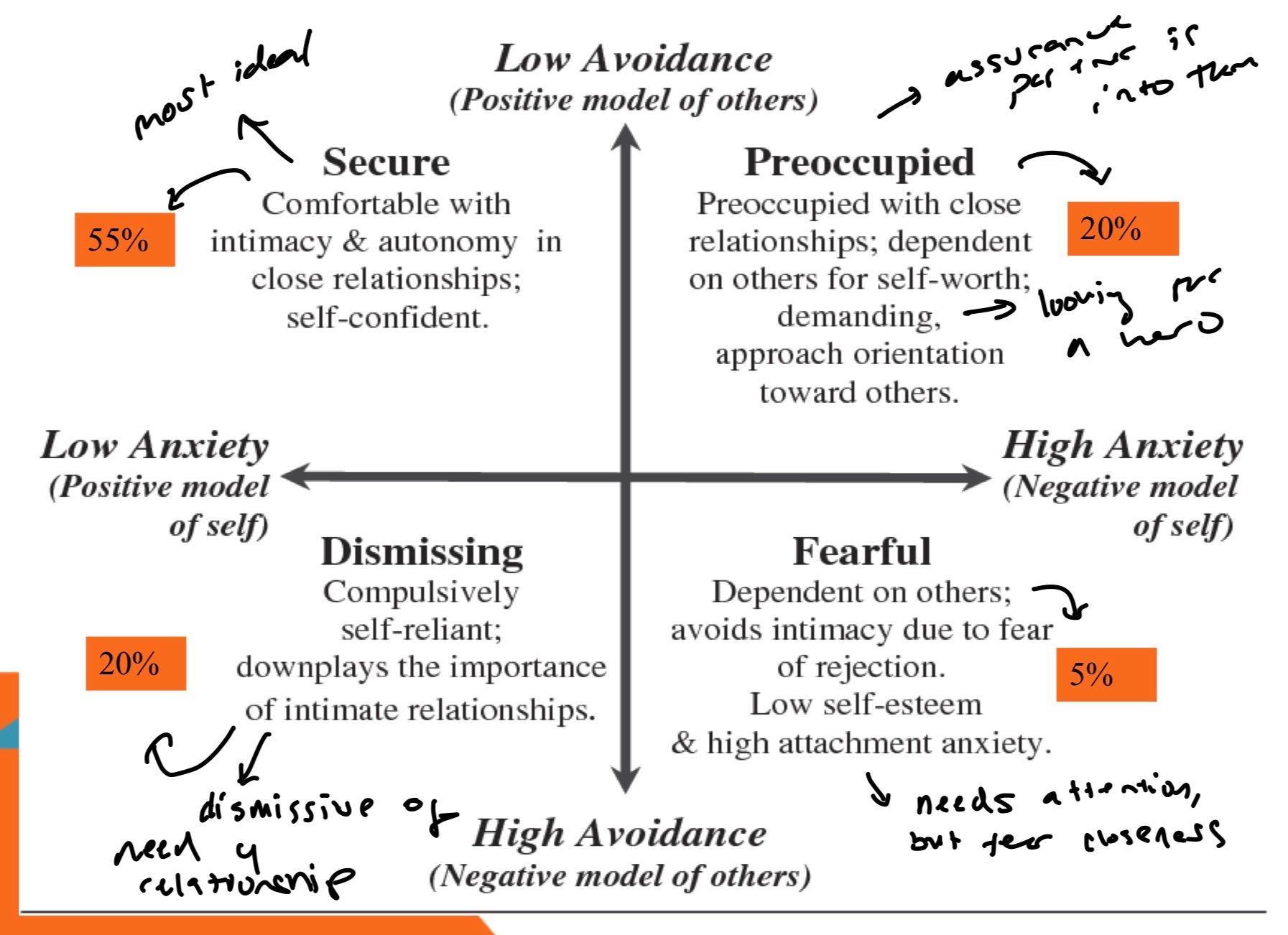
6
New cards
Although attachment styles are relatively stable, they can be altered by what?
usually stays the same unless massive trauma (or instance) occurs that changes your perspective
7
New cards
What criticisms does attachment theory have?
- Too broad (scope)
- Overstating the primary caregiver role
- Does not evolve
- Cultural impact
- Overstating the primary caregiver role
- Does not evolve
- Cultural impact
8
New cards
What does URT attempt to explain/predict?
explain/predict how comm can reduce uncertainties in initial interactions
9
New cards
What are the assumptions of URT?
-uncertainty causes cognitive stress
-initial interactions: primary concern is to reduce uncertainty and increase predictability
-interpersonal comm process that occurs through stages → main way to reduce uncertainty
-quantity and nature of info that ppl share change through time
-initial interactions: primary concern is to reduce uncertainty and increase predictability
-interpersonal comm process that occurs through stages → main way to reduce uncertainty
-quantity and nature of info that ppl share change through time
10
New cards
what are the three phases that exist in a new interaction?
entry, personal, and exit
11
New cards
Entry Phase
beginning stage of an encounter btw strangers
12
New cards
Personal Phase
when indivs start to communicate more spontaneously
13
New cards
Exit Phase
when individs make decisions abt whether or not to keep comm-ing
14
New cards
what are the 7 axioms of URT?
Verbal output, nonverbal warmth, *information seeking, self-disclosure, reciprocity, similarity, and liking
15
New cards
What three strategies do people use to reduce uncertainty?
Active, passive, and interactive
16
New cards
Passive
Unobtrusive Observation
17
New cards
Active
efforts to learn about other people other than direct contact
18
New cards
Interactive
Direct contact btw parties
19
New cards
How does uncertainty reduction work in developed relationships?
As the relationship progresses, you want to make some uncertainties
20
New cards
What role does culture play in the evaluation of URT?
- Uncertainties vary across cultures → context important
- Low-Context Cultures: most of the meaning is in the code/message (USA)
- High-Context Cultures: meaning of a message is in the context or internalized in listeners (JPN)
- Freq. of comm predicts URT in low context cultures, not high context cultures
- Not applicable to AA → not applicable to all cultural communities
- Low-Context Cultures: most of the meaning is in the code/message (USA)
- High-Context Cultures: meaning of a message is in the context or internalized in listeners (JPN)
- Freq. of comm predicts URT in low context cultures, not high context cultures
- Not applicable to AA → not applicable to all cultural communities
21
New cards
How does URT work in Social Media?
Extractive Strategy is part of active strategy (scrolling through their social media to learn more abt the other person)
22
New cards
Critique of URT
Weakness: Utility - is primary assumption to want to reduce uncertainty or to maximize relationship & validity is called into question (axiom 3:info-seeking)
Strength: Heurism - integrated into multiple fields of study
Strength: Heurism - integrated into multiple fields of study
23
New cards
SET goal?
Evaluating our relationships
24
New cards
What are the themes and assumptions of SET?
- Seek rewards, avoid punishments
- Rational
- Evaluate costs and rewards which vary from person to person
- Rational
- Evaluate costs and rewards which vary from person to person
25
New cards
Describe the role of power in calculating relational rewards and costs. What are the two types of power that are addressed in Social Exchange Theory?
Power: Fate control and Behavior control
26
New cards
Fate control
ability to affect a partner's outcome
27
New cards
Behavior control
power to change another's behavior
28
New cards
How does Social Exchange Theory explain how we evaluate relationships?
Worth = Rewards - Costs
29
New cards
Comparison level
a standard for what a person thinks he/she should get in a relationship
30
New cards
Comparison level for alternatives
how ppl evaluate a relationship based on what their alternatives to the relationship are
31
New cards
Critique of SET
Good: Heurism and utility; Bad: scope too narrow and testability is challenging to operationalize cost and rewards in a consistent way
32
New cards
Identify and describe the four stages in the process of social penetration.
Orientation (small bits), Exploratory Affetive Exchange (casual acquaintance, basic info known/small parts of personality shown), Affective Exchange (not brand new relationship, uncertainty has been reduced a bit), and Stable Exchange (efficient communication)
33
New cards
Describe the processes of de-penetration and dissolution. What role does communication play in each of these processes?
Relationship moves back towards non-intimacy. If communication is conflictual and continues to be destructive and unresolved, the relationship may take a step back and become less close.
34
New cards
Evaluate Social Penetration Theory using the standard criteria for theory evaluation.
Scope: too narrow
Heurism: can expand into multiple topics
Heurism: can expand into multiple topics
35
New cards
Do you think culture is a variable that has the potential to influence SPT? Why or why not?
Yes, intercultural relations influence SPT. Black patients have been treated/experienced a lot of racism in health care, so they prefer to disclose medical issues to a doctor of the same race.
36
New cards
Define and discuss two assumptions of Social Penetration Theory. In what ways have you experienced the phenomena they describe? Have you had any relational experiences that seem to contradict these assumptions?
-Relationships progress from nonintimate to initiate
-Relational development is generally systematic and predictable
-Relational development includes de-pentration and dissolution
-Self-disclosure is at the core of relationship development
-Relational development is generally systematic and predictable
-Relational development includes de-pentration and dissolution
-Self-disclosure is at the core of relationship development
37
New cards
How would you use Social Penetration Theory to research some aspect of relational development? Provide a hypothesis or research question and describe the study you would conduct to gain insight into this phenomenon.
How is SPT influence long-distance relationships btw two ppl who are not from the same cultural background?
38
New cards
Assumptions of RDT
Not linear, change will happen, contradictions present, and req. communications to manage
39
New cards
Basic Traditional Interactional Dialectics
1. Openness/Closedness
2. Predictability/Novelty
3. Autonomy/Connection
2. Predictability/Novelty
3. Autonomy/Connection
40
New cards
Responses to dialectics
Denial, Segmentation, Selection, and Integrations
41
New cards
Integration forms
Neutralizing, disqualifying, and reframing
42
New cards
How would you use Relational Dialectics Theory to develop a study investigating dialectical tensions in a particular type of relationship or context? Formulate a hypothesis or research question, and describe how you would go about conducting your study.
Mother-Daughter relationship → How does rebellion of an obedient daughter affect realtional dialectics between a mother and her daughter?
If mother is used to daughter to follow advice, rebellion wil affect predictability/novelty and connection/autonomy; therefore mother may change the management of dialectic tensions from denial to integration?
If mother is used to daughter to follow advice, rebellion wil affect predictability/novelty and connection/autonomy; therefore mother may change the management of dialectic tensions from denial to integration?
43
New cards
Neutralizing
Compromise
44
New cards
Disqualifying
Exempt issues
45
New cards
Reframing
Transform issue so that it does not seem like a tension
46
New cards
Denial
Deny if they have any dialectic problems
47
New cards
Segmentation
Tell everything or tell nothing
48
New cards
Selection
Select 1 or the other
49
New cards
Integration
Synthesis of opposites
50
New cards
Explain the role of impression management in Social Information Processing Theory. How does it manifest in online conversations and relationships?
Ppl try to form a better impression online
CMC & IPC req more time/energy than FTF
CMC & IPC req more time/energy than FTF
51
New cards
Do you agree with Social Information Processing Theory's belief that online relationships can become just as intimate as those developed face-to-face? Why or why not?
Personally, I think they can be just as intimate as FTF, but just in a different way... you can talk about really personal experiences/opinions/etc., but still have a buffer of security
52
New cards
Describe Social Presence Theory and Media Richness Theory. How does Social Information Processing Theory function as a critique of these theories?
- Social Presence theory- extent that individual are aware of each other via various comm media (awareness of individual during an interaction— characteristics, qualities, physicalities, and so forth)
- Media Richness Theory- while comm online, the medium is too narrow to allow for relationship development
- Walter argues that if interactants comm enough times w/ sufficient breadth and depth, nv comm does not remain paramount in relationship development
- Media Richness Theory- while comm online, the medium is too narrow to allow for relationship development
- Walter argues that if interactants comm enough times w/ sufficient breadth and depth, nv comm does not remain paramount in relationship development
53
New cards
Describe some of the ways in which online communicators adapt to the restrictions of the online medium. How do they compensate for the lack of nonverbal cues?
Emojis/emoticons, gifs, memes, and tone indicators (/j=joking, /hj= half joking, /s = serious, etc.)
54
New cards
Critique of SIT
Scope and utility is good, while the stability is criticized
This is an explain theory
This is an explain theory
55
New cards
CPM goal
Explain/predict how one controls private disclosure
56
New cards
Know the assumptions and key terms/principles of CPM
- Humans are choice makers
- Human rule makers and rule followers
- Humans choose and rule based on consideration of others and themselves
- Human rule makers and rule followers
- Humans choose and rule based on consideration of others and themselves
57
New cards
Apply Communication Privacy Management Theory to online relationships
Companies own ur data and can share it if you allow them to give u cookies
58
New cards
Differentiate between private disclosures and self-disclosures. Are they basically the same or are they different?
- Private disclosures- the process of comm private info(info that deeply matters to this person) to another
- Self-Disclosures- personal messages abt the self disclosed to another person
- Self-Disclosures- personal messages abt the self disclosed to another person
59
New cards
Explain the role of rules in Communication Boundary Management Theory. How are they interpreted by Petronio and how do they function?
- CBM theory was the previous name for CMT
- when people disclose private information, they depend on a rule-based management system to control the level of accessibility
- when people disclose private information, they depend on a rule-based management system to control the level of accessibility
60
New cards
Define boundary turbulence and describe an instance in which you experienced it. What adjustments were made in order to reduce turbulence and achieve coordination? Were they effective? Why or why not?
- Boundary Turbulence - conflicts about boundary expectations and regulations
- Clearly stating expectations, they were effective
- Clearly stating expectations, they were effective
61
New cards
How does boundary ownership exist in work relationships?
Boundary ownership - rights and privileges occurring to co-owners of private information
62
New cards
Critique of CPM
Utility and Heurism is good, but logical consistency is bad