COMM 335- Lecture 14: Communication Conflict Styles
 Call Kai
 Learn
 Practice Test
 Spaced Repetition
 Match
 Flashcards
 Knowt Play
1/17

There's no tags or description
Looks like no tags are added yet.
18 Terms
What is broad conflict definition?
According to the Oxford English Dictionary (2012), the term “conflict” has Latin roots. Dating back to the early 15th century, conflictus, the past participate of configigere, means to strike (“fligere”) together (“com”) or be in conflict.
Conflict definiton we uses
Most scholars adopt some variation of Mortensen’s (1974) definition of conflict:
“Conflict is an expressed struggle over incompatible interests in the distribution of limited resources” (p. 93)
Communication scholars Wilmot and Hocker (2011) define conflict as: “Conflict is a felt struggle between two or more interdependent individuals over perceived incompatible differences in beliefs, values, and goals, or over differences in desires for esteem, control, and connectedness”
Struggle
Conflict is a struggle = the result of opposing forces coming together
Conflict is a struggle and it's the result of opposing forces coming together
A struggle between interdependent parts meaning there must be another person involved, if not, there’s not really a struggle
Interdependent
There needs to be an element of interdependence between parties (if independent, no conflict)
Perceived
Conflict has an affective element: it is an emotional process that involves the arousal of feelings in both parties
Biggest aspect (perception)
He perceived he had a conflict with his sister and perceived this morning he was gonna be pissed about the dishes but there was no dishes so the perception was wrong
Perception of incompatible differences
Perceived differences, might not actually be no differences
Differences
There needs to be an element of interdependence between parties (if independent, no conflict)
Perceived
Conflict has an affective element: it is an emotional process that involves the arousal of feelings in both parties
Biggest aspect (perception)
He perceived he had a conflict with his sister and perceived this morning he was gonna be pissed about the dishes but there was no dishes so the perception was wrong
Perception of incompatible differences
Perceived differences, might not actually be no differences
Competing
Shark
Value of goal: High
Value of relationship: Low
Goal: I win, BECAUSE you lose
A competitive style is an attempt to gain power and pressure a change at the other person’s expense
Don’t care about the relationship at all, all you care about is the outcome
Benefits:
Required to make unpopular decisions (budget cuts or terminating employment)
- Its my way, I dont care its A&M policies
Emergency situations (time is of the essence)
- If you are at war, you need to follow your superior, don’t have time for discussion
Costs:
Strained work relationships
Decreased initiative and motivation
Avoiding
Turtle
Value of goal: Low
Value of relationship: Low
Goal: I lose, you lose (and if you lose, I don’t care)
Avoidance is characterized by deliberately ignoring or withdrawing from a conflict rather than facing it
You don’t care about the outcome or relationship, you just don’t want conflict at all so you avoid it
I don’t care about the relationship and I don’t want to achieve the goal
Might have things that are more important (I have no spoons left, I can’t do it anymore)
Benefits:
Reducing stress (for the time being because your putting it in the bottom of your priorities)
Steer clear of danger because you’re not making any issues
- Someone didn’t want to do the practice test, so he avoided it
Setting up more favorable conditions
Costs:
Declining working relationships
- Nobody wants to work with you
Resentment, delays, and degrading decisions
- A group member has avoided a group project so you start to resent them and start to get frustrated, might go in a competing mode and not collaborating mode
Accomodating
Teddy Bear
Value of goal: Low
Value of relationship: High
Goal: I lose, you win (I lose in order for you to win)
Setting aside personal needs to please others in order to keep peace
If you get mugged
With little kids, you are playing hide and go seek and you know where they are at but you are not going over there because we want them to win
Benefits:
Restoring harmony and building relationships
Choosing a quick ending (you’re right, let’s just do your plan)
Costs:
Sacrificed concerns
Loss of respect
Loss of motivation
Compromising
Fox
Value of goal: Medium
Value of relationship: Medium
Goal: We win some, we lose some
Sacrificing some goals while persuading others to give up part of their goals
You care about the outcome and relationship
Most see this as not a positive thing
In the United States we see it as we win some, and we lose son but abroad it’s you lose some, and I lose some (not a positive connotation)
Benefits:
Speed and expedience
Fairness
Maintaining relationships- meeting halfway
Costs:
Suboptimal decisions (not the best decision making policies)
Partially sacrificed concerns
Trevor wants to do the World Meal assignment with Mason, but Mason has a class at night and then Trevor has classes in the morning so one skips classes or gets there late while the other leaves class early so they meet in the middle (both lost)
International perspective would say that isn't the best option, unless we don’t have a lot of time so speed becomes important
Collaborating
Owl
Value of goal: High
Value of relationship: High
Goal: I win, you win
Views conflicts as problems to be solved by finding creative solutions that allow all parties to achieve their goals
Creating solutions for both parties
Benefits:
High quality decisions
Learning and communication
Strengthens relationships
Costs:
Time and energy required (takes a lot of time to make sure both parties are getting what they want)
Psychological demands (open to new views)
Cultivating and Collaborating Attitude
Avoid:
Win lose stalemates
Arguing only for your position
Changing your mind only to avoid conflict
Suppressing conflicts by resorting to voting, averaging, flipping a coin
Instead:
View differences as both natural and helpful
Search to understand the other parties perspective
View initial agreement as suspect
Work for mutual benefit (see yourself as “in it together”)
Show respect for the other party
Win Lose
Ignores cultural differences
Argues and defends self interest
Becomes rigid of conflict posture
Win Win
Respectes cultural differences
Uncovers deeper conflicts needs
Has willingness to change
Conflict Behavioral Components
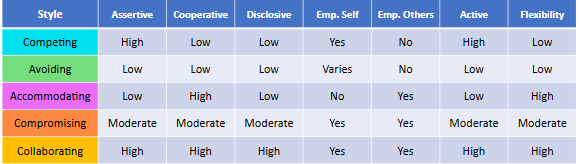
Flexibility
Behaviors demonstrating willingness to move on an issue
Which conflict style cores below across the board on behavioral components?
Avoiding
Which conflict style scores high across components?
Collaborating
How do we determine Conflict Styles of others?
Behavior is hard to read at the surface. We should be cautious drawing conclusions about others’ approaches to conflict. It can be difficult to distinguish the styles of others.
What are your goals in the immediate situation?
What are the longer term consequences of style?
What is the situation?
What are the ethical implications of each style?