Motivation and decision making
 Call Kai
 Learn
Learn Practice Test
 Spaced Repetition
 Match
Match Flashcards
 Knowt Play
1/17

There's no tags or description
Looks like no tags are added yet.
Name | Mastery | Learn | Test | Matching | Spaced | Call with Kai | Chat |
|---|
No analytics yet
Send a link to your students to track their progress
18 Terms
Motivation and decision making
Different motivations can strongly affect decision making

What can affect motivation
Motivation fluctuates through time and life history stages
Hormones
Age
Biological sex
Time of day
Season
Climate
Homeostasis
The maintenance of a stable state of internal physical and chemical conditions within narrow optimal ranges by living organisms
Involves many things, including: o Blood pH o Core temperature o Blood glucose and oxygen levels
How is homeostasis maintained?
Homeostasis maintains stability through negative feedback
The behavioural response is reactive – it occurs as a reaction to a deviation from homeostasis

Allostasis
Stability through change
Process by which animals actively adjust their internal state to meet predictable and unpredictable demands
Allostatic parameters allows for dynamic shifts in parameters to match needs to eventually return to homeostasis
Examples of allostastic adjustments:
The increase in heart rate and blood pressure during physical activity
Elevation glucocorticoids before a breeding season
Why this matters in the context of motivation: not every rise in a hormone or a drive reflects a deficit being corrected — some reflect anticipation of a demand
Allostasis and motivation
STABLE STATE vs ADAPATBILITY
Homeostasis: Fixed set points within a narrow range
Allostasis: Dynamic set points that can adapt to changing demands
Allostatic responses can be predictive, i.e. changes occur before deviation from a set point occurs
Example: You watch a movie and anticipate that a scene will be scary – your pulse goes up
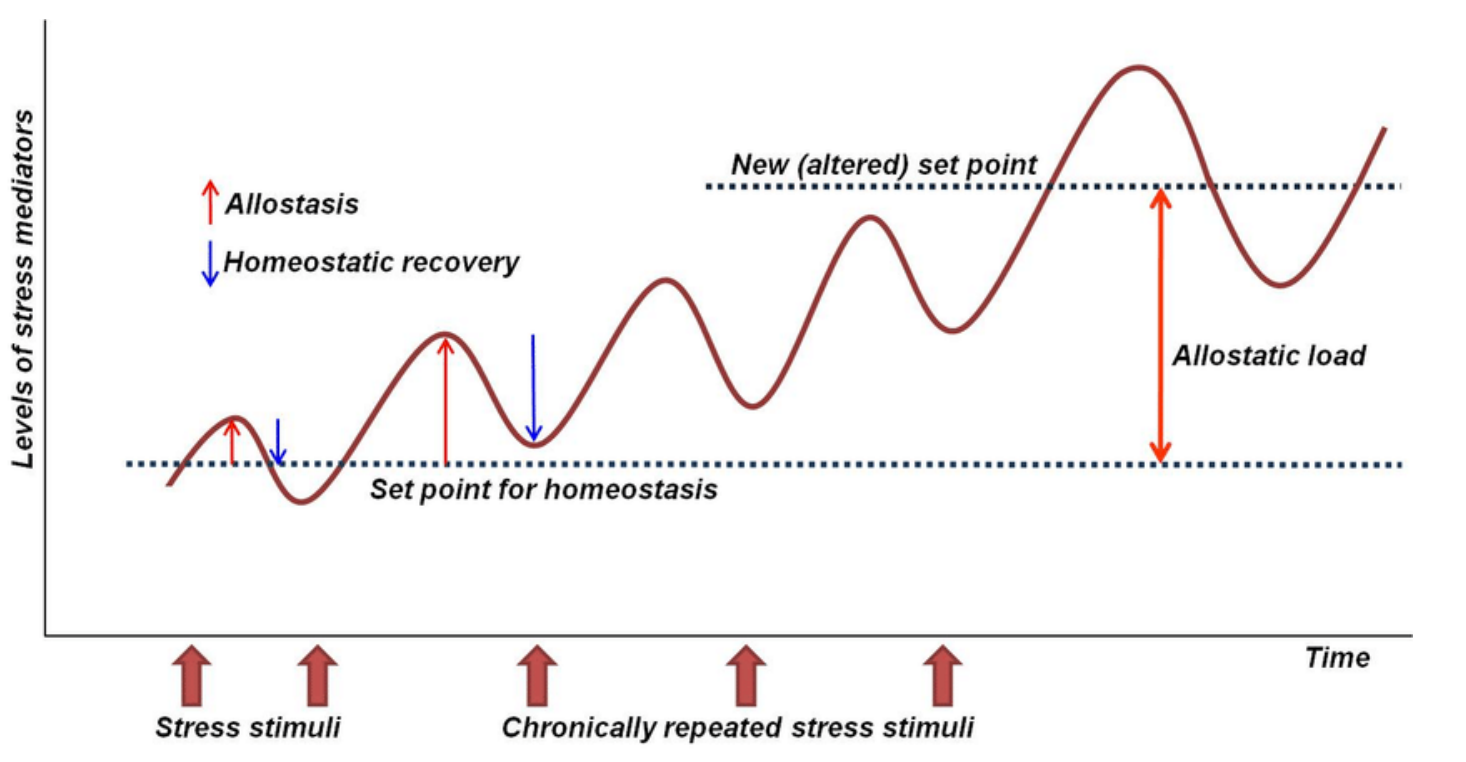
Allostatic load
The cumulative cost to the body of allostasis
All animals experience acute daily and seasonal stressors that they need to cope with. However, when stressors are repeated too often, there can be “wear and tear” across multiple somatic systems, which can lead to chronic stress
Can lead to an altered set point
Measuring motivation
The cost and animals is able to pay to gain access to a resource can tell us about its motivation for this specific resource
Preference tests with costs
Can measure:
How flexible the animal is in its motivation for this resource
Resource value
Maximum cost paid to get to the resource
Displacement activities
A normal behavioural pattern that appears out of its usual context
Expressed when motivations compete, or a motivated act is hindered
Ex: redirected behaviour, intention movements & ambivalence
Redirected behaviour
The correct behaviour is directed at the wrong object
Intention movements
Suboptimal or fractions of the correct behaviour
Ambivalence
Combination of intention movements from both conflicting motivational systems (e.g. approach and retreat)
Stereotypic behaviour
Repetitive, functionless and often damaging behavioural pattern
Stereotypic behaviour is most often a response to chronic stress, frustration or an inability to continued perform natural behaviours
Stereotypic behaviour is not necessarily a displacement activity but a repeated state of motivational conflict can lead to the development of stereotypic behaviours as a coping mechanism
Even if an animal is taken out of the situation in which it is not thriving the stereotypic behaviour often persists
Judgement vs decision making
Early decisions can modify subsequent judgments, which in turn can modify subsequent decisions

How to differentiate between lack of judgement and decision not to act in a behaviour study?
Potential solution – add additional measures to your set up:
Physiology
Neurology
More behaviours

State-dependent decision making
Energy reserves affect the decisions made by educated predators foraging on defended prey
Higher motivation leads to more risk taking
Aposematism
An advertising defence strategy where an animal uses bright colours, bold patterns, distinctive sounds, or strong smells to warn predators that it’s toxic, venomous, or tastes bad
Designing a study with motivation in mind
Separate motivational strength from loaded or andromorphic terms
“worked hard for it” is not the same as motivation
Control for and report deprivation/energy state before testing
it confounds tests involving food
Some animals are just less food motivated
will this influence your test?
Watch for general activity and arousal masquerading as a specific motivational or decision effect
Is your focal animal affected by the test situation itself? Something secondary in its environment? Or internally not related to your research question?
Watch for displacement activities being mistaken for the trait you are actually measuring