SA brain dx
 Call Kai
 Learn
 Practice Test
 Spaced Repetition
 Match
 Flashcards
 Knowt Play
1/41

There's no tags or description
Looks like no tags are added yet.
42 Terms
Recall the different neurolocalisations
Brain
Forebrain
Brainstem
Cerebellar
Vestibular (Peripheral vs Central)
Spinal
C1-C5, C6-T2, T3-L3, L4-S3
Neuromuscular system
What is involved in diagnostic investigation?
Blood work to rule out metabolic
MRI to visualise:
Vascular
Infectious / Inflammatory
Traumatic (but not Toxic)
Anomalous
Metabolic (there are primary intra-cranial metabolic diseases, although v v rare)
(Idiopathic – most idiopathic disorders normal on MRI)
Neoplasia
Nutritional – thiamine def
Degenerative
CSF to incr / decr suspicion of infectious / inflammatory
Give an examples of some metabolic dxs that will present as neuro dx
Hypoglycaemia
Hepatic encephalopathy
List some useful guides that can help to prioritise differentials
Age & breed
Neoplasia & vascular = focal and lateralised
Infect / Inflam = Asymmetric / multifocal
Degen / anom / nutritional = symmetrical
Extra cranial dx = symmetrical & diffuse
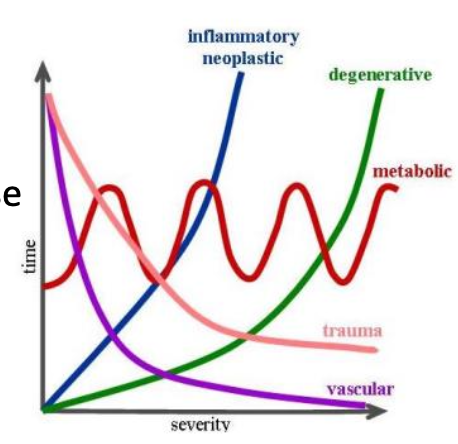
Hx —> time course
If there are seizures where is the lesion localised to?
Forebrain
Summary of physical exam and neurolocalisation

head turn & circling towards side of FB lesion
List of differentials for neurology for reference

Differentiate between peracute, acute and subacute & chronic
Peracute —> instantaneous (minutes)
Acute —> 1– 7 days
Subacute —> 1 – 2wks
Chronic —> 2 wks or more
How does vascular neuro disease present in terms of timing?
Peracute onset
Instantaneous
< 24hr progression
Give an examples of inflam dx that presents acutely
Meningo-encephalo-myelitis of Unknown Origin
What are the features of bacterial meningoencephalitis? (acute)
RARE
Direct invasion —> otogenic intracranial infection / nasal/ dog bite
Haematogenous (rare)
CSF = severe neutrophilic pleocytosis
What can cause protozoal meningoencephalitis? (acute)
Neospora caninum —> dogs only
Necrotizing cerebellitis & cerebellar atrophy
Toxoplasma gondii
Cats>>> dogs
myositis (m. infection)
Where in the brain is neospora caninum usually tropic for?
Cerebellum
What can cause viral meningoencephalitis? (Acute)
Canine distemper virus (dogs only)
resp, GI, dermatologic (hard pad), neurologic
FIP
dry form (brain +/or eye)
wet form (peritonitis ± pleural eff)
combo presentations e.g. wet then dry
What are the neoplasias of the brian?
1° (often focal, asymmetircal “lateralised”, forebrain)
Meningioma (cats & long nose dogs —> long word)
Glioma (brachy —> short nose —> short word)
2°
Haematogenous metastasis (haemangiosarc, lymphoma)
Direct extension of nasal / skull tumours
Pituitary tumours
Cushing’s (dogs)
acromegaly (cats)
How are brain tumours treated?
Symptomatic —> steroids ± seizure meds
Surgery alone (feline > canine curattive)
meningioma
Radiation alone —> 1yr survival?
Combinations —> sx, post op-radiation, clin trials etc.
What anomalous dx of the brain should you be aware of?
Hydrocephalus —> congen (can also be acquired)
Ventricles too large
Toy breed, dome headed breeds (Chihuahua, Yorkie)
Abnormal from birth
Porencephaly —> focal defect in brain tissue
Hydrancephaly —> complete absence of cerebral hemispheres
How does hydrocephalus present clinically?
Vocalize, house-training, cognitive
Forebrain primarily
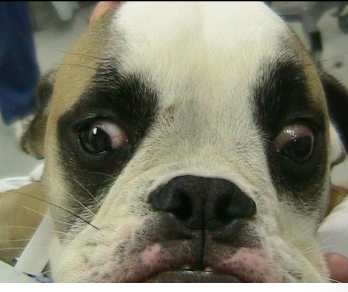
Setting sun sign (both eyes have strabismus)
How can you treat hydrocephalus?
Surgery (e.g. ventriculo-peritoneal shunt)
Medical management (steroids & other medication to reduce CSF production)
steroids cannot be used lifelong
Give an examples of a genetic disease that kicks in at an early age and its features?
Lysosomal storage dx (RARE)
Defect of a lysosomal hydrolase enzyme
Many start @ 3-6mo then progress
Accum & storage of substrate within cytopalsm of neurons & well as in cells in other organs
Diffuse neuro dysfunction (symmetrical, diffuse e.g. cerebellar then whole brain)
Give some examples of old age degenerative dx?
Canine cognitive dysfunction
Lafora disease
What are the features of canine cognitive dysfunction?
Pathological deterioration of brain
Changes in behavior, memory, & learning ability
disturbances in sleeping, staring into space, getting stuck in corners, loss of housetraining, pacing / vocalising @ night etc.
Accum of beta-amyloid, w/ senile plaque formation and& neurofibrillary tangles
COMMON
How can you treat canine cognitive dysfunction?
Support
Selegiline, nutritional supplementation w/ antioxidants and other brain protective compounds & behavior modification/environ enrichment
What is lafora dx?
Myoclonus, myoclonic seizures (sudden movement)
Eventually blind, ataxic
V. rare cf to canine cognitive dysfunction
How do you manage trauma?
Reduce ICP
Address 2° injury
List the difference between primary injuries and secondary injuries of the brain?
1°—> Contusion, Concussion, Laceration
2° —> Release of inflm mediators, continued haemorrhage, oedema; leads to incr ICP
What is ICP?
Pressure inside skull —> arterial, oxygenated blood only enters skull because arterial pressure higher than ICP
What is the relationship between MAP and ICP?
MAP-ICP = Cerebral perfusion pressure
Arterial pressure higher so oxygenates brain
E.g. If you get decr MAP due to blood loss & incr ICP due to trauma you can get no perfusion
What are the two targets of therapy when there is trauma?
Normalise hypotension
Fluid therapy
Decr ICP
What is the bodies response to CPP (cerebral perfusion pressure) falling?
Vasocon to incr MAP and incr CPP
Arterial hypertension causes reflex bradycardia
Cushings reflex = severe hypertension w/ severe bradycardia (e.g. HR <60)
This happens late in ICP raises —> don’t wait before getting aggressive
Mentation & resp will be severely affected
What is the Monro-Kellie doctrine?
The idea that the skull is a hard 'closed box' —> fixed vol
If the volume of one of the 3 components (brain tissue, blood, CSF) incr, the other copmonent have to decr
e.g. growing haematoma (image) sqaushes brain tissue
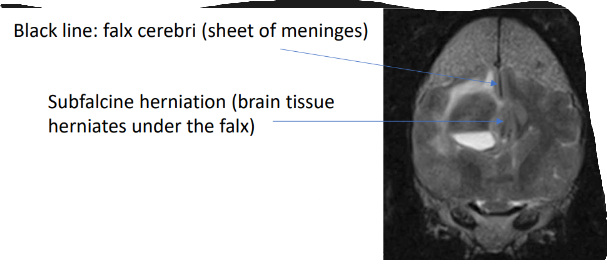
Once pressure dangerously high herniation starts to take place
What are the different types of brain herniation?
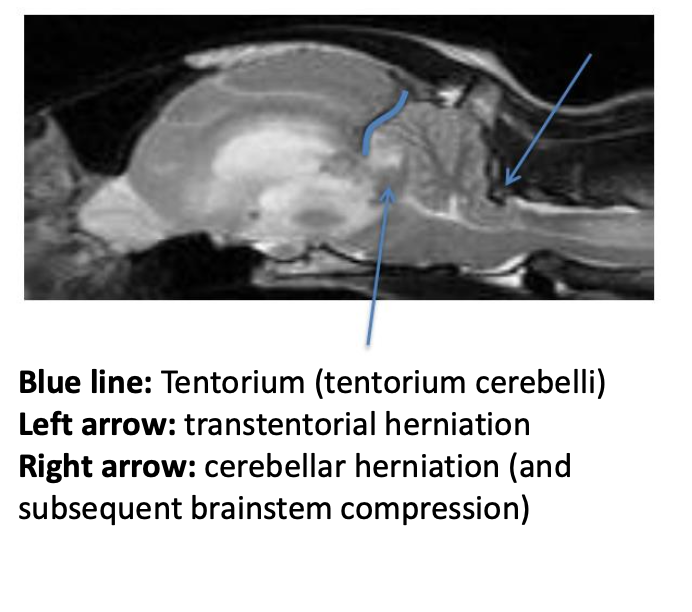
Subfalcine herniation, transtentorial herniation
Cerebellar herniation (aka caudal cerebellar herniation, cerebellar coning, foramen magnum herniation)
Cerebellum goes caudally out of back of skull, but in doing so it squashes the brainstem
What are the signs of cerebellar herniation?
Decerebellate rigidity —> Opisthotonos; all joints extended except hips flexed; BAR CEREBELLUM
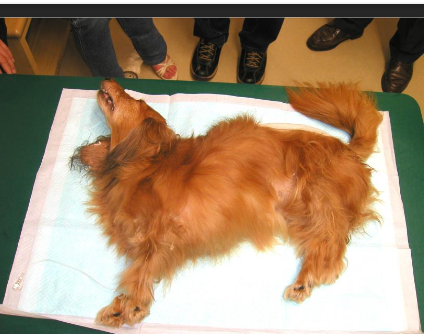
What is the difference between decerebellate rigidity and decerebrate rigity?
Decerebrate —> always comatosed and also all joint extended including hips (opisthotonos)
How can you manage raised ICP?
Resolve hypotension, rescusc then maintenance fluids, (consider hypertonic saline if hypovol)
hyperglycaemia makes prog worse so avoid glucose-containg fluids
Osmotic agents —> Mannitol, hypertonic saline
Elevate head 30°
Avoid jugular compression / thrombosis
Ensure normoglycaemic, normonatraemia, normothermic etc.
Supplement O2
Avoid hypercapnia (will cause intracranial vasodilation & incr ICP)
Monitor HR, BP, temp, SPO2 (ETCO2 if intubated)
When would you use mannitol vs hypertonic saline to reduce ICP?
Mannitol —> contraindicated in hypovaolaemia
Hypertonic saline —> contraindicated in CHF; excellent for hypovolaemic raised ICP patients

What can you use to monitor and grade head trauma/ raised ICP?
Modified Glasgow Coma Scale
Higher score = better prog
Pupils/ eyes
From normal to fixed & dilated
Physiologic nystagmus
One of last brainstem reflexes to go

What are the clin signs of brainstem squish → raised ICP?
Reduced mentation → coma
Many CN deficits e.g. pupil size & decr physiological nystagmus
Decerebrate/cerebellate
No proprioception
Hypertension, bradycardia, lack of intracranial circulation, death
Abnormal resp, no resp, death
What should you avoid when ICP is raised?
Steroids
Causes hyperglycaemia → worsens prog
What extra cranial diseases should you be aware of?
Toxins
acute <24hr onset for most
GI, resp, CV signs
major cause of status epilepticus
OPs, pyrethrin, pyrethroids, lead, avermectins, metaldehyde, human meds, tremorgenic mycotoxins (moldy food → severe tremours)
Hepatic encephalopathy
reversible neuro manifestations secondary to any aeitiology of acute/ chronic liver failure —> most commonly PSS
failure to thrive, wt loss, PU/PD, GI signs
FB signs —> behaviour changes, pacing, blindness, seizues (cats > dogs)
can be diffuse / other neurolocalisation
Hypoglycaemia
Rapid Na shifts
How is hepatic encephalopathy treated?
Lactulose
ABs —> reduce ammonia-producing bacteria in gut
Diet —> aim to reduce gut derived blood ammonia
Minimise contributing factors
incr ammonia prod
reduce clearence of toxins
affect neurotransmission
Seizure control
What is the most important contributor to ECF osmolarity?
Sodium
Rapid correction more dangerous than initial derangement —> brain adjusts to chronic hyponatraemia / hypernatraemia
Careful w/ rapid correction of Addison's → neuro deficits