UAB - CHEM 116 Lab Final
 Call Kai
 Learn
 Practice Test
 Spaced Repetition
 Match
 Flashcards
 Knowt Play
1/80

There's no tags or description
Looks like no tags are added yet.
81 Terms
Carey is using a lead cylinder as a counter weight. He would like to know the mass of the cylinder, but does not have a balance available. Knowing that his cylinder displaced a volume of 10.71 mL and that the density of lead is known to be 11.34 g/mL, what is the mass of his cylinder?
REPORT YOUR ANSWER TO 2 DECIMAL PLACES.
121.45
Jack and Jill are lab partners. Jill delivered 5.39 mL of a 19.87 % sugar stock solution using a graduated pipette into a 25-mL volumetric flask. Distilled water was added to the graduation mark on the flask and mixed well. What was the final concentration of the resulting solution?
REPORT YOUR ANSWER TO 2 DECIMAL PLACES.
4.28

Report the volume of liquid contained in the graduated cylinder to the correct number of decimal places. DO NOT include units in your answer.
2.50
Read the video description and decide which of the common errors listed as responses were made in the video:
Description: A person is pipetting a liquid and while doing so, air bubbles can be seen in the pipet.
Pulling air into the pipet
Read the video description and decide which of the common errors listed as responses were made in the video:
Description: A person is pipetting a liquid from beaker A to beaker B, then transfers the remaining liquid in the pipet back into the stock bottle
Returning unused reagent back to the stock bottle
Read the video description and decide which of the following values would be the most reasonable to record for the mass of the beaker and water on the balance:
Description: A person is weighing something on a scale. The scale jumps between 44.2078 and 44.2077 but stays on 44.2077 for most of the time.
44.2077
Fill in the blanks with the BEST required coefficients to balance the chemical equation. (If there is no coefficient needed, enter a 1 in the blank).
_ AgNO3(s) → _Ag(s) + _NO2(g) + _O2(g)
2, 2, 2, 1
The following reaction can BEST be described by which of the categories listed below?
Fe(s) + O2(g) → Fe2O3(s)
Reduction/Oxidation
The following reaction can BEST be described by which of the following categories?
NaOH(aq) + HBr(aq) → H2O(l) + NaBr(aq)
Acid/Base
Which of the following statements regarding the collection and use of pH data during this week's lab is FALSE?
pH data should be collected following completion of all of the reactions.
Two clear/colorless solutions are mixed quantitatively. No noticeable precipitate or gas is observed, and the reaction is performed on a small scale (in a well plate). The lab group should record "no reaction" in their notebook.
False

Decide which of the following would be the BEST for the individual performing this experiment to record for the reaction product represented in the picture.
bubbles
Where should the metal used in this week's lab be disposed of?
Solid waste container
If you encounter a gas formation reaction that you think may have an odor, you should waft the solution to see if it does in fact have an odor.
True
Which of the following statements regarding the use of the Buchner funnel is INCORRECT?
You are limited to only the amounts of 'wash' solvents that are listed in the manual.
What should you do if you measure 55.3 mL (59.4 g) of milk?
Record the mass and press on because you care more about exact mass than exact volume here.
In order to start Exercise 2, you need to… (From milk lab)
Use the precipitate from Exercise 1.
Which of the following statements regarding heating the acetone mixture in exercise 2 is incorrect?
The beaker should be cool enough that you can remove it from the hot plate with your bare hands.
What color should be observed when a small drop of basic solution is touched to litmus paper?
blue
Which of the following statements regarding the Benedict's Test for Reducing Sugars is INCORRECT?
This test will give a positive result for any sugar.
How many moles of phosphate were isolated from a sample of milk if 1.225-g of calcium phosphate were isolated after the completion of exercise 3?
Report your answer to 4 decimal places and WITHOUT units.
0.0079
Phosphate must be precipitated by the addition of a cation in order to be isolated from a sample of milk.
True
A fat molecule will likely be more soluble in heptane (an organic solvent) then in aqueous solution.
True
You can carry out the hot plate section of the experiment at your lab bench.
False
The following solutions can be disposed of down the sink: acetone, calcium nitrate, milk, and water.
False
What is the molar mass of KHP?
204 g/mol
How many mL of 0.01-M NaOH will be required to titrate 0.057-g of KHP to it's endpoint?
REPORT YOUR ANSWER TO 3 DECIMAL PLACES.
27.910
What is the ratio of citric acid and sodium hydroxide (NaOH) based on the balanced chemical equation?
3 NaOH: 1 Citric acid
What is the citric acid concentration in a soda if it requires 32.66-mL of 0.01-M NaOH to titrate 25-mL of soda?
REPORT YOUR ANSWER TO 4 DECIMAL PLACES.
0.0044
To how many decimal places should the volume on the buret be read (hint: it is graduated the same way that the Mohr pipet is)?
2
Which of the following pH's is most reasonable for a titration of a strong base and weak acid that uses phenolphthalein as an endpoint.
9.0
Which of the following would be considered the analyte in this week's lab?
Both NaOH and Citric acid
Why of the following statements regarding the citric acid titration is NOT CORRECT?
It is not necessary to know the exact amount of soda added to the flask.
At the end of lab, soda should be disposed of in proper, designated waste containers.
False
If you spill corrosive reagents such as NaOH onto your clothing and contaminate your clothing, you should:
Remove said article of clothing to prevent further skin irritation/burns/blistering and notify TA Immeidately
You will prepare solutions this week using a volumetric flask. What should you do if you add water too quickly and your solution goes above the graduation line?
Start weighing another sample of copper sulfate because you need to start over.
A lab group made a copper amine stock solution with a concentration of 0.019 M. A group member transfers 7.50 mL of this solution to a 25 mL volumetric flask and dilutes to the line with water. What is the concentration of the resulting solution?
Report your answer to 3 decimal places.
0.006
What mass of copper sulfate pentahydrate is necessary to produce 25 mL of a solution with a concentration of 0.024 moles per liter?
Report your answer to 3 decimal places.
0.150
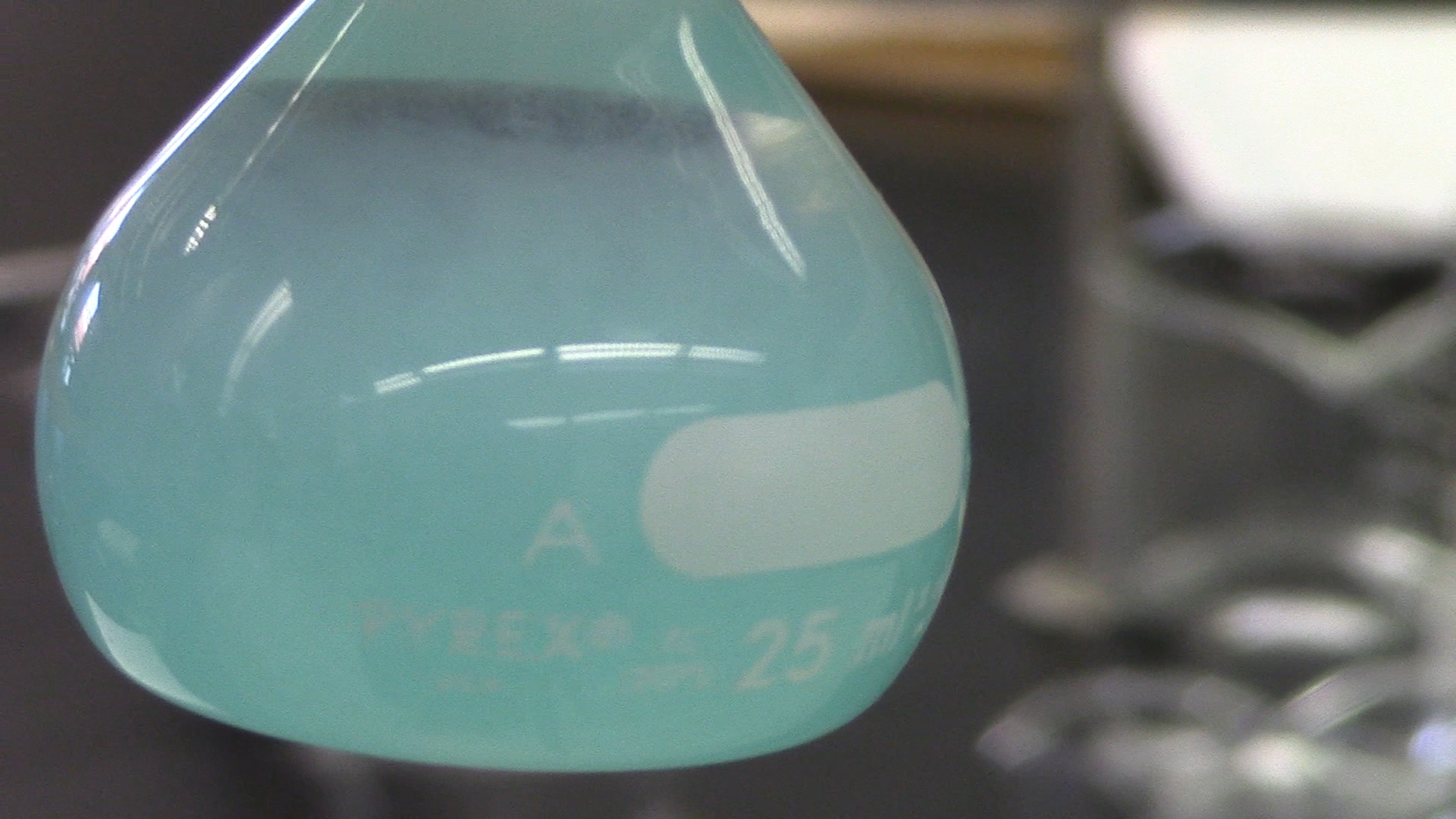
Review the following image and report what insoluble compound is likely leading to the opaque nature of the solution following the initial addition of aqueous ammonia.
Cu(OH)2
For this experiment, you will graphically determine how the concentration of a solution affects absorption. Which response represents the values of the independent (x) and dependent (y) axes that will be on the graph you prepare, respectively.
concentration (M), absorbance
If you accidentally break any glassware, you should:
Notify the TA and receive proper cleanup
If you spill any concentrated ammonia on the floor or lab bench, you should leave it and not say anything and hope it dries up quickly.
False
Which solution should be added to the calorimeter first?
The excess reagent
What is the MINIMUM temperature change that is acceptable to record in your manual?
4 degrees C
How much heat (in J) is evolved when two solutions are mixed together to give 31.68-g of solution and a temperature change of -6.77 degrees Celsius?
Report your answer to 2 decimal places, and the sign on your answer should correspond to the change in temperature.
-897.36
If a reaction evolves 649.37-J of heat as 0.024-moles of water are produced, what is the enthalpy of this reaction (in kJ/mol)?
Report your answer to 2 decimal places.
-27.06
A reaction involving acetic acid has an enthalpy change of 55.7 kJ/mol. What is the concentration of 32.17-mL of this acetic acid solution if the reaction it is involved in evolves 681.96-J of heat?
Report your answer to 2 decimal places
0.38
Which of the following is NOT included in the next ionic equation we are using this week?
The soluble salt
If a thermometer is broken you should dispose of in regular trash.
False
Acetic acid, although weak in this week's lab, should still be handled with care.
True
What are the most dominate intermolecular forces present in acetone?
dipole-dipole forces
Diethyl ether (CH3CH2OCH2CH3) molecules interact using Van der Waals forces. Would this be an example of a polar or a nonpolar solvent?
nonpolar

Calculate the Rf value for the measured spot on this TLC plate. Report your result to 2 decimal places.
0.53

The solvent used to develop the TLC plate shown gave sufficient separation of the components.
False
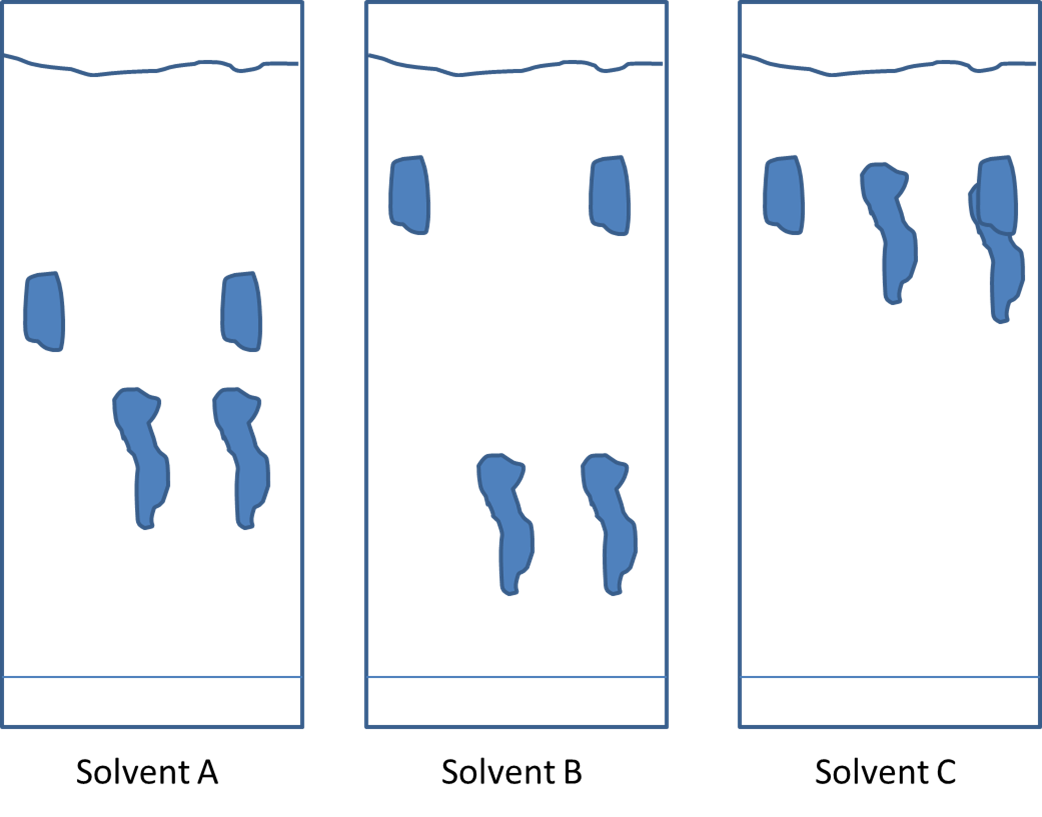
Which of the the TLC solvents shown in the picture would be the best to choose to separate unknowns using a microcolumn?
Solvent B
Which of the following statements best describes the spot size you should aim for when spotting your TLC plates with the dyes?
As small as possible
Which of the following statements best describes the line you will create on the bottom of your TLC plate?
It should be made in pencil about a centimeter from the bottom of the plate.
Which of the following answers lists the components for the microcolumn in the order you should add them.
glass wool, sand, silica gel, solvent and dye, sand
Which statement BEST describes the relationship between the spots that are developed on the TLC plate and the spots that are separated by the microcolumn?
The spots will appear in opposite order (ex: blue,pink and pink, blue) on the TLC plate and the microcolumn because we add solvent from the top in one and the bottom in the other.
Which of the following statements best describes the proper disposal of the microcolumn?
In the glass waste, without paper towels.
If you break any of the columns or beakers, you should:
Notify the TA and recieve proper clean up
What is the molar mass of CuSO4 * 5 H2O?
249.69 g/mol
What is the molar mass of Na2CO3?
105.99 g/mol
Given the balanced equation below:
2 CuSO4 * 5H2O (aq) + 2 Na2CO3 (aq) -> CuCO3Cu(OH)2 (s) + 2 Na2SO4 (aq) + CO2 (g) + 9 H2O (l)
How many moles of CuCO3Cu(OH)2 could you produce if you started with 1.814 grams of CuSO4 * 5 H2O?
Use the molar mass that you calculated for Question 1. Report your answer to 3 decimal places.
0.004
Given the balanced equation below:
2 CuSO4 * 5H2O (aq) + 2 Na2CO3 (aq) -> CuCO3Cu(OH)2 (s) + 2 Na2SO4 (aq) + CO2 (g) + 9 H2O (l)
How many moles of CuCO3Cu(OH)2 could you produce if you started with 3.917 grams of Na2CO3?
Use the molar mass that you calculated for Question 2. Report your answer to 3 decimal places. Do not include units.
0.018
Report all answers to 4 decimal places.
Given the balanced equation below:
4 CuSO4 5H2O (aq) + 6 NH3 (aq) -> CuSO43Cu(OH)2 (s) + 3 (NH4)2SO4 (aq) + 14 H2O (l)
How many moles of CuCO3 3Cu(OH)2 could you produce if you started with 1.3056 grams of CuSO4 5 H2O?
_______
How many moles of CuCO3 * 3Cu(OH)2 could you produce if you started with 1.3056 grams of NH3?
_______
What is the limiting reagent in this reaction?
________
0.0013, 0.0128, CuSO4*5H2O
You complete the malachite green reaction and determine that you've made 1.12 grams of CuCO3Cu(OH)2. Based on your starting quantities of reagents, you expected to make 1.56 grams of product. What is your percent yield?
Do not include the percent sign.
71.79
Oil paints and egg tempera paints both contain unsaturated fatty acids.
True
When making paint using the pigments from last week, you need to heat the binder once the pigment is mixed in so that the paint forms.
False
You calculated your theoretical yield of verdigris to be 3.494 grams. After making verdigris, your actual yield is 6.584 grams. What is your percent yield for your verdigris? Report your answer to 2 decimal places, and do not include a % sign.
188.44
Select the qualities that make for a good paint.
1. suspension of pigment
2. flammable
3. slow oxidation rate
4. smells nice
5. applies well to canvas/paper
1, 3, 5
What components are required to produce a paint?
1. pigment
2. binder
3. essential oils
4. good vibes
1, 2
What is the maximum amount of gas that your apparatus can collect? (In other words, how much water should you aim to displace?)
35-45 mL
Which of the following scenarios was NOT mentioned as a possible troubleshooting point in the technique video?
Crushing the tablet with a mortar and pestle is difficult.
What is the most likely cause of water not being displaced in the buret once the tablet has been dissolved?
Leaks in the system; fix them with parafilm.
How many moles of CO2 gas are generated if you collect 44.87-mL of the gas over water at 26.1 degrees C and 1.2-atm?
Report your answer to 4 decimal places.
0.0022
A tablet generated 0.002 moles of CO2. If that tablet had an initial mass of 0.550-g, what percent of the tablet was bicarbonate?
Report your answer to 3 decimal places.
22.182
Your manual mentions Dalton's Law of Partial Pressures. If you attribute all of the generated gas to CO2 production, which of the following statements is true?
Your calculated value for the generated CO2 will be higher than it actually is because you are not considering the vapor pressure of water.
How will you know that the pressure of your system is equalized and that it is okay to record an initial and/or final volume?
When the meniscus in the funnel is level with the meniscus in the buret.
If glassware is broken, you should not notify the TA for proper cleanup procedure.
False
It is okay to consume/eat the Alka-Seltzer during this week's lab.
False