chapter 13
 Call Kai
 Learn
 Practice Test
 Spaced Repetition
 Match
 Flashcards
 Knowt Play
1/152

There's no tags or description
Looks like no tags are added yet.
153 Terms
What is a stimulus
Changes detected by the nervous system in the internal or external environment
What does homeostasis mean?
Mantainance of constant internal environments within narrow limits despite changes in external environment
What’s the role of the neurone?
To transmit electrical impulses around the body so organisms can respond to stimuli
Motor neurone
Transmit impulses from a relay neurone or sensory neurone to an effector
Movement of electrical impulses
Receptor → sensory neurone → relay neurone → motor neurone → effector cell
Neurone structure

Schwann cells
Surround axon by wrapping around many times, protecting it and providigg by electrical insulation
Nodes of ranvier
Gaps between adjacent schawnn cells where there is no myelin sheath
Myelin sheath
Made of membranes of the schawnn cells and forms a covering of the axon
Dendrons (dendrites)
Short extension that come from the cell body. They divide into smaller branches called dendrites
Cell bodies in neurone cells?
Contains nucleus and large amount of endoplasmic reticulum (for production of proteins and neurotransmitters)
What are the four type of sensory receptors?
Mechanoreceptors, chemoreceptors, thermoreceptors, photoreceptors
What stimulus do photoreceptors detect?
Light
Why are sensory receptors called transducers?
They convert energy that they sense into a form of electrical energy known as generator potential
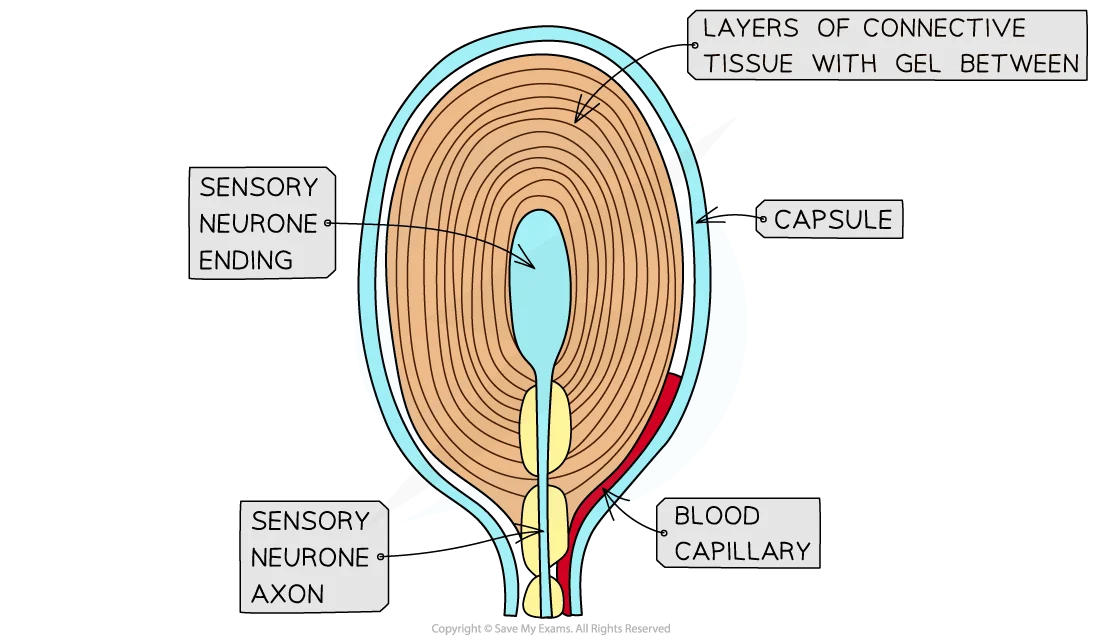
What is the pacinian corpuscle?
they are sensory receptors that detect mechanical pressure and are found deep in the skin.
How a generator potential causes an action potential:
stretch mediated channels sodium ions are too narrow at resting state
When pressure is applied to the corpuscle it changes shape and sodium ion channels widen causing sodium to diffuse into the neurone
The influx changes the potential of the membrane and it becomes depolarised
A generator potential is formed causing an action potential that passes along the sensory neurone and transmitted to the CNS
How do receptors act as transducers?
They detect stimuli and respond by opening or closing ion channels leading to a localised change in membrane potential
Pacinian corpuscle
What happens at resting potential in a neurone?
Potential difference is -70, no impulse is being transmitted and the pump is actively pumping 3 sodium ions out and 2 potassium ions in
What does it mean when the stimulus is stronger?
The more frequent the action potential will be
What is needed for a neuron to move from resting potential to action potential?
A short term electrical charge that slows an electrical signal to be passed form one neuron to another
What is the all or nothing principle?
A neurone either generates a full action potential when the threshold is reached or does not generate one at all.
what happens during depolarisation in a neurone?
The energy of a stimulus triggers the sodium VGC to open, causing sodium to diffuse in and the axon to become more positive, this leads to positive feedback, more sodium VGC open and more sodium diffuses in
What happens during action potential in a neurone occurs? (It’s at +40mv)
The inside is more positive than outside, after a delay the K+ channels open and the sodium VCG close. The K+ diffuses out
What happens during hyperpolarisation in a neurone?
The potassium ions quickly diffusing out causes it to become hyper polarised, at -75mv
What happens during the refractory period in a neurone?
Both VGC close and the pump returns the axon to resting potential
Action potential graph

Why do myelinated axons transfer electrical impulses faster than non myelinated axons?
Because depolarisation of the axon membrane only occurs in the node of ranvier. The action potential ‘jumps’ from one node to another in a process known as saltatory conduction
What two factors effect the speed at which an action potential Travels?
axon diameter- the bigger it is the less resistance so faster impulse
Temperature- higher temperature, the faster the nerve impulse (however temp over 40C cause protein to denature)
What’s the threshold potential?
-55 mv
What’s resting potential?
-70 mv
What is a cholinergic synapse?
A synapse that used acetylcholine as a neurotransmitter
Where are cholinergic synapses common?
At neuromuscular junctions
What is spatial summation?
When a number of presynaptic neurone connect to one post synaptic neurone
What’s temporal summation?
When a single presynaptic neurone releases neurotransmitters as a result of action potentials several times over a short period
What’s the go which separates the axon or one. Neurone from the next called?
A synaptic cleft
What are the types of neurotransmitters?
Excitatory
Inhibitory
What does an excitatory neurotransmitter do?
It depolarises the post synaptic membrane and if threshold is reached an action potential is triggered
What kind of neurotransmitter is acetylcholine (Ach)
Excitatory
What does an inhibitory neurotransmitter do?
It hyperpolarises the post synaptic membrane, preventing an action potential from being triggered
what is synaptic bulb?
The swollen end of the presynaptic neurone (contains many mitochondria and large amount of endoplasmic reticulum)
What is a synaptic vesicle?
Vesicles containing neurotransmitters
What are neurotransmitters receptors?
Receptor molecules which neurotransmitter binds to in the post synaptic membrane
What does the synapse ensure?
That impulses are unidirectional
What happens at the synapse?
An action potential reaches the end of the presynaptic neurone, depolarising it. Calcium channels open causing calcium to diffuse into the presynaptic bulb. This causes the synaptic vesicles to fuse with the presynaptic membrane. Neurotransmitters are released by exocytosis
what happens at the synaptic cleft?
The neurotransmitter diffuse across the synaptic cleft and bind with specific receptors molecule on the post synaptic membrane causing sodium ion channels to open and sodium ions diffuse into the post synaptic neurone triggering an action potential. The impulse is propagated along the post synaptic neurone
What happens to Ach after being diffused across the synaptic cleft and onto the post synaptic neurone?
Acetylcholine is broken down by acetylcholinesterase and it diffuses back to the presynaptic membrane where it’s recombined and repackaged back into synaptic vesicles
Which enzyme breaks down acetylcholine?
Acetylxholinesterase
what is summation?
When the amount of neurotransmitter build ups sufficiently to reach threshold and trigger an action potential
Nervous system division flowchart
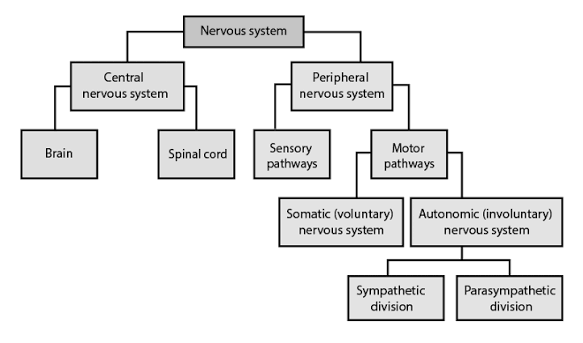
What’s the peripheral nervous system divided into?
Somatic nervous system
Autonomic nervous system
What is the somatic nervous system?
The part of the peripheral system responsible for carrying motor and sensory information both to and from the central nervous system. It’s responsible for nearly all voluntary muscle movements as well as processing sensory information that arrives via external stimuli
What is the autonomic nervous system?
The system that regulates functions of our internal organs such as heart, stomach and intestines. The function is involuntary.
What’s the autonomic nervous system divided into?
Sympathetic motor system
Parasympathetic motor system
What does the sympathetic motor system do?
Increases activity
What does the parasympathetic motor system do?
Decrease activities
What is the central nervous system made up of?
The brain and spinal cord
Structure of the brain image

What is the brain composed of?
The cerebrum, hypothalamus, cerebellum, spinal cord, medulla oblongata, Pituatry gland
What does the cerebrum do?
Controls higher functions such as thinking, speech, emotions, planning, memory and vision
What does the cerebrum consist of?
five lines divided into 2 halves
What does the right hemisphere od the cerebrum control?
The left side of the body
What does the left side of the cerebrum control?
The right side of the body
What’s the cerebral cortex?
The outer layer of the cerebrum
Where is the cerebellum?
Below the cerebrum
What does the cerebellum do?
It controls the coordination of movement, balance and posture (functions subconsciously)
What does balance involve?
Coordination between multiple parts, such as eyes, semi circular canal in the ears and many muscles, it’s a highly complex function
Where is the medulla oblongata?
At the base of the brain where it joined to the spinal cord
What does the medulla oblongata do?
It contains three centres that control diffrent functions.
The cardiac centre, vasomotor centre and respiratory centre
What does the cardiac centre in the medulla oblangata control?
Heart rate
What does the vasomotor centre in the medulla oblangata control?
Controls blood pressure by controlling the contraction of smooth muscle in arteriole walls
What does the respiratory centre in the medulla oblangata control?
Controls breathing rate. It also includes the inspiratory centre and an expiratory centre
Where is the hypothalamus?
In the middle part of the brain
What does the hypothalamus do?
Controls the automatic nervous system, such as regulating body temperature, digestion and endocrine functions
Where is the pituatry gland?
Below the hypothalamus
What does the pituatry gland do?
It’s responsible for osmoregulation, storing and releasing a range of hormones
What’s the pituatry gland divided into?
The anterior pituitary and the posterior pituitary
What does the anterior pituitary gland do?
Produce and releases certain hormones
What does the posterior pituitary gland do?
Stores and releases hormones produced by the hypothalamus eg ADH
What’s the brain protected by?
The skull and a surrounded protective membrane (meninges)
How does fMRI work?
Detects changes in blood oxygenation and flow that occurs in response to neural activity. Can be used to Produce activation maps showing which part of the brain are involved in particular process
How does CT work?
Builds a picture of the brain based on the differential absorption of x ray. Hard tissues absorb x ray well and soft tissues somewhere in between, so It reveals the gross features of he brain.
How does PET work?
Uses traces amount of short lived radioactive material to map functional processes in the brain. Areas of high radioactivity are associated with brain activity
how does an EEG work?
Measures electrical activity of the brain by recording from electrodes placed on the scalps an electroencephalogram(EEG) is produced an electrical signal from a large number of neurons
Why does EEG have such high temporal resolution?
It’s able to detect change in electrical a city on a millisecond level
What are reflex actions?
Involuntary responses to certain stimuli
What’s the role of a reflex arc?
It is very fast and usually has a protective porpoise or survival value
What’s a reflex arc?
The pathway of neurones involved in a reflex action
Why are reflexes essential for survival?
They avoid the body being harmed/ reduce the severity of any damage
How do reflexes increase your change of survival?
They are involuntary
They don’t have to be learnt- they are present from birth
Extremely fast- usually only involved one or two synapses
What sequence do reflexes follow?
Stimulus → receptors → sensory → relay → motor → effector → response neurone
the action of the reflex arc:
The receptor detects the stimulus and creates an action potential in the sensory neurone. The sensory neurone carries the impulse to the spinal cord. The relay neurone connects the sensory neurone to the motor neurone which carries the impulses to the effector to carry out the response. The effector carries out a response
What’s the knee jerk reflex used by doctors for?
To asses weather the nervous system of a patient is working properly or not
What does the knee jerk reflex consist of?
Stimulus- the stretch of the muscle caused by pressure on the lightest
Receptor: stretch receptors in the muscle
Coordinator: the spinal cord
Effector: quadriceps muscle
Response: contraction of the quadriceps muscle causing leg to strengthen
What are the three types of muscle in the body?
Cardiac, smooth and skeletal
cardiac muscle
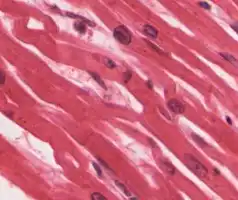
what the muscles look like?

Fibre appearance of skeletal muscle?
Striated
Fibre appearance of cardiac muscle?
Lightly striated
Fibre appearance of smooth muscle?
non striated