AP Chem Semester Review
 Note
Note Call Kai
 Learn
Learn Practice Test
 Spaced Repetition
 Match
Match Flashcards
 Knowt Play
1/99

There's no tags or description
Looks like no tags are added yet.
Name | Mastery | Learn | Test | Matching | Spaced | Call with Kai | Chat |
|---|
No analytics yet
Send a link to your students to track their progress
100 Terms
Mass Spectrometry separates isotopes of an element to determine __________.
isotopic composition.
The process of __________ involves high-energy electrons ionizing atoms.
Mass Spectrometry
In Mass Spectrometry, ions are separated by their __________ using an electric field.
mass-to-charge ratio (m/z)
The __________ displays isotopic deflection and abundance in Mass Spectrometry.
mass spectrum.
In electron configurations, each orbital can hold __________ electrons with opposite spins.
2
According to the Aufbau principle, electrons fill __________ first.
lower energy orbitals
Coulomb's Law states that the attractive force (F) is proportional to the __________ of particles divided by the square of the distance between them.
charge
Effective Nuclear Charge (Z_eff) is calculated as: Z_eff = __________.
Protons - Core Electrons
Atomic radius decreases across a __________ due to higher nuclear charge.
period
Ionization energy increases across a period and __________ down a group.
decreases
Ionic bonds involve the __________ of electrons between a metal and a nonmetal.
transfer
Hydrogen bonding occurs with H bonded to __________, O, or F.
N
Boyle’s Law states that pressure is inversely proportional to __________.
volume
The definition of a solute is the substance that is __________.
dissolved
Dilution can be expressed as M1V1 = __________.
M2V2
A combustion reaction involves a hydrocarbon and __________.
O2
At the equivalence point in a titration, the moles of titrant equal the moles of __________.
analyte
Oxidation in redox reactions is defined as the __________ of electrons.
loss
The Beer-Lambert Law relates absorbance (A) to concentration and is expressed as A = __________.
εlc
Explain why elements B and Al deviate from normal ionization energy trends.
Boron (B) and Aluminum (Al) deviate from normal ionization energy trends because their valence electrons occupy the higher-energy p-orbital, which is further from the nucleus and more shielded by inner electrons, making them easier to remove.This results in lower ionization energies compared to elements in the same group, which have their valence electrons in the s-orbital.
What does PES stand for in the context of chemistry?
PES stands for Photoelectron Spectroscopy, a technique used to study the electronic structure of atoms and molecules by measuring the kinetic energy of electrons emitted from a sample.
What is the primary purpose of Mass Spectrometry?
The primary purpose of Mass Spectrometry is to determine the isotopic composition of an element.
What happens during the ionization process in Mass Spectrometry?
High-energy electrons ionize atoms, creating charged ions.
How does mass-to-charge ratio (m/z) affect the separation of ions in Mass Spectrometry?
Ions are separated based on their mass-to-charge ratio (m/z) using an electric field.
What information can be derived from a mass spectrum?
A mass spectrum displays isotopic deflection and abundance of ions.
What does the empirical formula represent in a compound?
The empirical formula represents the smallest whole number ratio of atoms in a compound.
What is the difference between empirical and molecular formulas?
The empirical formula depicts the simplest ratio of atoms, while the molecular formula indicates the actual number of atoms in a molecule.
What is the first step in determining an empirical formula from percentage composition?
The first step is to convert percentage composition to mass.
How do you calculate the molecular formula from the empirical formula?
To find the molecular formula, divide the molecular mass by the empirical mass.
What does a hydrate formula indicate?
A hydrate formula indicates that the ionic compound contains water molecules in its structure.
How many electrons can each orbital hold in electron configurations?
Each orbital can hold 2 electrons with opposite spins.
What are anions and cations?
Anions are negatively charged ions that gain electrons, while cations are positively charged ions that lose electrons.
How many electrons does an anion gain?
An anion gains one or more electrons, depending on its charge.
How many electrons does a cation lose?
A cation loses one or more electrons, depending on its charge.
Why does the size of an atom increase from top to bottom of the periodic table?
The size of the atom increases due to the addition of electron shells, which increases the distance between the nucleus and outermost electrons.
What is effective nuclear charge (Z_eff) and its effect on atomic size across a period?
Effective nuclear charge (Z_eff) is the net positive charge experienced by an electron in a multi-electron atom. As Z_eff increases across a period, it pulls electrons closer to the nucleus, causing the atomic size to decrease.
What distinguishes groups from periods in the periodic table?
Groups are vertical columns in the periodic table, while periods are horizontal rows.
Why can two elements in the same period belong to different groups?
Two elements in the same period can have different chemical properties due to variations in their electron configurations, particularly in the filling of orbitals.
How does Z_eff affect ionization energy trends?
As effective nuclear charge increases, ionization energy tends to increase, making it harder to remove electrons.
What is electron affinity?
Electron affinity is the amount of energy released when an electron is added to a neutral atom to form a negative ion.
What is the relationship between atomic size and electron affinity?
atomic size goes up > electron affinity goes down
What is electronegativity?
Electronegativity is a measure of an atom's ability to attract and hold onto electrons in a chemical bond.
Whats the relationship between electronegativity and nuclear shielding electrons?
nuclear charge goes up > Electronegativity goes up
A dipole is a difference in electrical charge within a molecule, resulting from one end being slightly positive and the other slightly negative due to differences in __________.
electronegativity.
A dipole influences interactions between molecules and can affect properties like __________ and boiling points.
melting.
Nonpolar bonds occur when electrons are shared __________ and have __ dipole moment.
equally, no
Polar bonds occur when electrons are shared __________ and have __ dipole moment.
unequally, a
What kind of bonding occurs in a polyatomic ion?
covalent
Covalent bonding occurs between a _____ & _____.
nonmetal, nonmetal
______ bonding occurs between a metal & nonmetal.
Ionic
_______ bonding occurs between a metal & metal.
Metallic
In a graph of potential energy vs bond distance what’s indicated by y-axis?
bond strength
In a graph of potential energy vs bond distance what’s indicated by x-axis?
bond length
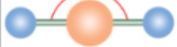
Name the VSPR & angle
180 & linear
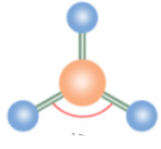
Name the VSPR & angle
trigonal planar & 120
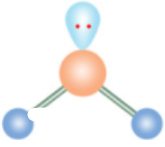
Name the VSPR & angle
angular/bent & 118
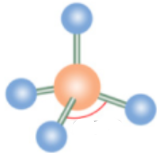
Name the VSPR & angle
tetrahedral & 109.5
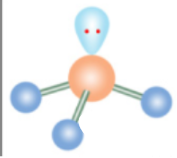
Name the VSPR & angle
trigonal pyramidal & 107
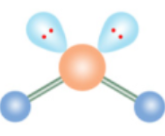
Name the VSPR & angle
angular or bent & 105
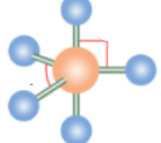
Name the VSPR & angle
trigonal bypyramidal & 90/120
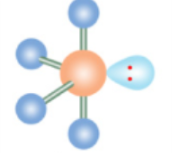
Name the VSPR & angle
seesaw & 88
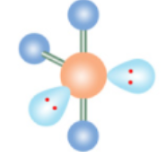
Name the VSPR & angle
t-shaped & 86
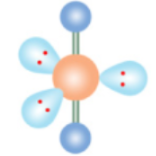
Name the VSPR & angle
linear & 84
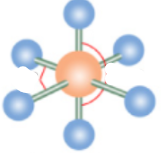
Name the VSPR & angle
octahedral & 90/180
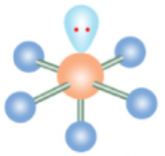
Name the VSPR & angle
square pyramidal & 88
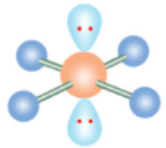
Name the VSPR & angle
square planar & 86
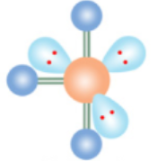
Name the VSPR & angle
T-shaped & 84
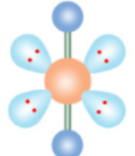
Name the VSPR & angle
LInear & 82
name 3 covalent solids
BN, SiO2, SiC
What are factors that influence KE?
velocity (temp) & mass
which factors influence speed
KE, mass
what does thermal equilibrium mean?
that temperatures are about to be come the same
what do you do when confused about a size of an element?
refer to whether its anion or cation (cations > positive > smaller) (anions > negative > Bigger)
microwave radiation movement?
rotational
infrared radiation movement?
vibrational
ultraviolet / visible radiation
translational
sublimation
solid > gas
deposition
gas > solid
synthesis
A + B > AB
decomposition
AB > A + B
single replacement
AB + C > AC + B
double replacement
AB + CD > AD + CB
combustion
Cx + Hy + O2 > CO2 + H2O
whats an equivalence point in a titration?
when all the titrant reacts w the analyte
titration base?
analyte
titration reactant you adding
titrant