2.3 Supply
 Call Kai
 Learn
 Practice Test
 Spaced Repetition
 Match
 Flashcards
 Knowt Play
1/16

There's no tags or description
Looks like no tags are added yet.
17 Terms
Supply
The amount of product that producers are willing and able to sell at a specific price at a specific point in time
Law of supply
Price is directly proportional to quantity supplied
What causes a movement along the supply curve?
change in price
What causes the supply curve to shift?
1. Cost of production
2. Taxes and subsidies
3. Technology
4. Increase in the number of producers or the size of existing firms
5. Government regulation
6. Climate
Economies of scale
When the average unit cost of productions falls as output of business increases
price elasticity of supply
The responsiveness of quantity supplied to a change in price
Elastic supply
Percentage change in quantity supplied is greater than percentage change in price
Elastic supply curve

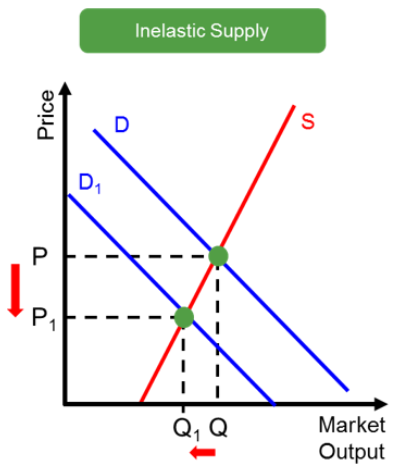
inelastic supply
Percentage change in quantity supplied is less than percentage change in price
Inelastic supply curve
Price elasticity if supply equation
% change in quantity supplied/ % change in price
PES is always ______ because it obeys the law of supply (supply curve slopes downward)
Positive
Why does a firms PES become ire elastic in the long run?
All the factors of production become variable, allowing them to increase production and potentially gain economies of scale
importance of PES for firms
1. Firms prefer an elastic supply as they can easily respond to changes in price.
2. A more elastic supply allows firms to offer consumers more flexibility (e.g. wider range of products). They are able to trial different products and increase output of successful ones, which allows them to maximise revenue, thus potentially profit.
3. Very inelastic supply means that price depends entirely almost on demand, leading to a potential fall in revenue and profit.
4. If a company has elastic PES, it will rarely have empty shelves or be out of stock. This means consumers will view the company as reliable and build brand loyalty, increasing revenue.
5. Inelastic supply would lead to shortages and delays, leading to poor reputation with consumers, leading to a fall in revenue
Importance of PES for firms (evaluation)
1. PES might be very difficult to calculate
2. PES may change rapidly
3. In the long run, PES will become more elastic, so a firm with a very long term perspective will not find an inelastic PES very important
4. Customers may only care about price/ reliability
5. There might be no repeat buyers (e.g. tourist shop)
Importance of PES for consumers
1. If the product is inelastic prices are likely to be higher and the item harder to get
2. Elastic supply allows consumers to buy more (more stock)
3. If the company has elastic PES it will rarely be out of stock and therefore consumers will perceive it as reliable
4. If consumers know a company has inelastic PES they can start looking for substitutes early in advance.
5. If consumers delay their purchases, they can take advantage of more elastic PES in the long run.
6. Consumers can stockpile goods with an inelastic PES just in case.
Importance of PES for consumers (evaluation)
1. There may not be any substitutes
2. Delaying the purchase is only possible with non essential products.
3. Stockpiling may be impossible with services and perishable goods.
4. Consumers may not want more of a product (their demand may be inelastic)
5. Consumers may have very high income and not care about high prices.
6. PES may change rapidly