CPSY 0450: Brain Damage and the Mind
 Call Kai
 Learn
 Practice Test
 Spaced Repetition
 Match
 Flashcards
 Knowt Play
1/156

There's no tags or description
Looks like no tags are added yet.
157 Terms
What is attention?
Wiliam James** important definition 1890
“everyone knows what attention is. It is the taking possession by the mind, in clear and vivid form, of one out of what seem several simultaneously possible objects or trains of thought. Focalization, concentration of consciousness are of its essence. It implies withdrawal from some things in order to deal effectively with others, and is a condition which has a real opposite in the confused, dazed, scatterbrain state.”
fourt criteria: alertness, concentration, selectivity, control
attention simplified
focalization, concentration of consciousness, withdrawal from some things in order to deal effectively with others
exists in parietal cortex
Attention is not a single entity, instead it is?
it is a set of processes that interact with other processes in the performance of different perceptual, cognitive, and motor tasks
Why do we need attention?*** check video again later
limited capacity to process all information so we need to select information based on relevance to current goals
attention acts as a selective filter to trigger appropriate responses
early selection vs late selection
limited capacity to process: early selection
filters information before it gets to registration and perceptual analysis (basically filtering out info b4 you even stop to understand what is going on “blocking out white noise”)
What does late selection do in processing info
filters out info after you’ve understood it and know it is irrelevant
what do each of these processes do
influence your executive functions, decisions and memory which ultimately lead to a response
bottom-up: based on senses that grab your attention
top-down: based on your goals and focus, what is your aim?/overall intention
Spotlight Metaphor of Spatial Attention
may move from one location to another
can zoom in&out; have a narrow or wide “beam”
attend to words vs. attend to letters in a word
Attended location not necessarily same as where eyes are fixated, can shift attention without moving eyes
metaphor not too literal
What is covert orienting
it has to do with the fact that one can shift attention without moving eyes
can keep your eyes focused on one spot but then covert focus in different space
Why shouldn’t the spotlight metaphor for spatial attention be taken too literally?
bc we can split attention between two non-adjacent locations
important cornerstone of spatial attention and binding
spatial attention is critical for binding features into unified representations
seeing stimulus processed in different parts of the brain, we have to bind them together to create a coherent perception.
Feature Binding: Find the blue T (pop out search)
as soon as you see display, blue T pops up so reaction time to identify the blue T is independent of how many distracting letters are in that set (straight horizontal line of reaction time)
only looking for one distinctive feature so you don’t need to use attention, reaction is fast and automatic, increasing distractors wont cause you to find things at slower speed
Feature Binding, find the blue T: conjunction search results
time it takes to find blue T is a linear function of how many different stimuli are out there so its a red linear increasing function as set size gets larger
Conjunction Search method and explanation why it takes longer
The only way to correctly identify target is if you move spotlight serially across the display binding info in each letter so takes longer more distractions u have
general conclusion drawn from how conjunction search is conducted
spatial attention must be directed serially to each stimulus to bind features—>attention is the “GLUE” that binds features
at first we see a bunch of disconnected features, but attention helps you realize that all of those features all belong to same object
feature binding and spatial attention
processed in little maps and project to the same topographical location in master map of locations then attentional spotlight beams onto that particular location of my visual field where red and square are and combined into coherent representation of a red square
mapped onto each other but processed independently

Role of Parietal cortex in attention and space
goes through two routes in the parietal cortex
ventral and dorsal
Ventral Route in Attention and Space
concerned with identifying what an object is
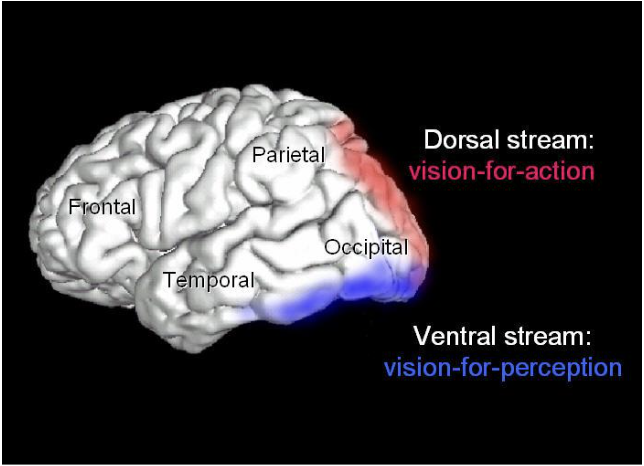
Dorsal Route in Attention and Space
specialized for spatial processing
attending to and acting on objects in space

Salient map of space (parietal cortex in attention and space)
topographically organized (your brain makes a spatial layout and its the same spatial arrangement as what you see in front of you, just some things are more highlighted than others)
Re-entrant feedback
eyes see blue thing —> goes to brain—> brain is like check if thats a blue bottle or a blue box —> eyes go back to look again to check what it is
important fact about the dorsal and ventral streams
THEY ARE DISSOCIABLE SEPARATE PERCEPTUAL PHENOMENA
Two Visual Processing Streams: MISHKIN ET AL 1983 STUDY
Object discrimination: Tested on monkeys — hide the raisin under one of 2 objects, and the raisin is under the object you didn’t see in the beginning
Don’t know what something is, but knows that it exists there in the space, knows where it is
Same as agnosia
Landmark discrimination: monkeys are supposed to learn that raisin is in the well that is the closest to the cylinder, test their spatial location
Seen in Balint’s syndrome: bilateral parietal lobe damage
Can’t represent space, act on space, or attend to space
Can see what it is but don’t know where it is in space
Parietal lobe: the whole brain region
Parietal cortex: the outer region of the parietal lobe in charge of spatial perception
Mishkin et al conclusion:
ventral stream lesion patients could NOT do object discrimination but cld do landmark discrimination
dorsal stream lesion patients could do object discrimination but not landmark discrimination

Private M: Visual Location Deficit (Holmes)
soldier with bilaterial lesions of parietal lobe
normal vis perception: intact acuity in central vision, detects presence of objects in periphery, detected moving stimuli, but no sense of location: “smthn moving somewhere”
cld see and recognize objects: js not sure where they were, double dissociation with object agnosia
had great problems controlling movement of eyes: difficulty moving eyes in specified direction
cld not determine location of objects: absolute and relative location (objects in same relative position as others)
cldn’t accurately reach out to grasp objects, project arm in wrong direction with “groping strategy”
Private M Visual Location Deficit quote:
“When I look at one it seems to go further away, when I try to see which is the nearer they seem to change in position every now and then; that one at which I look directly seems to move away.” (not anchored*)
Balint’s Syndrome
“lost in space” couldnt represent space, act on space, or attend to space
Balint’s Syndrome: Blood supply to brain
anterior cerebral artery, middle cerebral artery, posterior cerebral artery 3 major ones
superior parietal lobe is at a border zone/WATERSHED ZONE: edge of all this field of supple at interface of all three so blood supply is least sufficient, drop of blood supply means watershed area thus damaged first generally causing lesions and strokes to frontal lobe called watershed infarction
Balint’s syndrome: 3 symptoms
simultagnosia: inability to see more than one object at a time
impaired awareness of the whole scene
if put another object in vis field, they need to neglect one (if only 1 object, its kinda okay)
Optic Ataxia
impaired reaching under visual guidance (based on vision)
Ocular apraxia
impaired ability to voluntarily shift gaze towards visual stimuli
chaotic fixation patterns
failure to fixate on informative regions
irrelevant perceptual details capture gaze
Double Dissociation Between Agnosia and Optic Ataxia (Milner and Goodale) experiment
shown an object and asked to use finger and thumb to either mime its width (perception) and grasp the object (action)
DF: action ability to adjust miming was impaired, opposite for RV whose dorsal stream was impaired
Double Dissociation Between Agnosia and Optic Ataxia (Milner and Goodale) 2nd experiment DF
Patient DF: Woman with agnosia due to carbon monoxide poisoning (ventral stream damage
Impaired orientation matching: Couldn’t match orientation of an object to a hole
Intact visuomotor posting
Could still put the object in the hole in the right direction
DF cannot consciously perceive or describe object size (ventral damage), but her dorsal stream is intact, so she can still act on it accurately.
Double Dissociation Between Agnosia and Optic Ataxia (Milner and Goodale) 2nd experiment RV
optic ataxia (dorsal stream damage)
Grasp Object → RV could not adjust grip properly when reaching.
Mime Width → RV could accurately represent the width when asked to mime it.
RV can perceive the size correctly (ventral stream intact), but cannot translate that perception into an accurate movement (dorsal stream damaged).
Double Dissociation Between Agnosia and Optic Ataxia (Milner and Goodale) conclusions
DF → perception impaired, action intact
RV → action impaired, perception intact
Impaired Feature Binding in Balint’s Syndrome: Patient RM
54 year old man who suffered 2 strokes that resulted in nearly symmetrical bilateral parietal-occipital damage
experiment displayed until RM responded (10-30 sec max)
Results: least illusory conjunctions when it was color+shape, then motion+shape, then motion+color
Illusory conjunctions happened less when it was already a part of stored object representation (yellow corn)
Less attention needed for stored representations of feature conjunctions
graph shows a gradient of increasing illusory conjunctions reflecting how far in cortical space features are from each other (ex: two features together like color and shape more closely represented)

Illusory Conjunctions
misbounded features causing incorrect perceptions of objects in visual fields due to insufficient attentional resources and impaired feature binding.
Interactions between “What” and “Where”
Parietal cortex is in charge of allocating spatial attention to integrate or bind visual information into unified representations
Also allows for reentrant feedback
Binding of the visual information prevents illusory conjunctions (feature binding errors)
Bilateral damage to parietal cortex leads to increased illusory conjunction
Role of the parietal cortex
Allocate spatial attention to integrate or bind visual feedback
Reentrant feedback
Prevent illusory conjunctions esp for arbitrary pairings
Less critical for stored object representations (dorsal doesn’t need to bind those features together in ventral stream)
Activation of stored object representation can be an important source of within-object spatial relations

Rappaport et al. Interactions between “What” and “Where”
learned: something that already exists in stored object representation, the other stuff is like new combinations/arbitrary, random
objects that are familiar allow for faster and more accurate responses

interactions between “what” and “where” in terms of ventral and dorsal stream
ventral to dorsal for patients impaired dorsal stream to manage spatial relations and can use stored representations within ventral streams
Patient GK: Impairment at determining the relative location of objects (Shelav & Humphreys)
two strokes at 48, bilateral parietal lobe lesions
procedure: (see image)

Patient GK: Impairment at determining the relative location of objects: more features of a familiar “face” vs not having and what it shows
When more features were given it activated stored object representations
Reflects interactions between ventral and dorsal pathways
Reverse of reentrant dorsal feedback supporting ventral feature binding
The ventral ("what") and dorsal ("where") systems interact — they don’t work separately.
When one pathway (like “where”) is damaged, the other (like “what”) can sometimes compensate.
This reflects re-entrant feedback — the idea that the “what” and “where” areas send information back and forth to each other to build a complete picture of the world.
important source of coding about within-object spatial relations
Gestalt Grouping Effects on Simultanagnosia in Patient GK (Humphreys and Riddoch)
Identify the colors of the stimuli, and whether they fell above or below fixation
One item trials, high percentage correct, could attend to one object at a time, didn’t matter if it had strong, weak, or no grouping
Two item trials, very few could report both, and if they reported only one, the one with strong grouping had a lot higher reporting rate than weak grouping
Identify letters present and whether they fell above or below fixation
Could shift spatial attention to location of the strong group usually, but unable to localize the selected target

Balint’s Syndrome Hallmark characteristics provided major contributions to our understanding of?
the role of attention and the parietal lobe in feature binding
the different functions of the dorsal and ventral visual streams
vision for action vs. vision for perception
neglect syndrome
unilateral parietal lobe damage
usually seen in patients with right parietal damage (vast majority)
neglect left (contralateral) side of space
Neglect Syndrom Clinical Characteristics
hemispatial neglect
allesthesia
extinction to simultaneous stimuli
hemiakinesia, motor extinction, impersistence
anosognosia
Hemispatial Neglect
Can’t report or respond to stimuli on the side opposite to their lesion, literally doesn’t acknowledge that it exists
Neglect that side of space (hemispace) when asked to perform task
Can’t recognise contralateral extremities as their own (can’t recognise their own limbs on that side of their body)
**not a visual deficit, all sensory modalities

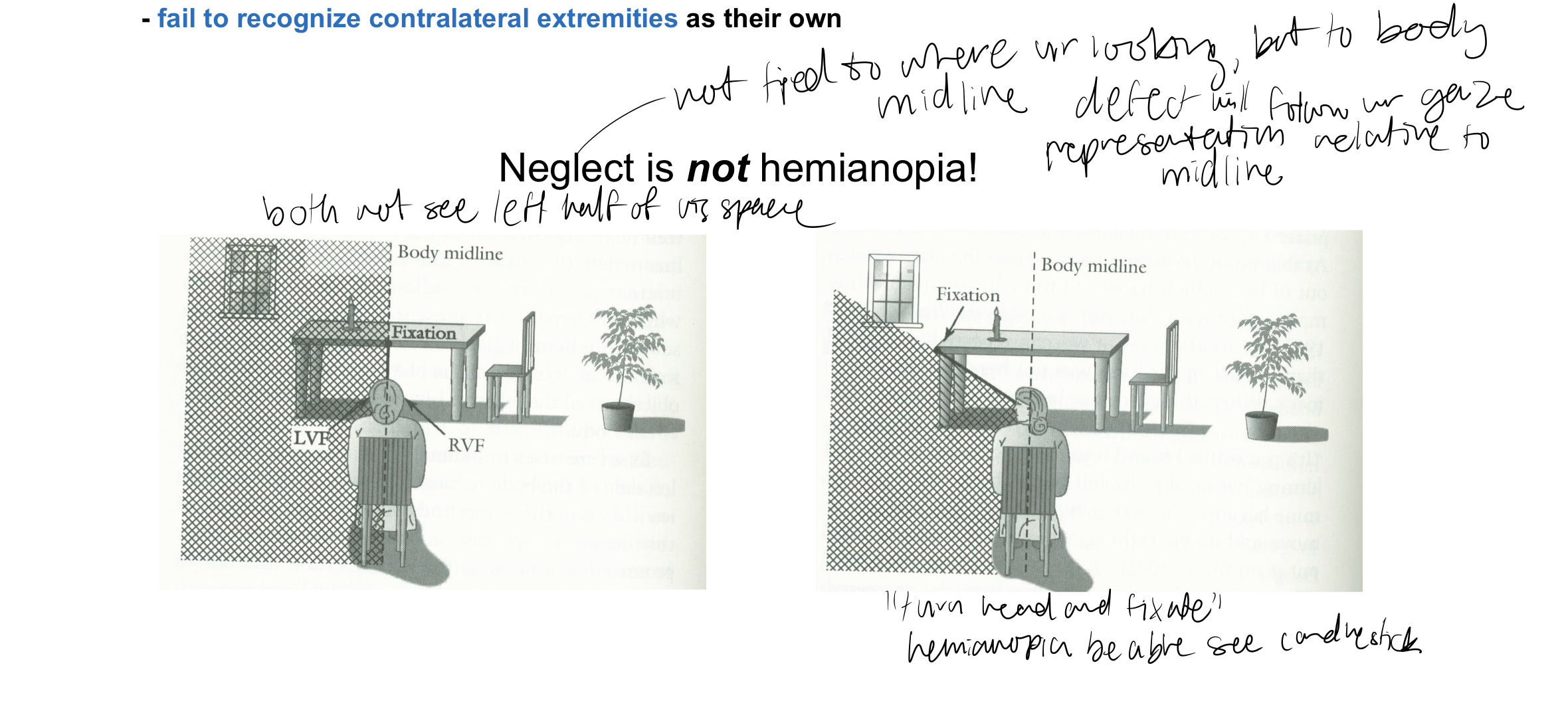
Neglect vs hemianopia
awareness: hemianopia: usually know about deficit and compensate by moving eyes toward the blind field, neglect: often unaware and don’t explore contralesional space
modality: hemianopia=purely visual, neglect: multimodal (visual, auditory, tactile, motor) higher order (has to do w one’s model of the world)
reference frame: hemianopia: retinotopic, moves w gaze; neglect can be egocentric or allocentric
Allesthesia (Neglect syndrome characteristics)
sensory stimulus is perceived as coming from opposite side of body, ie. touch on left arm, report that it was on right arm
Extinction to Simultaneous Stimuli (neglect syndrome characteristics)
fail to report contralateral stimulus under simultaneous bilateral presentation ie. extinc on left for right later on: single object is fine but left half of space is too weak or fragile to compete with right half and disappears and they only see the right half
Hemiakinesia, motor extinction, impersistence
fail to use or to sustain movement of contralateral extremeties
won’t move left side, right arm compete with left arm so they stop using left arm, extreme state they wont use left at all
Anosognosia (neglect syndrome characteristics)
unawareness of deficits, reality they have created so they feel complete not knowing
theories of neglect
primary sensory disorder
attentional disorder
representational disorder
Neglect syndrome as a primary sensory disorder: why is it false or why doesn’t it make sense
neglect arises because of an underlying sensory deficit on the side opposite to the brain lesion (fails to attend to one side of space not because of attentions deficit but because they don’t properly perceive sensory information from that side)
Evidence against Neglect syndrome as a primary sensory disorder
MRI studies show that objects in neglected space activate the appropriate visual regions in occipital lobes
neglect affects auditory and tactile judgments as well as vision
sounds on left are mislocalized but still heard
visual extinction suggests that different perceptual representations are competing for attention and visual awareness
Tactile Maze (De Renzi et al.)
burning house experiment (Marshall & Halligan): unconscious vs conscious awareness of visual scene
Tactile Maze (De Renzi et al., 1970)
Maze is placed behind a curtain, so patients can’t see it — must find the marble by feeling around with a finger
Vision is blocked so performance reflects tactile exploration and spatial attention, not visual input
When the maze side is contralateral to the lesion, search times are much longer and vice versa
Patients with right hemisphere damage take much longer to search on the left side of the maze, even when using their right (unimpaired) hand, because they are neglecting the left side of space.
Problem isn’t that their ouch sensors are broken, it's that the brain’s attention system doesn’t direct the sensor towards the other side of space
Sense of touch works just fine, it’s just that the brain doesn’t tell the brain to search on the other side
Burning House Experiment (Marshall & Haligan 1988)
Patient PS has left neglect with aneurysm (right side damage)
Couldn’t see anything different with two houses, even though one was burning on the left side
Asked which house she would prefer to live in, but 81% of the time she chose the non burning house even though she couldn’t acknowledge that it was burning - brain still processes them at deeper levels, up to object recognition or even semantic meaning
Ventral visual stream (what pathway) was still analyzing the neglected image enough to recognise fire and danger, but attention system (where/spatial system) failed to bring it into conscious awareness

Theory of Neglect: Attentional Disorder: Riddoch and Humphreys bisection
Distinguished between two aspects of attentional orienting
Automatic (exogenous, stimulus-driven) (impaired)
Elicited by the mere presence of cue
Deliberate (endogenous, internally-driven) (intact)
Involved when the cue must be reported
Neglect patients have a specific deficit in the automatic component of attentional orienting
Neglect patients have impairment in the automatic orienting of spatial attention to the contralateral hemispace
Automatic Orienting of Attention (Posner et al 1982)
valid cue: flash cute on the left, then flash another left target
invalid cue: flash cue on the right, then flash a left target - forced to disengage and move attention from cue to the target location

Posner et al 1982 results ***(check back at notes)
Hemispheres compete for attention - the cues elicit automatic shifts of attention to the cued side, even if it is equally likely to be valid or invalid.
Detection of stimulus is faster if it was previously cued, because otherwise they need to disengage to attend to the uncued side
Competition between hemispheres to control attention in the contralateral space
Neglect is due to an imbalance in competition
Particularly in difficulty to disengage from intact hemispace
Showed right hemisphere dominance of spatial neglect

Attentional Theory of Neglect
competition between hemispheres to control attention in contralateral space
neglect is due to an imbalance in competition
particularly in difficulty to disengage from intact hemispace
Concern that Attentional Theory of Neglect fails to address
then why is there a right hemisphere dominance of spatial neglect?
while both left and right hemisphere lesions can cause neglect, only right hemisphere lesions cause severe and persistent deficits
suggests a corresponding asymmetry in spatial attention
Right Hemispheric Dominance of Spatial Neglect
Only right hemisphere lesions cause severe and persistent deficits
Standard theory of neglect (Mesulam)
Right hemisphere controls shifts of attention to both left and right space
Left hemisphere controls attention to only right space
LH damage can be compensated, but RH damage cannot

dorsal attention network (spatial, Corbetta and Shulman)
spatial, goal directed, voluntary attention (look left, find the red car, etc.)
Bilateral distribution (not asymmetric) - exists in both hemispheres, working together
Ventral attention network (nonspatial, Corbetta and Shulman)
handles nonspatial, stimulus-driven, reflexive attention — the kind that makes you react when something unexpected happens (sudden loud noise, flashing light)
arousal and vigilence, reorienting your attention when something important occurs unexpected happens
detection of salient unexpected stimuli
What does the RH dominance of neglect reflect?
reflects the laterality of ventral network mediating nonspatial mechanisms of arousal, detection, and disengagement/reorienting
if u damage RH you lose the ability to reorient your attention (ventral) esp to the left side of space, since RH attends to both sides but LH mainly attends to right
not the laterality of dorsal network mediating spatial attention
Neglect is not just because one part is broken but also because of what?
Neglect is not just because the spatial (dorsal) system for left side attention is broken, it's also because the nonspatial (ventral) system, which keeps your attention awake, alert, and flexible, is impaired, and that system is RH dominant
Piazza del duomo study (Bisiach and Luzzati) experiment itself
Studied two patients (PATIENT IG and PATIENT NV) with left neglect
Asked to imagine and describe the square from two different perspectives
imagine looking at the front of the cathedral from the opposite side of the square
Imagine looking from the reverse perspective seen from the front doors of the cathedral
Piazza del duomo study (Bisiach and Luzzati) results
Patient IG and NV only saw the right landmarks whether or not he was on the front or opposite side of the cathedral
Concluded that their deficit is in the construction of the mental representation, because they weren’t actually attending to anything through their visual field
Can’t form the representation of the left side of real or imagined space
The Cloud Study (Bisiach, Luzzatti, Perani)
Asked whether clouds were the same or different
Clouds were either identical, different on the left, or different on the right
Patients made more errors when difference was on the left side (like it was identical on the right but different on the left)
The Cloud Study (Bisiach, Luzzatti, Perani) LEVEL 2
Level 2: move the clouds across a central slit - patients again mode more errors were on the left side, direction of the moving slit did not matter
Patients neglect the left side even when clouds are only seen through a central area, therefore patients have to translate the sequence in which the clouds move past the slit (temporal dimension) into a representational spatial one (mental image or spatial layout that the patient must reconstruct in their mind)
Had to mentally rebuild the spatial arrangement of the whole scene from a time sequence of what they saw through the slit
Because visual input not spatially available all at once, the task required internal spatial representation, not just visual attention
Number line mental timeline and neglect application
Right bias when asked to mark the midpoint of a line
Heard 2 numbers that defined a number interval and asked to state the midpoint number without making calculations
Neglect also applies to MENTAL TIMELINE (spatial representation)
Food preferences from past and present
Perceptual neglect
Unable to attend to visual, auditory, or olfactory stimuli in the contralesional side of the perceptual domain
Representational neglect
Unable to represent, describe, or explore the contralesional side of their mental images
Perceptual vs representational neglect
almost always observed together, but like a few dissociations have been observed
representational neglect involves interaction between visuospatial working memory and attention, so you can have RN without PN but if you have PN you will also have RN
Apraxia
not caused by: impaired comprehension, impaired primary motor ability
in right handers, associated with focal lesions of the left hemisphere, so in right hand they will have hemiplegia (paralyzed), so they test it in the non dominant hand
tested via multiple clinical assessments
limb gestures
limb manipulation
buccofacial gesture
buccofacial manipulation
Multiple stages
Apraxia Clinical Assessment
limb gesture: wave goodbye, hitchhike, salute, stop
limb manipulation: open a door with a key, flip a coin, open a catsup bottle, use a screwdriver, use a hammer
buccofacial gesture: stick out tongue, blow a kiss
buccofacial manipulation: blow out a match, suck on a straw
Apraxia: Clinical Assessment: gradient of impairment
pantomime > imitation > object use
“Show me how…” —> “Watch how I…” —> “Here is a…., show me how…”
Ideomotor apraxia
patients with apraxia look clumsy; they have difficulty with the selection, sequencing, and spatial orientation of movements
often use body-parts as objects
Patients rarely complain of apraxic disturbances
often paralyzed in right arm; attribute clumsiness to using nondominant hand
apraxia most severe when asked to pantomime a skilled act (e.g. charades), and mildest when actually using the object
Liepmann & Mass (1907)
studied patient with right hemiplegia who performed poorly when attempting to carry out verbal commands with his left hand
Geschwind (1962)
studied a patient who was apraxic in left but not right arm
could carry out command with right arm correctly and without hesitation
when given commands to use left arm, would make no or incorrect response
but could imitate or use actual object with left arm
Correct following verbal command with right arm —> not comprehension deficit
Correct on imitation or if given object in left arm —> not primary motor deficit
Conclusion: patient had damage to anterior 4/5 of corpus collosum
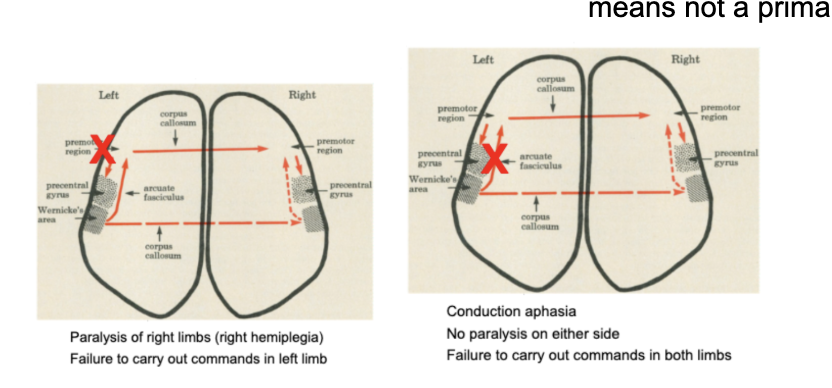
Geschwind (1962) involving structures and localization
Correct on imitation or if given an object in left arm means not a primary motor deficit
Posited that language was localised in the LH
On the right hand, command goes from Wernicke’s to premotor to primary motor in LH
On the left hand, command must also pass through Wernicke's to premotor in LH, then to premotor in RH
Verbal command could not reach RH to control left hand, loss of connection between the two hemispheres through the carpus callosum
But could imitate or use objects because those were not dependent on language
Basically saying that apraxia is a language issue and not different issue
Correct on imitation or if given an object in left arm means not a primary motor deficit
Geschwind (1962, in rhea’s words)
the “freaking” catch here is that most apraxic patients are also impaired on imitation so bro actually said nothing. bro is useless. if apraxia is simply due to disconnection of language areas, then they should be able to imitate. but they can’t. shucks.
Liepmann and Mass (1907)
LH dominant for motor skills, superiority of right hand is not just in great strength but in greater skill
LH contains motor engrams
movement formulas*
time-space-form picture of movement*
skill of left hand is “borrowed” from the left hemisphere (which controls the right hand)
lesion in corpus callosum not only disconnects language but also separates LH motor engrams from the motor areas of the RH which leads to impairments of commands, imitation, and object use (also accounts for finding that left hand of patients with right hemiplegia is more clumsy than that of people who broke their right hand)

Heilman et al 1982
reported a left handed man with damage to right motor/premotor areas
severe left-sided paralysis, but no language disorder—>language lateralized to LH
What about the unparalyzed right arm? If language, then no apraxia

Heilman et al 1982 What happened to unparalyzed right arm
he had apraxia! —> disconnection from motor engram
Motor engrams (findings based on Heilman 1982)
Stored in supermarginal gyrus and angular gyrus which is in the parietal lobe of the dominant hemisphere
Supermarginal gyrus and angular gyrus
Ideomotor apraxia could arise from
Damage to SMG/AG
Disconnection of SMG/AG from premotor areas
Both lead to impairment of performing to command and imitation, but only damage to SMG/AG should be impaired at discriminating poorly performed from well-performed acts because they can’t even store what the actual move is supposed to be

Heilman et al (1982) Gesture Comprehension Test testing apraxia
patients classified into four grps, according to locus of lesion (anterior vs. posterior) and whether or not they were apraxic
Gesture comprehension test: watched film of person performing pantomimed acts
well-executed
clumsily performed
used body-part as object
choose the gesture that looks the best
patients were classified into four groups: 1. apraxic vs nonapraxic, 2. anterior vs. posterior lesion
motor engrams are stored in parietal lobe of dominant hemisphere

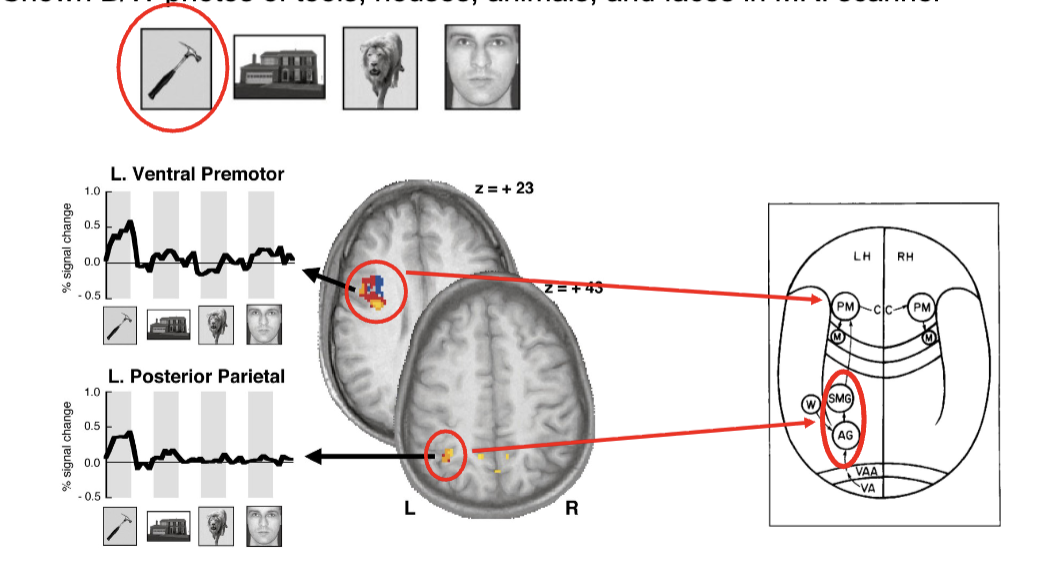
Chao & Martin (2000): Neuroimaging Study
10 healthy, right handed participants, shown B/W photos of tools, houses, animals and faces in the MRI scanner
Location that lit up matched the supramarginal gyrus (SMG)/angular gyrus (AG) and premotor region
viewing and naming tools automatically activates the left posterior parietal cortex (including the supramarginal gyrus) and the left ventral premotor cortex
Rumiati et al. (2004): Neural Basis of Pantomiming
14 healthy, right handed participants
shown videotapes of actions and objects in PET scanner, and asked to either imitate or pantomime action or object, and name the action or object shown
the same parts showed up on the PET scanner, showing that that’s where the motor engrams

sooo after all that Heilman et al 1982 apraxia due to either
damage to motor engrams
disconnection from premotor areas
but is apraxia really a disorder of skilled learning? What actually is a skill? What are the motor engrams actually for?

What is skill?
Skill characterised by economy and speed
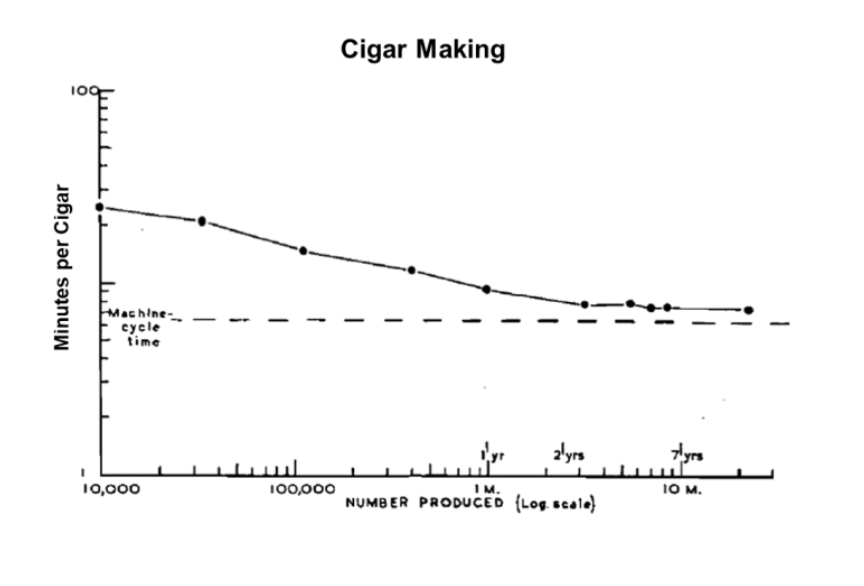
Increased speed of performance (crossman)
Increased economy of effort - less muscle effort (kamon and gormley)
Performer must combine appropriate movements into the correct serial order and correct temporal pattern within that order.
Involves refinement through practice of the sequencing and timing of he movements underlying a task
Reflected in coordinated and rapid performance, as well as in economy of effort and muscle groups used to perform the task
Increased speed of performance (crossman, 1959)
***check lecture
Economy of Effort (Kamon & Gormley, 1968)
***check lecture

Stages of Skill Acquisition (Fitts, 1964)
cognitive phase
Associative phase (these two are controlled, attentional)
Autonomous Phase (automatic)
key to automatization: predictability
Stages of Skill Acquisition (Fitts, 1964): cognitive phase
controlled and attentional - closed loop control - dependent on feedback
identify strategy to accomplish task
verbalize each part of task
Stages of Skill Acquisition (Fitts, 1964) Associative Phase
controlled and attentional - closed loop control - dependent on feedback
component parts of skill tried out
set of action components assembled
knowledge of results (feedback) critical
Stages of Skill Acquisition (Fitts, 1964) Autonomous Phase
automatic = skilled - open loop control - internal predictive control
automatization of component processes
reduction in attentional demands
loss of ability to verbalize describe task
predictability is crucial
Predictability and Automatization (Frith & Lang, 1978)
Tracking Task
Participants moved a joystick to keep cursor superimposed on target,
minimize the distance between the cursor and the target
target movement in vertical direction was random
target movement in horizontal direction was predictable (sine wave)

Predictability and Automatization (Wulf & Schmidt, 1997)
Tracking Task
target moved across screen in a pattern (30s)
first and last 10 s segments of each pattern were random
middle 10s segment was repeated

Closed loop
use feedback to guide and correct your movements while it’s happening