tissues (lab practical)
 Call Kai
 Learn
Learn Practice Test
 Spaced Repetition
 Match
Match Flashcards
 Knowt Play
1/20

There's no tags or description
Looks like no tags are added yet.
Name | Mastery | Learn | Test | Matching | Spaced | Call with Kai | Chat |
|---|
No analytics yet
Send a link to your students to track their progress
21 Terms
Nervous Tissues
Neuron
Characteristics:
Cell body (soma) = star-shaped
Branching dendrites from soma
Extracellular matrix = glial cells (tiny dots)

Functions:
Detect & send sensory info using electrical signals (action potentials) to the brain for interpretation & bodily response


Muscle Tissue (which one)
Skeletal
Characteristics
Little extracellular matrix
Long, cylindrical fibers (striated) (kind of look like ribbons)
Multiple nuclei – small/flat on edges of fibers
Function
aid in voluntary movement (attached to bones)

Muscle Tissue (which one)
Cardiac
Characteristics:
Little extracellular matrix
Shorter cells w/ smaller diameter
Some have 1 nucleus, others have 2
Branching fibers
Intercalated disks – connect adjacent cells
Striated fibers but less defined
Function:
Allows the heart to pump blood throughout the body

Muscle Tissue (which one)
Smooth
Characteristics:
Cells w/ little extracellular matrix
Cells = small, slender, spindle-shaped
Densely packed
Cells have 1 nucleus
NO striations
Functions:
Respiratory
Passage with control
Transportation of substances
(urinary)
(circulatory)
Digestive, Urinary, Reproductive, walls of the stomach, small intestine & esophagus (helps move food)
Goosebumps
Integumentary

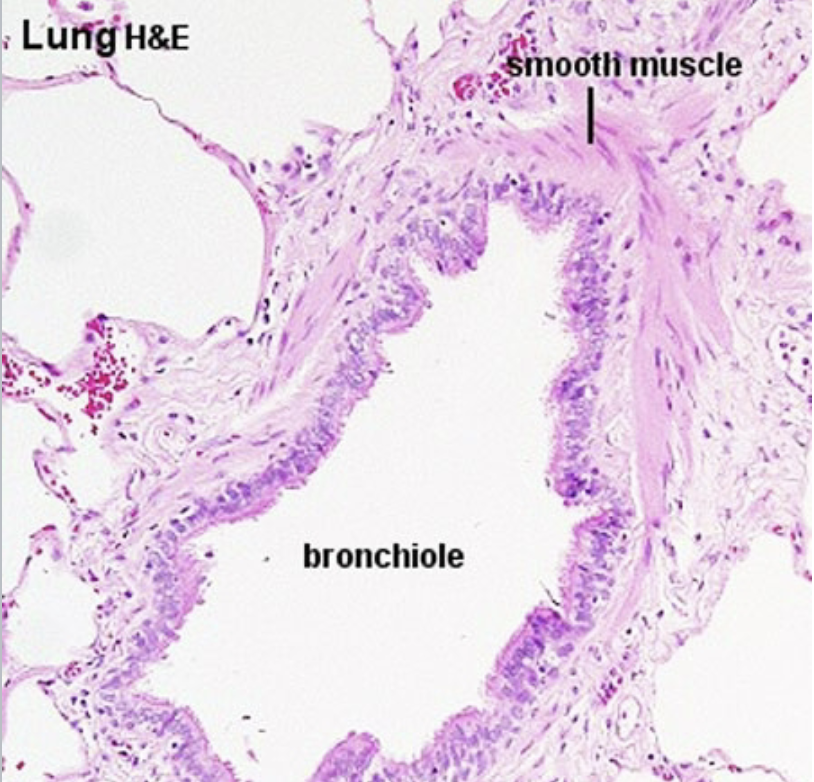
Smooth Muscle in the Respiratory System
bronchiole
Regulates airflow: contraction & relaxation changes diameter
trachea
Lines the posterior wall
when it contracts, it narrows the diameter of the trachea; this narrowing increases the force of expired air, which helps clear mucus & foreign particles (coughing)

Smooth Muscle in Circulatory System
Regulates blood flow & pressure via vasoconstriction & vasodilation
3 Components of the Connective Tissue
Cells:
Fibroblast (primary; produces/maintains ECM),
Immune system cells:
Macrophages: phagocytosis
Lymphocytes: ‘sentinels’; surveillance & response
Mast cells: ‘recruiters’ of other immune cells; inflammatory regulation
Ground substance:
jelly-like, transparent, colorless, fills gaps between fibers & cells
Fibers:
Collagen: most abundant, very strong, helps maintain structural integrity of tissues
Reticular: thin, delicate, form mesh-like networks
Elastic: give stretching/bending properties to tissue
Connective Tissue Groups & Subcategories
Proper:
• Loose: (fewer fibers, holds organs in place, attaches epithelial tissue to other underlying tissues)
• Areolar, Reticular (& specialized), Adipose (& specialized)
• Dense: (more fibers, attaches muscles to bones, link bones together at joints)
• Regular, Irregular, Elastic
Specialized:
• Cartilage: (semi-solid matrix)
• Hyaline, Fibrocartilage, Elastic
• Bone (solid matrix)
• Blood (fluid)
Connective Tissue Functions
PTSSDRC
Protection (skeletal system)
Transportation & exchange (blood = nutrients, oxygen, waste [e.g., CO2], hormones, immune cells)
Storage & thermal insulation (adipose [fat] can serve as an energy source)
Support…internal structural framework (skeleton)
Defend body against pathogens (immune system cells in ECM)
Repairing…triggers inflammation & forms scar tissue to heal damaged areas of the body
Connects & binds other tissues

connective tissue (type)
Loose Areolar
Characteristics:
ECM = lots of ground substance (white space), lots of reticular fibers, some elastic & collagen fibers
Lots of fibroblasts, some macrophages, some mast cells, some WBCs, lots of blood vessels
Found almost everywhere in the body
Function:
‘Universal packing material’ = fills spaces between organs & tissues to hold them in place (support/cushion)

connective tissue (type)
Loose Reticular
Characteristics:
ECM = lots of reticular fibers (very thin, form a branching network), lots of ground substance
Cells = fibroblasts (a.k.a. reticular cells; make reticular fibers), lots of WBCs
Functions:
Supports & anchors immune cells (WBCs, lymphocytes, macrophages)
Supports other cell types (kidney, liver)
Filtration: in filtering organs (spleen, lymph nodes), the ‘mesh-like’ network traps & filters out pathogens & worn-out blood cells
connective tissue (type)
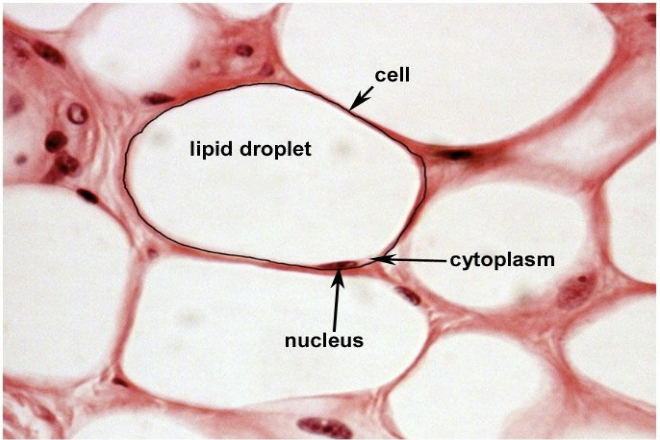
Loose Adipose (fat)
Characteristics:
ECM = very little (very few fibers & ground substance)
Lots of fat cells (adipocytes)
Fat cells = large, open, have thin margins, very pale, thin rim of cytoplasm that encircles a large lipid droplet, have a small nucleus on periphery
Functions :
Subcutaneous fat: energy source, thermal insulation, protects underlying organs
Visceral fat: energy source, cushions organs; poses greater health risk (e.g., heart disease, type 2 diabetes, high blood pressure)

connective tissue (type)
Dense Regular
Characteristics:
ECM = densely packed, parallel, often wavy collagen fibers
Slender nuclei compressed between collagen bundles
Very few blood vessels
Locations & Functions:
Tendons (connect muscles to bone) & ligaments (connect bones to other bones)
In tendons = transmit muscle forces to create movement
In ligaments = provide stability to joints

connective tissue (type)
Dense Irregular
Characteristics:
ECM = densely packed collagen fibers going in all directions, very little ground substance
Few cells (mainly fibroblasts that produce the collagen & ground substance)
Very few blood vessels Locations & Functions:
Location & Function
Resists excessive stretching (dermis [thickest layer of skin]; hollow organs [e.g., stomach, small & large intestine]), protection (encapsulates organs [e.g., kidneys, liver, spleen])
connective tissue (type)

Dense Elastic
Characteristics:
ECM = rich in elastin fibers, some collagen fibers
Some cells (fibroblasts [produce fibers])
Locations & Function:
Allows organs (e.g., aorta, pulmonary trunk, pulmonary arteries, major arterial branches) to stretch/expand (when the heart pumps blood) & recoil

connective tissue (type)
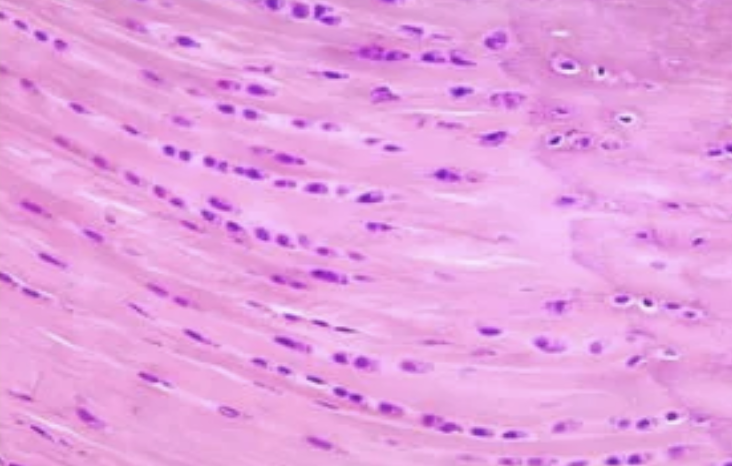
Cartilage Hyaline
Characteristics:
ECM = ground substance & fine collagen fibers blend smoothly (glassy appearance); lacks blood vessels, nerves & lymphatic vessels
Chondrocytes = in lacunae (small cavities), often in small clusters of 2-4 cells (sometimes up to 8)
Locations & Functions:
Reduces friction & allows for easy movement (joints [covers ends of bones])
Provides structural support (shapes nose; holds open larynx, trachea, bronchi
connective tissue (type)
Fibrocartilage
Characteristics:
ECM = lots of parallel collagen fibers in thick bundles, very little ground substance
Rows of un-clustered chondrocytes in lacunae between collagen fibers
Locations & Functions:
Provides support & cushioning (e.g., intervertebral discs, menisci), resists pulling & shearing forces (e.g., joints, intervertebral discs, menisci, tendons, ligaments), provides firm attachment point for tendons & ligaments (where they attach to bone), connects/bridges structures (pubic symphysis)

connective tissue (type)
Cartilage Elastic
Characteristics:
ECM = has similar proportion of ground substance relative to hyaline cartilage, lots of elastic fibers (very fine, thin), some collagen fibers
Chondrocytes in lacunae
Locations & Function:
Provides rigidity but w/ more flexibility than other cartilage types (e.g., external ear, epiglottis)

connective tissue (type)
Bone
Characteristics:
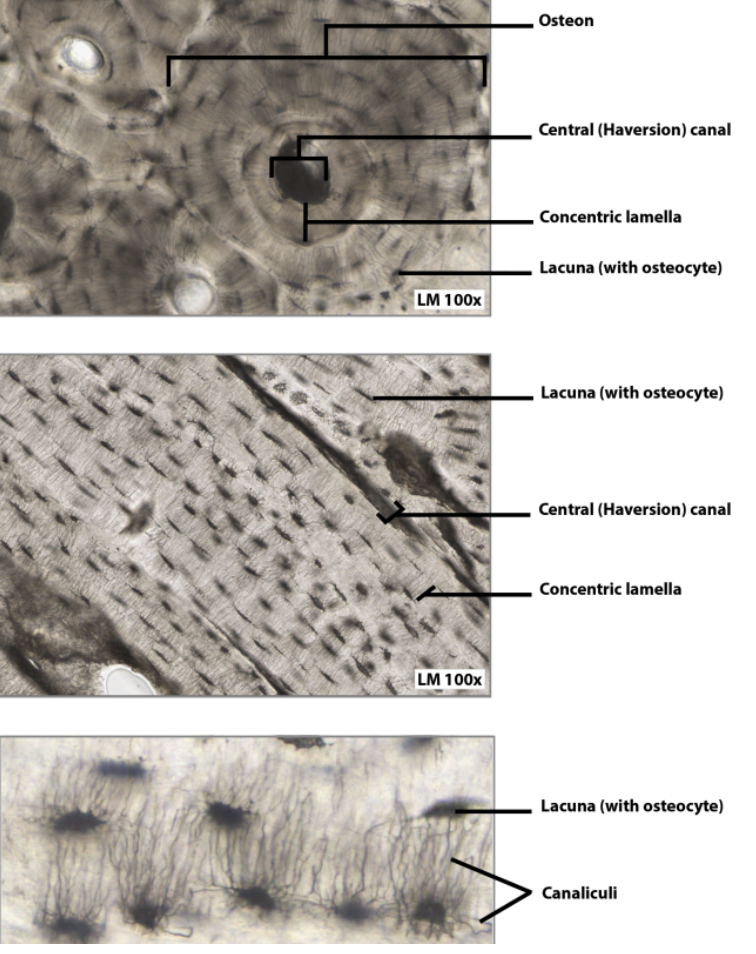
Lots of osteons = in compact bone (hard, dense outer layer of bones); densely packed, cork-like circles w/ concentric rings (lamellae) around a central canal (contains blood vessels, lymphatic vessels & nerves)
Tiny, dark dots in rings are bone cells (osteocytes); connected by canalicular network
Functions:
Provide significant strength & rigidity
Transportation of nutrients & waste via canaliculi
Remodeling
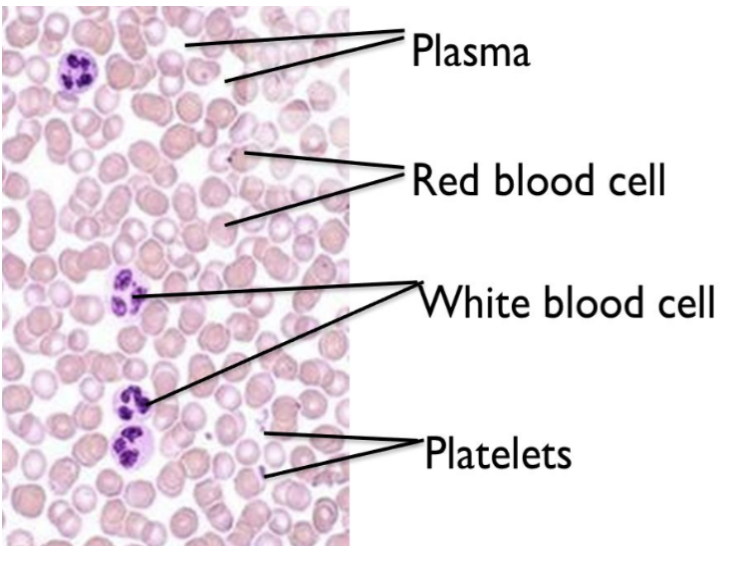
connective tissue (type)
Blood Tissue
Characteristics:
Lots of RBCs (small, biconcave discs)
Some WBCs (fight pathogens) & platelets (blood clotting)
ECM = plasma (blood cells are suspended in…)
Location & Functions :
Arteries, Veins, Capillaries
Transportation (oxygen, nutrients, waste products)
Protection = WBCs & platelets
Regulation = of body temp. (distributes heat throughout the body)
JESUS
IS KING