Emergency Medicine EOR: Cardiovascular (Smarty PANCE)
 Call Kai
 Learn
 Practice Test
 Spaced Repetition
 Match
 Flashcards
 Knowt Play
1/88

There's no tags or description
Looks like no tags are added yet.
89 Terms
What is the most common chronic arrhythmia?
Atrial fibrillation (AFib)
What is the classic ECG finding in Atrial Fibrillation?
Irregularly irregular rhythm with no discernible P waves

What is the first-line treatment for rate control in stable AFib?
Beta-blockers (e.g., Metoprolol) or non-dihydropyridine Calcium Channel Blockers (e.g., Diltiazem)
What is the definitive treatment for Atrial Flutter?
Radiofrequency catheter ablation
What is the classic ECG appearance of Atrial Flutter?
"Sawtooth" P-wave pattern (F waves), usually in leads II, III, and aVF

What is the first-line medication for stable Paroxysmal Supraventricular Tachycardia (PSVT)?
Adenosine (6mg rapid IV push, followed by 12mg if needed)
What is the definitive treatment for unstable atrial arrhythmias?
Synchronized cardioversion
What defines First-degree AV block?
PR interval >0.20 seconds with a 1:1 P to QRS ratio

What is the classic ECG finding of Mobitz I (Wenckebach) 2nd-degree block?
Progressive PR interval prolongation until a QRS complex is dropped (longer, longer, longer drop now you've got a Wenckebach)

What is the classic ECG finding of Mobitz II 2nd-degree block?
Intermittent, non-conducted P waves without progressive prolongation of the PR interval
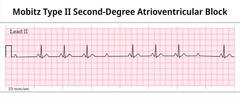
What is the clinical significance of Mobitz II 2nd-degree block?
High risk of progression to 3rd-degree heart block; requires permanent pacemaker
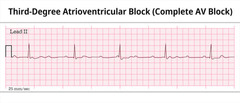
What ECG finding defines 3rd-degree (Complete) Heart Block?
AV dissociation: P waves and QRS complexes occur independently with no relationship
What is the ECG criteria for a Left Bundle Branch Block (LBBB)?
QRS >0.12s, broad R waves in I and V6, and deep S waves in V1

What does a new LBBB in the setting of chest pain suggest?
STEMI equivalent until proven otherwise
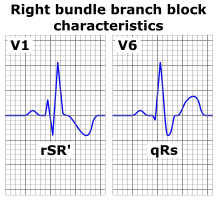
What is the ECG criteria for a Right Bundle Branch Block (RBBB)?
QRS complex > .12 seconds
R and R’ (upward bunny ears) in V1-V3
Wide S wave in V6
What defines an accelerated junctional rhythm?
Regular rhythm originating from the AV node with a rate of 60–100 bpm and inverted or absent P waves

What is the most common cause of Junctional Rhythm?
Digitalis toxicity (classic board answer) or sick sinus syndrome
What is a Premature Atrial Contraction (PAC)?
Ectopic beat originating in the atria causing a premature P wave with a different morphology

When are Premature Ventricular Contractions (PVCs) concerning?
When they are frequent (>10/min), multifocal, occur in runs (V-Tach), or exhibit "R-on-T" phenomenon
What is the first-line treatment for symptomatic PVCs?
Beta-blockers
What defines Ventricular Tachycardia (V-Tach)?
3 or more consecutive PVCs at a rate >100 bpm

What is the treatment for Pulseless V-Tach or Ventricular Fibrillation?
Defibrillation (unsynchronized) plus CPR and Epinephrine
What is the treatment for stable, monomorphic V-Tach?
Amiodarone or Procainamide
What is the classic EKG finding of Torsades de Pointes?
Twisting QRS around the baseline

What is the treatment for Torsades de Pointes?
IV Magnesium Sulfate
What is the most common cause of Dilated Cardiomyopathy?
Idiopathic (most common) or Chronic Alcohol Use
What physical exam finding is classic for Dilated Cardiomyopathy?
S3 gallop and displaced apical pulse
What is the most common cause of Hypertrophic Cardiomyopathy (HCM)?
Genetic mutation in sarcomere proteins (Autosomal Dominant)
Which murmur increases with Valsalva and decreases with Squatting?
Hypertrophic Cardiomyopathy (HCM)
What is the first-line medical treatment for HCM?
Beta-blockers (to increase diastolic filling time)
What is the hallmark of Restrictive Cardiomyopathy?
Impaired diastolic filling (diastolic heart failure) with normal or near-normal systolic function
What is the most common cause of Restrictive Cardiomyopathy?
Amyloidosis
What is the classic ECG finding in Restrictive Cardiomyopathy due to Amyloidosis?
Low voltage QRS complexes despite thick ventricular walls on echo

What defines Stable Angina?
Chest pain predictable with exertion and relieved by rest or Nitroglycerin
What is the gold standard for diagnosing Coronary Artery Disease?
Coronary Angiography
What are the three components of Acute Coronary Syndrome (ACS)?
Unstable Angina, NSTEMI, and STEMI
What differentiates NSTEMI from Unstable Angina?
NSTEMI has elevated cardiac biomarkers (Troponin); Unstable Angina does not
What is the door-to-balloon time goal for STEMI?
90 minutes (at a PCI-capable center)
What is the most specific cardiac marker for MI?
Troponin I (remains elevated for 7-10 days)
Which ECG leads represent the Inferior wall and which artery is involved?
Leads II, III, aVF; Right Coronary Artery (RCA)
What is the treatment for Vasospastic (Prinzmetal) Angina?
Calcium Channel Blockers and Nitrates (Avoid Beta-blockers)
What defines HFrEF (Systolic HF)?
Heart failure with an Ejection Fraction ≤40%
What are the four foundational "pillar" meds for HFrEF?
ARNI (or ACE/ARB), Beta-blocker, Mineralocorticoid Receptor Antagonist (MRA), and SGLT2 inhibitor
What is the most common cause of HFpEF (Diastolic HF)?
Chronic Hypertension leading to Left Ventricular Hypertrophy
What is the classic triad of Acute Decompensated Heart Failure (ADHF) on CXR?
Cephalization of flow, Kerley B lines, and Cardiomegaly
What is the immediate management mnemonic for ADHF?
LMNOP: Lasix, Morphine (less common now), Nitrates, Oxygen (CPAP), Position
What is the BP threshold for diagnosing Chronic Hypertension?
≥130/80 mmHg on at least two separate occasions
What differentiates Hypertensive Emergency from Urgency?
Emergency involves evidence of acute end-organ damage (e.g., encephalopathy, ACS, AKI)
What is the BP reduction goal in Hypertensive Emergency?
Reduce MAP by no more than 25% in the first hour to prevent cerebral ischemia
What is the first-line IV drug for Hypertensive Emergency with Aortic Dissection?
Esmolol (Beta-blocker) to reduce shear stress
What defines Orthostatic Hypotension?
Drop in SBP >20 mmHg or DBP >10 mmHg within 3 minutes of standing
What is the most common cause of Vasovagal Syncope?
Enhanced vagal tone leading to transient bradycardia and vasodilation (often triggered by stress/pain)
What is the hallmark of all types of Shock?
Inadequate tissue perfusion (hypoperfusion)
What is the hemodynamic profile of Cardiogenic Shock?
High PCWP (Preload), Low CO, High SVR (Afterload)
What is the hemodynamic profile of Hypovolemic Shock?
Low PCWP, Low CO, High SVR
What is the only type of shock where SVR is decreased?
Distributive Shock (Sepsis, Anaphylaxis, Neurogenic)
What is the first-line vasopressor for Septic Shock?
Norepinephrine (Levophed)
What is the treatment for Obstructive Shock due to Tension Pneumothorax?
Needle decompression followed by chest tube
What is the classic physical exam finding in Acute Rheumatic Carditis?
New onset murmur (usually Mitral Regurgitation) and friction rub
What is the "Beck Triad" for Cardiac Tamponade?
Hypotension, JVD, and Muffled heart sounds
What is Pulsus Paradoxus?
Drop in SBP >10 mmHg during inspiration; seen in Cardiac Tamponade
What is the most common valve involved in Infective Endocarditis (general population)?
Mitral Valve
What is the most common valve involved in Endocarditis in IV drug users?
Tricuspid Valve (Staph aureus)
What are Roth Spots, Osler Nodes, and Janeway Lesions?
Endocarditis signs: Roth (retinal hemorrhages), Osler (painful pads), Janeway (painless palms/soles)
What is the gold standard diagnostic for Myocarditis?
Endomyocardial biopsy
What is the classic ECG finding for Pericarditis?
Diffuse ST-segment elevation and PR-segment depression
What is the first-line treatment for Acute Pericarditis?
NSAIDs (high dose) plus Colchicine
What is the classic murmur of Aortic Stenosis?
Harsh crescendo-decrescendo systolic murmur at RUSB radiating to carotids
What is the classic murmur of Aortic Regurgitation?
High-pitched decrescendo diastolic murmur at LUSB; widened pulse pressure
What is the classic murmur of Mitral Stenosis?
Opening snap followed by a mid-diastolic rumbling murmur at the apex
What is the most common cause of Mitral Stenosis?
Rheumatic Heart Disease
What is the classic murmur of Mitral Valve Prolapse?
Mid-systolic click followed by a late systolic murmur
What are the Jones Criteria used for?
Diagnosis of Acute Rheumatic Fever (Major: J-O-N-E-S: Joints, Carditis, Nodules, Erythema marginatum, Sydenham chorea)
What is the screening recommendation for Abdominal Aortic Aneurysm (AAA)?
One-time ultrasound in men aged 65-75 who have ever smoked
What size AAA usually requires surgical intervention?
≥5.5 cm or rapid expansion (>0.5 cm in 6 months)
What is the classic presentation of Aortic Dissection?
Sudden "tearing" or "ripping" chest pain radiating to the back
What CXR finding is classic for Aortic Dissection?
Widened mediastinum
What is the "6 Ps" of Acute Arterial Embolism?
Pain, Pallor, Pulselessness, Paresthesia, Paralysis, Poikilothermia
What is the most common site for Arterial Thrombosis?
Superficial Femoral Artery
What is the gold standard for diagnosing DVT?
Compression Ultrasound (Venous Duplex)
What is Virchow’s Triad for DVT?
Stasis, Hypercoagulability, and Endothelial injury
What is the first-line outpatient treatment for DVT?
Direct Oral Anticoagulants (DOACs) like Rivaroxaban or Apixaban
What is the classic symptom of Peripheral Artery Disease (PAD)?
Intermittent claudication (pain in calves relieved by rest)
What is a positive Ankle-Brachial Index (ABI) for PAD?
ABI ≤0.90
What is the first-line medical therapy for PAD symptoms?
Cilostazol
What is Trousseau’s sign of malignancy?
Migratory thrombophlebitis associated with internal malignancy (pancreatic cancer)
What is Giant Cell (Temporal) Arteritis?
Large vessel vasculitis presenting with headache, jaw claudication, and risk of blindness; treat with high-dose steroids
What is Kawasaki Disease?
Medium vessel vasculitis in children: Fever >5 days, conjunctivitis, rash, extremity changes, adenopathy, mucosal changes (CRASH and Burn)
What is the most feared complication of Kawasaki Disease?
Coronary artery aneurysms