The labour market
 Call Kai
 Learn
 Practice Test
 Spaced Repetition
 Match
 Flashcards
 Knowt Play
1/108

There's no tags or description
Looks like no tags are added yet.
109 Terms
Why is the demand for labour described as a derived demand?
Because it depends on the demand for the goods and services labour produces
What is marginal product of labour (MP)?
The additional output produced by employing one extra worker
What is marginal revenue product (MRP)?
The extra revenue generated by employing one additional worker
How do you calculate MRP?
MRP = MP × MR
State the profit-maximising condition for labour demand.
A firm employs labour until MRP = wage rate
If MRP > wage → hire more workers
If MRP < wage → reduce employment
Why does the demand curve for labour slope downward?
Law of diminishing marginal returns:
As more workers are employed, MP falls
Therefore MRP falls
Firms will only employ extra workers if wages fall
What causes an increase in demand for labour (rightward shift)?
Higher product demand, increased productivity, higher product prices, substitution away from capital
How does an increase in demand for the product shift labour demand to the right?
more workers are needed to produce a higher output
How does an increase in labour productivity shift labour demand to the right?
Higher productivity → each worker produces more
→ higher marginal revenue product (MRP)
→ DL shifts right
How does a rise in the price of the product shift labour demand rightwards?
Increases MR → increases MRP
How does substitution away from capital shift the labour demand curve right?
if capital becomes more expensive, more labour will be demanded as a substitute
How does changing technology shift labour demand?
Labour-saving technology → DL shifts left
Labour-using technology → DL shifts right
Example:
Automation vs AI support tools.
What is elasticity of demand for labour (PEDL)?
how responsive demand for labour is to changes in wage
What are the determinants of PEDL?
substitutability of labour
elasticity of demand for product
proportion of total costs
time period
How does the availability of substitutes for labour affect PEDL?
If labour can easily be replaced by capital:
Labour demand is elastic
Example: self-checkouts replacing cashiers
additionally, unskilled workers are also easy to replace and so they have a lower wage rate
How does the proportion of total costs accounted for by labour affect PEDL?
If wages are a large share of total costs:
Labour demand is more elastic
How does time period affect the PEDL?
Long run → more elastic
Firms have time to:
Invest in automation
Change production methods
How does elasticity of demand for the product affect PEDL?
if product demand is elastic:
A rise in wages increases costs
Prices rise significantly
Demand falls sharply → labour demand is elastic
What is labour supply?
the number of workers willing and able to work in a particular occupation at different wage rates
Why is the labour supply curve upward sloping?
Higher wages attract more workers into an occupation
Name a few monetary influences on labour supply
wages
bonuses
overtime pay
pension contributions
Name a few non-monetary influences on labour supply
job satisfaction - enjoyment of works
working conditions - hours, stress levels
job security - permanent vs temp contracts
location - transport links, cost of living
Define net advantage.
the sum of the monetary and non-monetary benefits of working
utility derived from wage + utility derived from working
What is a compensating wage differential?
Higher pay offered to compensate for poor non-monetary conditions.
“Higher wages act as a compensating differential…”
What is the substitution effect?
when higher hourly wage rate makes work more attractive than leisure, so workers substitute labour for leisure
What is the income effect?
Higher wages increase income, allowing individuals to consume more leisure, reducing the quantity of labour supplied
What factors may cause an increase in supply (rightward shift)?
Improved wages or benefits in an occupation
Improved non-monetary conditions
Better hours
Safer environments
Increased training and education
More qualified workers
Increased immigration
Improved occupational mobility
Lower retraining costs
What might cause a decrease in supply (leftward shift)
Worsening working conditions
Falling relative wages
Higher training costs
Emigration
Ageing population
Give examples of nurses and teachers.
Nurses
Poor working conditions → labour shortages
Higher wages needed to compensate
Teachers
High stress and workload
Non-monetary dissatisfaction reduces supply
What is the elasticity of supply of labour?
how responsive labour supply is to a change in wage rate
What are the determinants of PESL?
skills and qualifications
unemployment levels
time period
How do skills and qualifications affect PESL?
if few skills and qualifications are needed for a job then supply is more elastic - lower wage rates
How do unemployment levels affect PESL?
if unemployment levels are high, supply is elastic as people are desperate and so there is a big change to even a small change in wage rate - low wages
How does time period affect PESL?
in the short-run, supply is inelastic as to go for a high wage job, it takes time to train and apply for the job
What is a perfectly competitive labour market?
A labour market with many firms and workers, perfect information, homogeneous labour, no barriers to entry or exit, and firms acting as wage takers.
Why are firms wage takers in a perfectly competitive labour market?
Because no single firm employs enough workers to influence the market wage rate.
What determines wages in the economists’ model of a competitive labour market?
The interaction of labour demand (MRP) and labour supply
Perfectly competitive labour market diagram
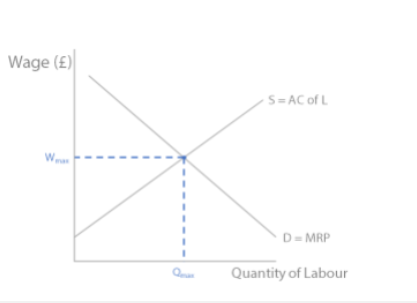
What happens if the wage rate is above equilibrium?
Excess supply of labour (unemployment)
What happens if the wage rate is below equilibrium?
Excess demand for labour (labour shortages)
Why do some occupations have higher wages than others?
Differences in labour demand, labour supply, compensating wage differentials and elasticities
How does labour demand affect relative wages?
Higher demand for labour (due to productivity or product demand) leads to higher wages
How does labour supply affect relative wages?
Scarce labour with inelastic supply leads to higher wages
Why do highly skilled workers tend to earn higher wages?
Due to long training periods and limited supply
How does elasticity of labour supply affect wages?
More inelastic supply leads to larger wage increases when demand rises.
Why do high wages not always mean high employment?
Employment depends on the intersection of demand and supply, not wages alone e.g teachers have high employment but moderate wages
Why is the competitive labour market model unrealistic?
Real labour markets are imperfect due to unions, regulation, and monopsony power
Why may wages be sticky in real labour markets?
Keynes coined this due to contracts, social norms, recessions, and efficiency wage theories
What is an imperfectly competitive labour market?
A labour market where wages are influenced by market power rather than pure demand and supply
Why are labour markets imperfect?
Firms may have monopsony power
Workers may be represented by trade unions
Imperfect information limits mobility
Labour is heterogeneous
Barriers to entry and exit exist
Name three sources of labour market imperfection.
Monopsony power, trade unions, imperfect information
What is a monopsony?
when there is only one buyer in the market
What gives firms monopsony power?
Geographical isolation (e.g. mining towns)
High occupational immobility
High training costs
Poor transport links
Lack of alternative employers
What does the labour supply curve represent in monopsony?
The average cost of labour (ACL)
What is the average cost of labour?
total wage costs / number of workers employed
What is the marginal cost of labour?
cost of hiring one additional worker
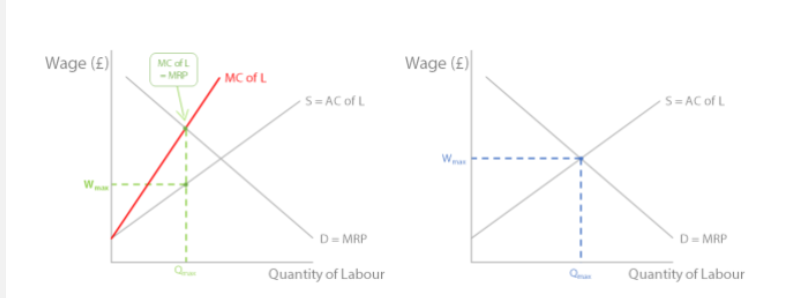
Draw the monopsony diagram
MCL is twice as steep as ACL
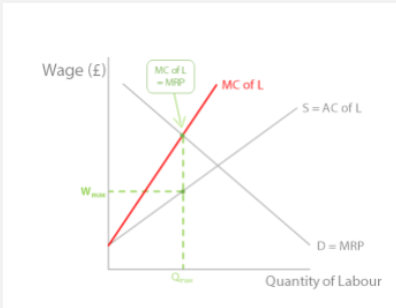
What is the profit-maximising rule for a monopsonist?
Employ labour where MRP = MCL
How are wages determined in monopsony?
From the labour supply curve at the chosen employment level
How do wages and employment in monopsony compare to perfect competition?
they are lower:
Labour supply to the firm is inelastic
Workers have limited alternatives
The firm can attract labour without raising wages much
Give key examples of monopsonies?
the NHS
the government for teachers
How does imperfect information contribute to imperfections in a labour market?
Workers may lack information about higher-paying jobs in other firms/industries
Some underestimate long-term benefits of education and skill investment
This limits worker productivity and career progression
Results in labour market inefficiency
What are trade unions?
when a group of workers use collective bargaining to improve employee welfare
What are key examples of trade unions?
National union of teachers (NUT) - 400,000 teachers
British medical association (BMA) - around 200,000
Why can trade unions increase efficiency in monopsony?
By raising wages and employment towards competitive levels
What government policies can reduce monopsony power?
Minimum wages, training subsidies, improved transport
What are the main objectives of trade unions?
To increase wages and improve working conditions
What are some of the factors affecting trade union power?
Union membership density
Elasticity of demand for labour
Degree of monopsony power
Legal framework
Globalisation
How does union membership density affect trade union power?
Higher membership → stronger bargaining power
Closed shops increase union influence
What is a closed shop?
A closed shop is a workplace or labour market where employees must be members of a trade union to be hired or to remain employed.
How does the elasticity of demand for labour affect trade union power?
Inelastic labour demand → unions can raise wages with less job loss
Elastic labour demand → wage rises cause significant unemployment
How does the degree of monopsony power impact trade union power?
Stronger monopsony → unions more effective
Can raise both wages and employment
How does legal framework affect trade union power?
Employment law
Right to strike
Restrictions on industrial action
How does globalisation affect trade union power?
Firms can relocate or hire workers from abroad
Reduces union bargaining power
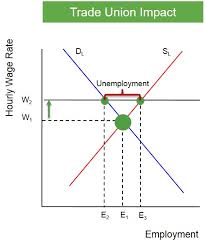
What happens when a union raises wages above equilibrium in perfect competition?
Employment falls and unemployment arises
Why does unemployment occur in competitive labour markets with unions?
Labour supply exceeds labour demand at the higher wage
Draw a diagram that shows the effect of trade unions in a perfectly competitive market
How do trade unions affect wages in monopsony markets?
They increase wages
How do trade unions affect employment in monopsony markets?
Employment increases up to the competitive level
Draw the diagram that shows the effects of trade unions in a monopsony
start at the intersection of where supply = demand
go to wage - this is the new MCL=ACL
join back at other ACL and MCL
new wage and quantity
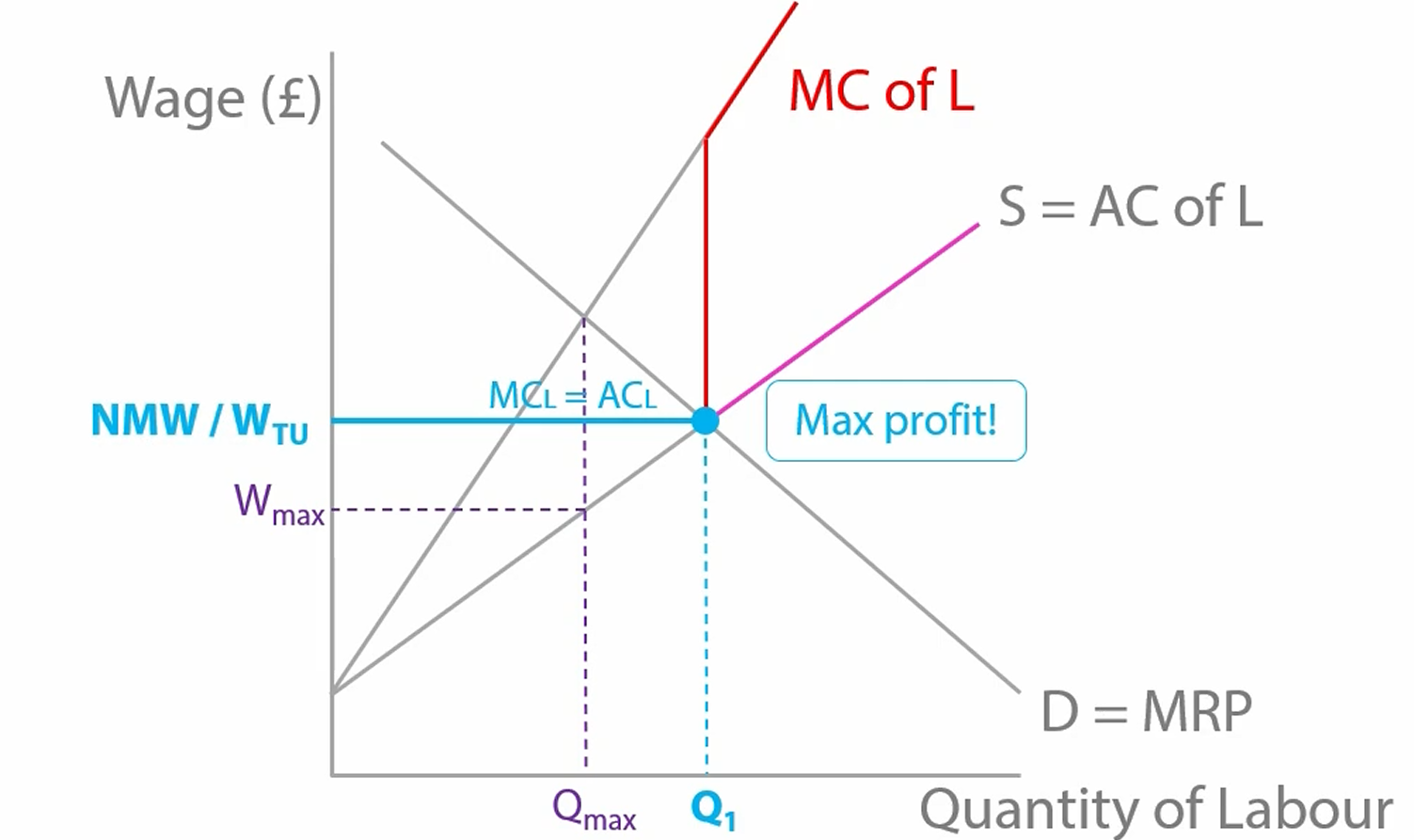
What is the national minimum wage?
the lowest wage employers can hire a worker for
What is the main aim of the NMW?
To reduce low pay and worker exploitation
What happens if the NMW is set above equilibrium in perfect competition?
Unemployment occurs
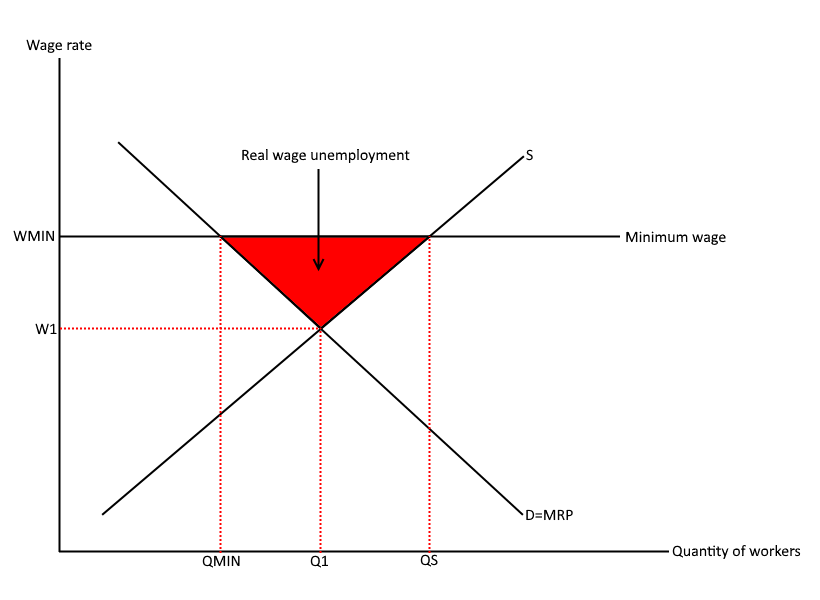
Why does unemployment occur with an NMW?
Labour supply exceeds labour demand at the higher wage
How does the NMW affect monopsony labour markets?
It increases wages and employment
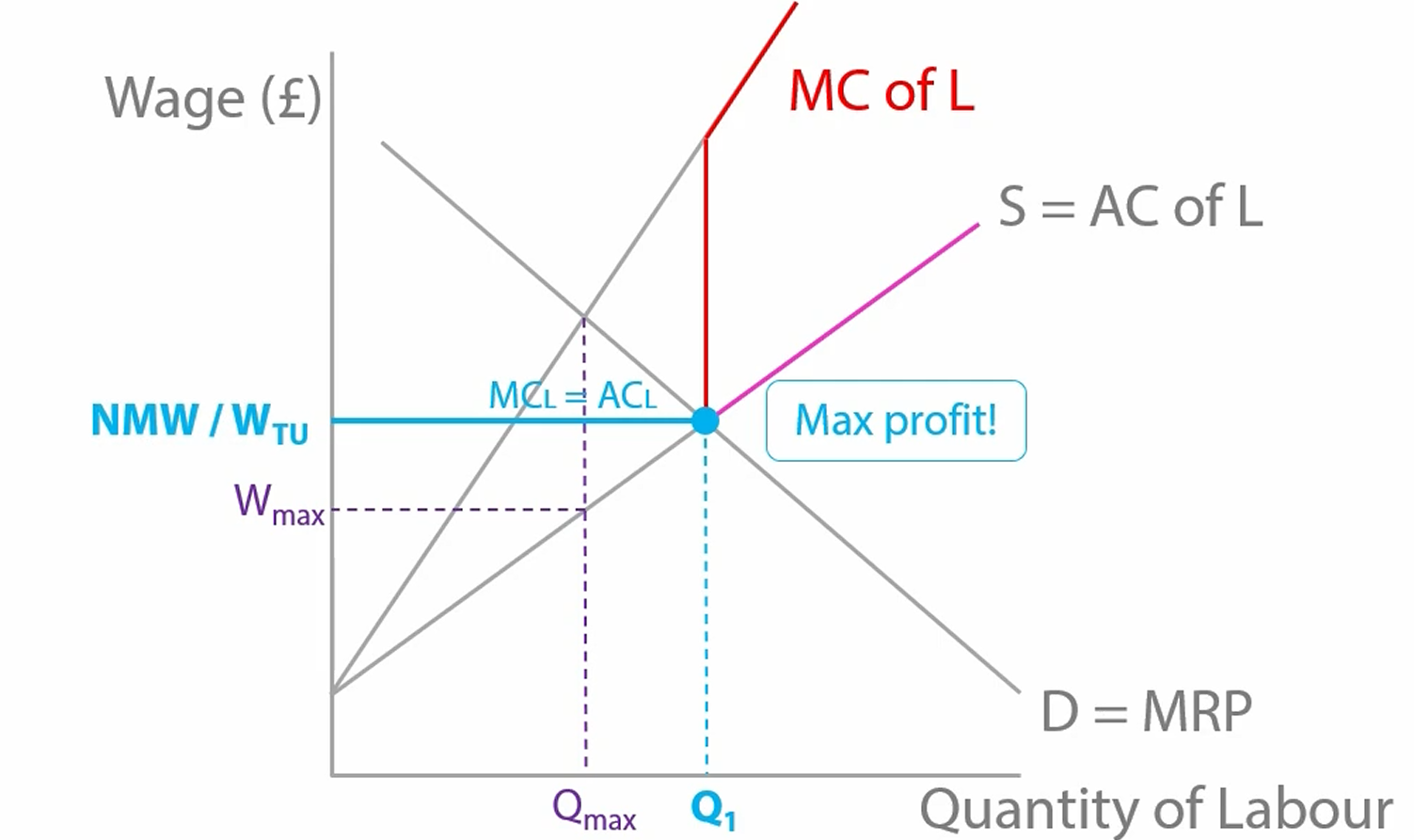
Why can employment rise with an NMW in monopsony?
It removes monopsonist power and flattens MCL
How does the NMW reduce inequality and exploitation?
By raising wages of the lowest-paid workers
What is an efficiency wage effect of the NMW?
Higher wages increase productivity and reduce turnover. Higher incentives to work
When is unemployment most likely from an NMW?
When labour demand is elastic and the wage is set too high
What are non-wage adjustments firms may make due to NMW?
Reduced hours, training, or poorer conditions
How is higher costs for firms a disadvantage of NMW?
they are passed on via:
Higher prices
Reduced profits
Lower investment
How does NMW cause regional disparities?
Same wage floor across different productivity regions
What is the national living wage and how is it different from the national minimum wage?
higher minimum pay rate for workers aged 23 and over. It was introduced in 2016 to ensure older workers earn more in line with the cost of living
What is wage discrimination in labour markets?
paying different workers different wage rates for doing the same job
Define wage differentials?
differences in wage rates down to economic factors
Which groups are commonly affected by discrimination?
Gender, ethnicity, age, disability
What are the conditions necessary for wage discrimination?
Workers are not perfectly substitutable - Employers perceive differences between groups
Employers have some market power - Wage-setting ability (monopsony)
Workers cannot easily switch jobs - Occupational immobility, Geographical immobility, Barriers to information
Market imperfections exist - Imperfect information, Discrimination persists despite laws
Give some examples of discrimination?
gender - women on average earn ~15% less than men
ethnicity - Minority groups underrepresented in high-paying jobs
disability - Disabled workers often paid less or underemployed
When did wage discrimination become illegal?
in the 1970s due to the equal pay act
Why is national minimum wage the only discrimination allowed?
it gives young people the chance to get a job