Attention & Motion
 Call Kai
 Learn
 Practice Test
 Spaced Repetition
 Match
 Flashcards
 Knowt Play
1/45

There's no tags or description
Looks like no tags are added yet.
46 Terms
Treisman's Attenuation Theory of Attentional Selection
Psychological theory that proposes that attention allows items that match our goals to be fully represented. Other items are still represented, but are reduced in strength.
Desimone & Dunca’s Biased Competition Theory
Neuroscientific theory that proposes that all available items compete for representation.
Attention enhances signals associated with the attended item at all levels of representation and diminishes signals associated with other items at all levels of competition.
Cell in V4
RF in lower left visual quandrant
Treisman’ Feature Integration Theory
Proposes that attention is a stage of processing. Prior to attention, all perceptual features are represented, but they are not bound together into coherent objects. After attention processes an item, its features are bound together.
Deutsch & Deutsch's (late selection) filter theory
Attention operates at a decision stage; inefficient; selection occurs after meaning has been processed
Proposes that attention allows many or all stimuli to be processed to the point of extracting meaning, and then attention operates at the level of decision making to influence what information is available
Broadbent's (early selection) filter theory
hard filter that filters out extraneous stuff and only things we’re looking for makes it past the filter
Proposes that attention only allows stimuli whose physical characteristics match our goals to be processed to the point of extracting meaning.
Goal-driven/top-down/Endogeneous
A Posner cueing task uses a cue at central visual fixation (like an arrow or a color) to indicate that the target will be in a particular location. This cue is 90% valid--that is, it is telling the truth on 9 out of 10 trials, but the target is actually elsewhere on 1 out of 10 trials.
Bottom-up/Salience-driven/Exogeneous
A Posner cueing task uses a cue in one of the potential target locations (like a brief flash) to indicate that the target will be in that location. This cue has chance validity (that is, for two potential target locations, the cue is telling the truth half of the time and lying half of the time).
Value-driven/Selection History
A two-stage task starts out by having participants report something about an item with a particular color. The important color changes from trial to trial, and participants are told at the start of each trial what the important color is on that trial and how much they will be rewarded for correct performance. In a second stage, color is no longer relevant at all -- but colors that were previously strongly rewarded are more distracting than colors that were previously less- or un-rewarded.
Goal-driven/Top-driven/Endogeneous
You, a novice birdwatcher, go for a walk in the woods with your binoculars, your experienced birdwatcher friend, and the goal of spotting a rare wood thrush. You and your friend find a nice spot to wait and watch for birds. Your friend notices you looking up at the trees but tells you that the wood thrush is more often found on the ground, so you start watching the ground instead of the trees.
Serial
Occurs one item at a time
Ex: writing down notes, one word of at a time
Limited-Capacity Parallel
a process happen a few items at a time
Ex: eating blueberries by putting 3 or 4 in your mouth in your at time
Unlimited-Capacity Parallel
A process can handle as manyyy items at possible at once
Ex: you hearing multiple instruments playing at once or multiple people in a cafeteria
Feature Search
A visual search where the number of distractors does not effect the quickness of the search (efficient)
Conjunction Search
The more distractors, the slower the search (ineffieficent)
A Reichardt detector is a circuit model of a motion-sensitive cell that (5 points):
explains apparent motion
explains sensitivity to motion direction
includes a delay
includes two receptive fields
explains sensitivity to motion speed
Saccade
A rapid eye movement jumping from one point to another
Smooth pursuit
A slow eye movement following a moving object
Area MT
Brain structure that seems to lead out awareness of motion
Bimodal neuron
A neuron that can have a hand-centered visual receptive field
Mirror neuron
A neuron that responds to watching someone else perform an action and you performing the actio yourself
Motion opponent
Receives input from two Reichardt detectors such that it increases its firing rate for one direction of motion and decreases its firing rate for the opposite direction of motion.
Indicators fo biological motion
Piecewise rigidity
Sudden changes in motion/direction
Smooth pursuit
Having no obvious external cause for changes in motion
Prime
A stimulus that might make it easier or faster to respond to a subsequent stimulus
Ex: if you see the word cat, you are ____ to respond to words associated, like “mouse” or “dog”, faster than “blanket.”
William James defines attention as:
“taking possession by the mind, in clear and vivid form, of one objects or trains of thought
implies withdrawal from some things in order to deal effectively with others
“ and the foreground of consciousness is
filled, if by anything, by a sort of solemn sense of
surrender to the empty passing of time.”
Principles of Psychology 1890
The “essence” of attention described by William James (1890) is:
Focalization, concentration, and consciousness
Focalization
Selective attention
Processing some information more than (or instead of) other info
Concentration
sustained attention or vigilance
remaining engaged in the task at hand; avoiding mind-wandering
Consciousness
Awareness; related to attention, but not identical to awareness
A capacity limit
A maximum rate of processing or quantity of representation within some system
Ex: capacity limit of eating dinner stems from the size of your mouth and the rate at which you can chew your food
Research in perception primarily focuses on this ________
Selective Attention
Attention as a label for _________ and the way we allocate resources to tasks or sources of information helps explain ____ ____ ____ ____
limited-capacity resources; why we need attention
Before vision, selective attention was studied in ______
Audition
Dichotic listening
Cocktail party effect (Cherry 1953)
Change blindness (ex: passing the basketball and the monkey)
Inattentional blindness
…and lwky time
attentional blink
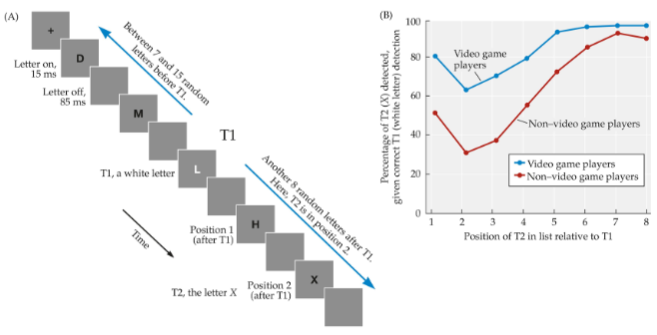
Attentionl Blink
A temporary reduction in the ability to notice or identify a second target stimulus (T2) if it appears between 200 and 500 milliseconds after a first target stimulus (T1) in a rapid stream of information
Attentional Blink diagrams
Remaining conflict with early selection theory
only the stimuli to which you attend are processed to the point of extracting meaning
But then how does something you don’t intend to attend ever grab your attention? Like, if your attention needs to switch bc of a car alarm
Moray (1959) showed that under dichotic listening conditions, the participant’s own name could capture their attention from the ignored ear…
Perceptual Load theory
agree that the locus of selection is dynamic. Selection may be early or late depending on task and other circumstances.
Overt
We move our eyes to the relevant place, fixating it
Say, “Hey, look over there!”
Covertly
We shift attention without moving our eyes
Says ,“Hey, don’t look so they notice you, but can you believe what those people over there are wearing.”
Many studies of visual attention focus on _______ attention in order to study attention separately from eye movements
Covert
Attentional Priority Map
the integration of different features and different kinds of attentional control (top-down, bottom-up, value-driven/selection history)
Posterior parietal cortex
Where attentional priority maps found in the brain
Biased competition
study this

Attending to an object/location/feature
increases neural activity in cells/brain regions
sensitive to that object/location/feature.
• makes neural signals appear more like the attended item is the only object/location/feature on display.
The binding problem
How do we link together the distributed (across
neural representations) featural components of an
item’s representation into a coherent whole?
Feature integration theory (FIT)
Anne Treisman’s theory of visual attention, which holds that a limited set of basic features can be processed in parallel preattentively, but other properties, including the correct binding of features to objects, require attention.
Scene Gist
our strange ability to be aware of the high-level meaning of a scene under conditions in which there is insufficient attention to make low-level discriminations