Learn: C3 - Structure and Bonding (TRIPLE)
 Call Kai
 Learn
 Practice Test
 Spaced Repetition
 Match
 Flashcards
 Knowt Play
1/60

There's no tags or description
Looks like no tags are added yet.
61 Terms
Which kind of atoms form ionic bonds?
Metals with non-metals
Which kind of atoms form covalent bonds?
Non-metals
Which kind of atoms form metallic bonds?
Metals
What happens to metals in ionic bonding?
They lose electrons to form positive ions
What happens to non-metals in ionic bonding?
They gain electrons to form negative ions
What must be included on ions in dot and cross diagrams?
Square brackets and charges
How are ionic compounds held together?
By strong electrostatic forces of attraction between the oppositely charged ions
What is the structure of an ionic compound?
A lattice of alternating positive and negative ions
State three limitations of dot and cross diagrams
They show electrons in fixed positions but in reality they should be moving.
They do not show the different sizes of ions.
They only show a small number of atoms/ions.
State two limitations of ball and stick diagrams
There are no sticks between atoms in ionic lattices.
Does not show the true shape of small covalent molecules.
State one limitation of 3D diagrams of ionic lattices
They can only show a tiny fraction of the structure
What happens to electrons in ionic bonds?
They are lost by metals and gained by non-metals
What happens to electrons in covalent bonds?
They are shared
State the three types of covalent structure
Small covalent molecules, large covalent molecules (polymers and fullerenes), giant covalent structures.
Draw the dot and cross diagram for hydrogen

Draw the dot and cross diagram for chlorine

Draw the dot and cross diagram for nitrogen
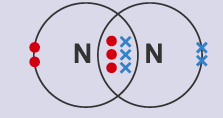
Draw the dot and cross diagram for oxygen

Draw the dot and cross diagram for HCl

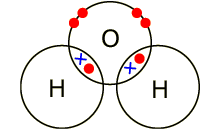
Draw the dot and cross diagram for water
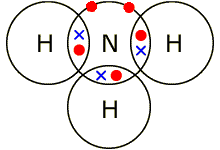
Draw the dot and cross diagram for NH3
Draw the dot and cross diagram for CH4

Describe the structure of metals
Lattice (regular arrangement) of positive ions with a sea of delocalised electrons
What holds the structure together in metals?
Strong electrostatic forces of attraction between positive ions and delocalised electrons
Give three limitations of the particle model of solids, liquids and gases
All particles are represented as spheres.
Particles are solid but should be mostly empty space.
There are no forces between the particles.
Define boiling point
The temperature at which boiling and condensing take place
Define melting point
The temperature at which freezing and melting take place
How are melting/boiling point related to bonding?
The stronger the forces between particles, the higher the boiling and melting point.
Give the state symbol for a solid
(s)
Give the state symbol for a liquid
(l)
Give the state symbol for a gas
(g)
Give the state symbol for an aqueous solution
(aq)
Is the melting point of an ionic compound high or low and why?
High because strong electrostatic forces require a lot of energy to break
Do solid ionic compounds conduct electricity and why?
They cannot conduct because ions are fixed in a lattice so cannot move so charge cannot flow.
Do liquid or aqueous ionic compounds conduct electricity and why?
They can conduct electricity because ions are free to move so charge can flow.
Is the melting/boiling point of small covalent molecules high or low and why?
Low because there are only weak intermolecular forces which require very little energy to break. Strong covalent bonds between the atoms are not broken when it melts/boils.
How is the size of a small covalent molecule related to boiling point?
The bigger the molecule, the higher the boiling point as the weak intermolecular forces are stronger for bigger molecules.
Do small covalent molecules conduct electricity and why?
They cannot conduct because there are no charged particles. Covalent molecules do not have an overall charge.
Describe a polymer
Large covalent molecule which is a chain of monomers joined by strong covalent bonds with weak intermolecular forces between the polymer chains
Describe why metals can be bent/shaped
The layers of atoms in a metallic lattice can slide over each other
Describe why metals are good conductors of electricity
Delocalised electrons are free to move so charge can flow
Describe why metals are good conductors of heat
Delocalised electrons are free to move and transfer energy
Describe why alloys are harder than pure metals
The regular layers of atoms are distorted by atoms of different sizes in an alloy so the layers cannot slide over each other.
Describe the structure of diamond
Each carbon atom forms four strong covalent bonds to other carbon atoms
Why is the melting point of diamond high?
Strong covalent bonds require a lot of energy to break.
Can diamond conduct electricity and why?
It cannot conduct because there are no charged particles
Describe the structure of graphite
Each carbon atom forms three covalent bonds with three other carbon atoms, forming layers of hexagonal rings of carbon atoms. There are delocalised electrons and weak intermolecular forces between layers.
Explain why graphite and graphene conduct electricity
It has delocalised electrons which can move through the structure so charge can flow
Describe the structure of graphene
Single layer of graphite
Describe the structure of fullerenes
Large covalent molecules of carbon atoms with hollow shapes, with rings with five, six or seven carbon atoms
What is buckminsterfullerene?
C60
State two properties of carbon nanotubes
High length to diameter ratio, good conductors of electricity
State one use of graphene and carbon nanotubes
Electronics
What are nanoparticles?
Structures that are 1-100 nm in size, of the order of a few hundred atoms
State the diameter of fine particles
Between 100 and 2500 nm
State the diameter of coarse particles
Between 1 x 10⁻⁵ m and 2.5 x 10⁻⁶ m
What happens to surface area to volume ratio when the side of a cube decreases by a factor of ten?
As the side of cube decreases by a factor of 10 the surface area to volume ratio increases by a factor of 10.
Why may nanoparticles have properties different from those for the same materials in bulk?
Because of their high surface area to volume ratio.
State six uses of nanoparticles
Medicine, electronics, cosmetics, sun creams, deodorants, and as catalysts
What does "aqueous" mean?
Dissolved in water
Explain why graphite is soft and slippery
The structure has layers and there are no covalent bonds between the layers but only weak intermolecular forces, meaning the layers can slide over each other.