Cell Bio - Exam 4
 Call Kai
 Learn
 Practice Test
 Spaced Repetition
 Match
 Flashcards
 Knowt Play
1/122

There's no tags or description
Looks like no tags are added yet.
123 Terms
What is the epithelium
A thin tissue forming covering the body’s surgace and the lining of the GI tract and other organs with a lumen
Is the epithelium single layer or multiple layers
can be both
What are the major features of the epithelium (5)
microvilli
polarity
specialized trafficking
junctions
ECM
What are the three types of junctions we discussed
Anchoring junctions
Tight junctions
Gap junctions
What does the Anchoring junctions do
holds the tissue together, transduce mechanical information
What does tight junctions do
holds the tissue together, barrier between inside and outside the organism
What does gap junctions do
cell communication - diffusion of small, soluble molecules between cells
Draw a epithelial cell (2 of them next to each other)

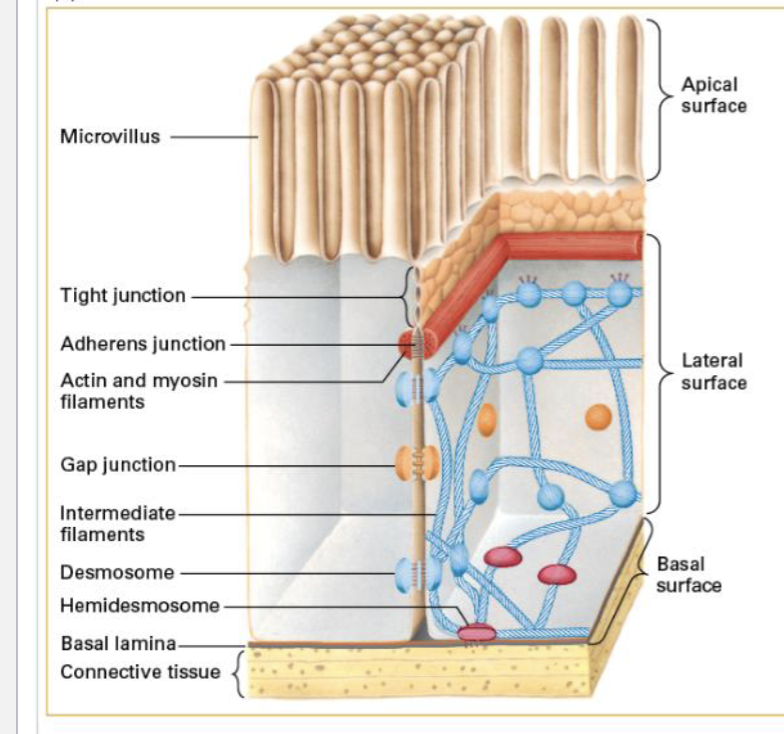
What are the 4 types of anchoring junctions
adherens junctions
desmosomes
hemidesmosomes
focal contacts
Features of adherens junctions
adhesion type
principal CAM/Adhesion receptors
Cytoskeletal attatchment
Intracellular adapters
Function
cell-cell
Cadherins
actin filaments
catenins, vinculin
shape, tension, signaling, force transmission
Features of desmosomes
adhesion type
principal CAM/Adhesion receptors
Cytoskeletal attatchment
Function
cell-cell
desmosomal cadherins
intermediate filaments
strength, durability, signaling
Features of hemidesmosomes
adhesion type
principal CAM/Adhesion receptors
Cytoskeletal attatchment
Function
cell-ECM
inegrin
intermediate filaments
shape, rigidity, signaling
Features of focal contacts
adhesion type
principal CAM/Adhesion receptors
Cytoskeletal attatchment
Function
cell-ECM
integrins
actin filaments
To review what is the principal CAM for
adherens junction
desmosomes
hemidesmosomes
focal contacts
cadherins
desmosomal cadherins
integrin
integrin
Adhesion types for:
adherens junction
desmosomes
hemidesmosomes
focal contacts
cell-cell
cell-cell
cell-ECM
cell-ECM
to review what is the cytoskeletal attachment for (outside the cell connects to CAM)
adherens junctions
desmosomes
hemidesmosomes
focal contacts
actin filaments
intermediate filaments
intermediate filaments
actin filaments
What is a CAM
transmembrane cell adhesion molecules (CAMs) that stick out of the plasma membrane into the space between cells and bind to CAM on the neighboring cell.
What is the homophillic CAM and Heterophillic CAM we discussed
homophillic: Cadherins —> always for cell-cell
heterophillic: Integrins —> cell-cell or cell-ECM
What are homophillic interactions
2 cells that connect bind together using the same CAM( like cadherins)
What are the 3 parts of Cadherins (u got this think)
cytosolic tail (inside cell)
transmembrane region
Extracellular Cadherin domain (EC) with calcium binding sites
What is cadherin binding dependent on
calcium
What is the role of Ca in cadherin binding
stabilizes the elongated and curved structure of the extracellular domain to help with cis and trans interactions
What are cis vs trans interactions for cadherins
cis - cadherins from the same cell bind together (EC1-EC1)
trans - cadherins from different cells bind together (EC1-EC2)

What is heterophillic interactions
Cell 1’s integrin (or selectin) binds to a different ligand—either an extracellular matrix (ECM) protein or a carbohydrate group on another cell.
Proteins that bind the cytoplasmic tails of Cadherins can (3)
influence Cadherin stability
facilitate connections to actin that strengthen adhesion
effect mechanical tension and transmission of tension information (mechanotransduction)
What creates mechanical tension at the junctions intracellular (2)
actin and myosin contractility
What creates mechanical tension at the junctions extracellular (5)
adjacent cells, blood flow, cell shape change, physical trauma, muscle contraction
What deos mechanical tension at junctions do specifically (2)
regulate gene expression
cause changes in proliferation and differentiation
What is the mechansosensor in the adherens junction that we discussed
a-catenin
What does it mean that a-catenin is a mechanosensor
senses mechanical tension and undergoes a conformational change
What does conformational change of a-catenin result in (2)
tighter binding to actin
unmasking of cryptic bindng sites that recruit other proteins to the junction
How does cadherin based adhesion help epithelial structure
cells are more static and sturdy with polarity
What is EMT
Epithelial to Mesenchymal transition. Transition from tight, polarized epithelium to loose, migratory mesenchymal state
How many extracellular domains (EC) are in protocadherin
6 EC
Where is EC1 vs EC6 on a protocadherin tail
EC6 is closest to the cell’s plasma membrana nd EC1 is the furthers out of the tail into extracellular space
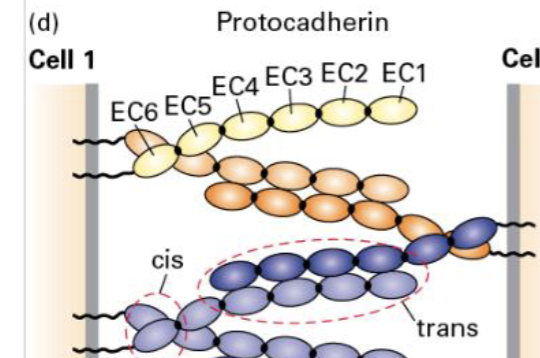
What are heterophilic and homophilic EC interactions
heterophilic - two different isoforms can binds together (yellow - orange)
homophilic - two idential isoforms can bind together (purple - dark purple)
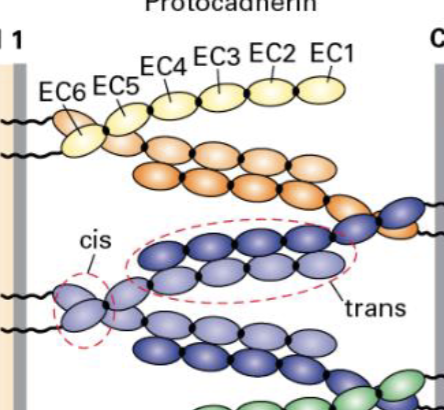
are cis interactions of protocadherin heterophillic or hopophilic
can be both
What is the role of the N-terminal amino acids of cadherins
participates in strand swapping between cadherin molecules and stabilitzes trans interactions.
Explain neuronal self-avoidance for dendrites and axons originating from the same neuron.
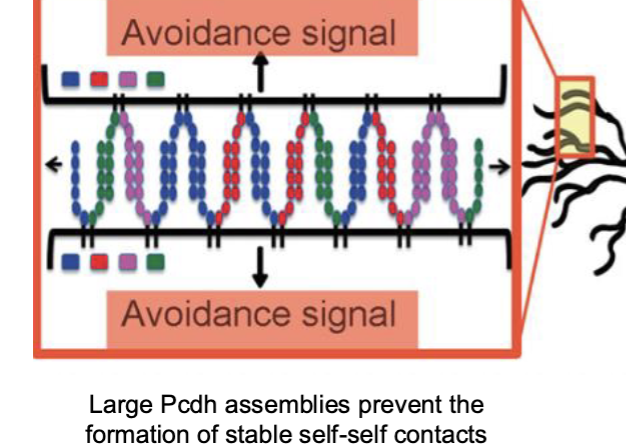
Trans homophillic interactions of pcdh (isoforms) of the branches causes a buildup of avoidance signal which signals branches of the same neuron to repel eachother.
Explain why branches from different neurons dont have avoidance
There is more interactions between mismatched pcdhs (non isoforms) across branches so there is no buildup of pcdh assemblies that allow for self-avoidance signaling.
What is the main components in adherins junctions (4)
classic cadherins, actin, catenins, under tension: reinforcement proteins (ena/vasp)
Compare classic cadherin to protocadherin
Classical cadherins build a mechanical, tension-bearing cell–cell grip across neighboring cells, whereas clustered protocadherins in neurons use isoform matching and assembly size to trigger a self-avoidance repulsion signal when a neuron's own branches touch
Explain how classic cadherins, actin, catenins work to create adherens junction
classic cadherins - interact extracellularly with its tail and EC domains to have cis/trans iteractions
catenin - binds to cadherin tail inside each cell + senses mechanical tension inside the cell
actin - binds to catenin-cadherin complex and transmits mechanical tension to help influence gene expression, delamination, proliferation, ect.
What are the transmembrane adhesion proteins in a desmosome, and what do they connect to?
Desmocollin and desmoglein are desmosomal cadherins and connect to eachother on different cells. connect to cytoplasmic plaque and intermediate filaments on the inside of each cell.

Compare the subunits of actin filament vs keratin intermediate filament
actin - G-actin acts as subunit to create F-actin, either bound to ATP or ADP
keratin intermediate filament - dimers are formed from 1 acidic and 1 basic subunit, no nucleotide binding
compare the main functions of actin filaments and keratin intermediate filaments
actin - Structure, movement, muscle contractions
keratin - Tissue strength and integrity. They have high tensile strength.
compare the polarity between actin filaments and keratin intermediate filaments
actin - Has a + and a - end which creates its intrinsic polarity
keratin - Does not have intrinsic polarity
compare the junction association between actin filaments and keratin intermediate filaments
actin - Associated with cadherins in adhesion junctions. Also associated with focal contacts through integrins.
keratin - Associated with desmosomes through desmosomal cadherins and hemidesmosomes through integrins
Compare stability of actin vs keratin intermediate filaments
actin - less stable and more dynamic bc of faster subunit exchange
keratin - more stable bc slower subunit exchange
compare eukaryotic conservation of actin vs keratin intermediate filament
actin - conserved in all eukaryotes
keratin - not all eykaryotes have
what are the subunits of microtubule, microfilaments, intermediate filaments
microtubule - alpha-beta tubulin
microfilaments - actin
intermediate filaments - variety of proteins
Are keratin IF dynamic
not completley frozen or static but more sturdy and rope like
What are 4 features of Actin and microtubulin that IF dont do
nucleating (starting new filament from individual subunits)
sequestering (binding to subunits to stop them from adding)
capping ( end capping)
filament severing proteins (things like cofilin to snap filaments)
What are the subunits for keratin IF specifically
dimers form from 1 acidic and 1 basic subunit
What are the two classes of keratin IFs
acidic and basic
where are keratin IF found in epithelial cell
connected to desmosomes
What is the function of keratin IF
tissue strength and integrity
What is the other class of IF that we discussed
lamins!
Where is the lamins found
around the edge of nucleus
what is the function of lamins
nuclear structure and organization
What are LINC complexes
Linker of Nucleoskeleton and Cytoskeleton. Inside of the nuclear membrane and spans the inner and outer nuclear membrane. connects to the outer nuclear things like microtubules, IF and Actin. Connects to inside nucleus nuclear lamina
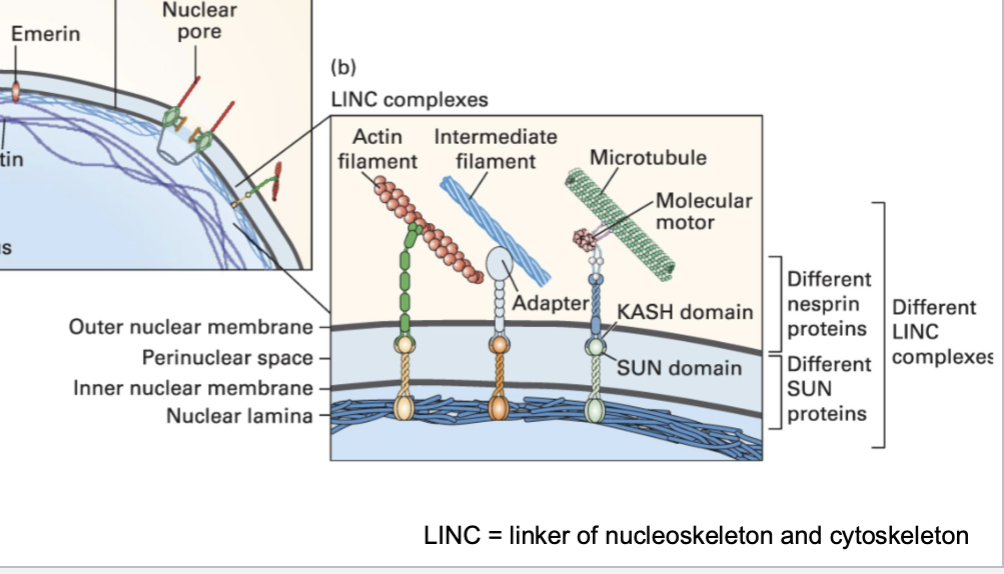
What are the key outermembrane LINC protein/domain (2)
KASh domain and nesprin proteins
What are the key inner membrane LINC protein/domain (2)
SUN domain, SUN proteins
what is a dominant negative protein
A dominant-negative protein is a mutated, non-functional protein that actively interferes with (poisons) the normal wild-type protein. brings down other proteins
what downstream changes are linked to lamina defects (2)
Changes in chromatin modifications (histone methylation and acetylation) and changes in gene expression.
function of tight junctions (2)
holds tissue together
barrier between inside and outside organism
draw epitilium with two cells including all the junctions + label polarity
hint: like 10 things

what specific barrier does tight junctions make + give an example
barrier that seals off body cavities
intestinal lumen
blood-brain barrier
where is tight junction usually in cell
apical side
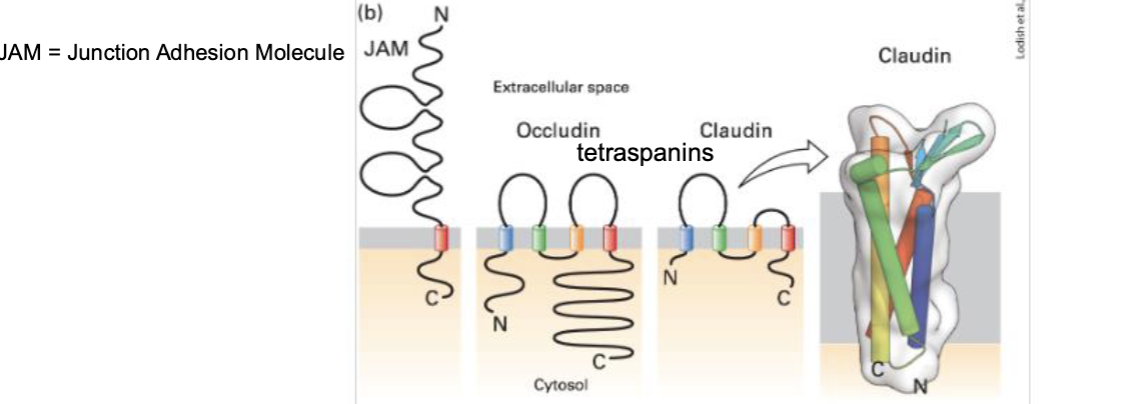
Which three main transmembrane protein families make up tight junctions
Claudins
occludin
JAM

What is JAM + what does it do
Junction Adhesion Molecule, N terminus interacts with other cell to cause cell-cell adhesion to form continuous sealing
How do ZO proteins and actin filaments interact with tight junctions?
ZO (Zonula Occludens) proteins act as intracellular scaffold/adaptor proteins that link tight junction transmembrane proteins to the actin filament cytoskeleton.
How do occludin and claudins differ in membrane-spanning topology from JAM?
Occludin and claudins span the membrane four times (forming two extracellular loops, tetraspanins), whereas JAM has a single transmembrane pass.
What is the difference between the paracellular pathway and the transcellular pathway across an epithelial sheet?
paracellular - passing between cells
transcellular - pass through cell themselves

What is the TJ barrier function and how is it regulated
Tight junctions control selective permeability across the paracellular space
permeability is regulated by GPCRs and cAMP-coupled pathways.
what is TJ fence function
The fence function restricts lateral diffusion/mixing of membrane components (helping maintain apical vs. basolateral polarity)
You got this: Explain how alpha-catenin can act as a mechanosensor in adheren junction (type of anchoring junction), what happens when a-catenin is put under tension, and then the consequences of its mechanosensing (2)
a-catenin acts as mechnosensor bc its structure is responsive to mechanical tension placed on the adheren junction
under tension —> a-catenin unfolds and streches
results in 1. conformational change so tigher binding to actin 2. unmasking of hidden binding sites that can recruit other proteins to junction
You have two cells, one that expresses a wild type form of Cadherin and another that expresses a mutant form with several amino acid substitutions at the N-terminus of Cadherin. Predict the consequence to adhesion between the two cells and explain your rationale in as much detail as possible.
The N-terminal amino acids of Cadherins participate in strand swapping between Cadherin molecules. Stabilizes trans-interactions.
I predict that the amino acid substitutions would prevent strand swapping but might not completely interfere with EC1-EC1 trans-interactions. This would depend on how many and which amino acids are substituted. If this is the case, then I would expect Cadherin-based adhesion between the two cells to be a least significantly weakened.
What is Progerin, and how does it act as a dominant negative against wild-type Lamin A?
Progerin is a truncated form of Lamin A that interferes with normal wild-type Lamin A function.
Step-by-step, how could Progerin disrupt intermediate filament assembly? (4)
Progerin can form dimers with Lamin A
form defective tetramers (due to missing part of the protein)
form abnormal protofilaments
result in defective intermediate filaments.
What are protofilaments
substrands of IF. 16 protofilaments make up an IF
Where is progerin localized to usually
nuclear envelope
What kind of adhesion is tight junction
cell-cell
What kind of adhesion is gap junctions
cell-cell
to review what is the adhesion types for anchoring, tight and gap junctions
Anchoring
Adherens and desmosomes —> cell-cell
hemidesmosomes and focal contacts —> cell-matrix
Tight —> cell-cell
Gap —> cell-cell
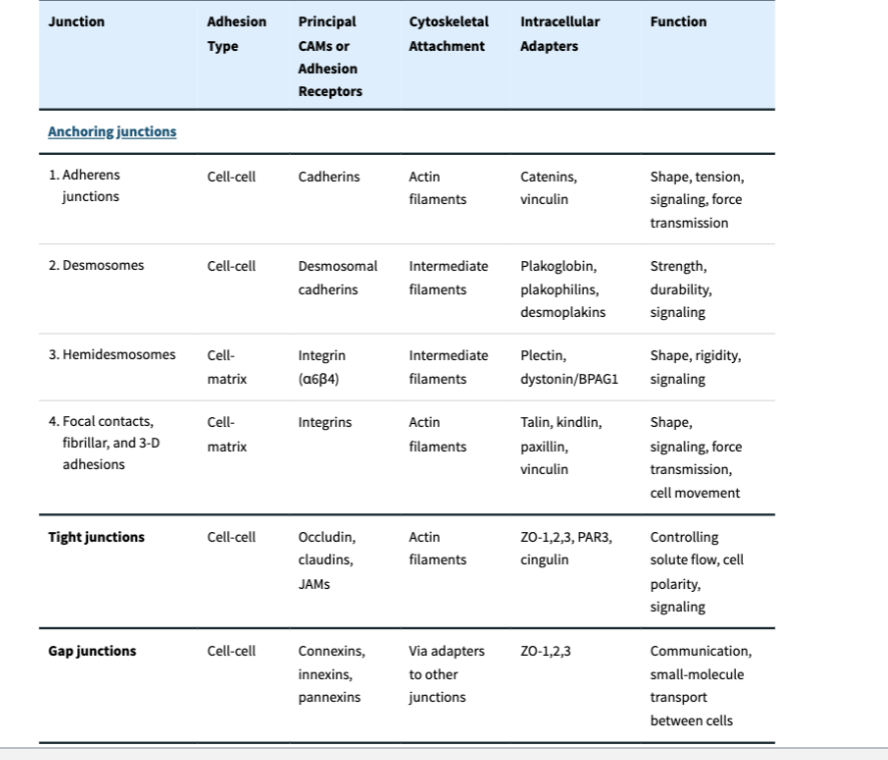
what is the principal CAM or adhesion receptors for tight junctions (3)
occulin, claudins, JAMs
What is the principal CAM or adhesion receptors for Gap junctions (3)
connexins, innexins, pannexins
What is the cytoskeletal attachment for tight and gap junctions
tight - actin filaments
gap - via adaptors to other junctions
What is the main function of gap junctions (2)
communication, small-molecule transport between cells
What are the main functions of tight junctions (3)
controlling solute flow
cell polarity
signaling
What is the makeup of a gap junction channel
a connexon hemichannel from each cell meet at the intercellular gap and form the gap junction channel
How many connexons form a hemichannel and how many form gap junction
6 in hemichanel
so 12 in gap junction
What four categories of substances can pass through gap junctions1
ions
Low MW precursors of cellular macromolecules
Metabolic products
Small signaling molecules
describe the structure of connexins and how they are oriented
4 transmembrane domains (TM1–TM4),
cytoplasmic N- and C-termini (including NTH and CTD),
1 intracellular loop (ICL),
2 extracellular loops (EC1 and EC2).

both N and C terminus is in cytoplasm and EC1 and EC2 stick out in extracellular space to bind
What are functions of gap junctions in neuronal networks
electrical synapse

What is the functional significance of gap junction in heartc
contributes to the electriclaly stimulated coordinated contraction of cardiac muscle cells when the heart beats
What are the 3 types of Extracellular Matrix protieins
proteoglycans
collagens
multi-adhesive matrix proteins
What are the 6 functions of the ECM
Anchoring cells & maintaining 3D tissue structure/boundaries
Determining biomechanical properties (stiffness, elasticity, porosity, shape)
Controlling cell polarity, survival, proliferation, differentiation, and fate
Inhibiting or facilitating cell migration (acting as a barrier or "track")
Binding/storing growth factors (forming gradients, acting as a co-receptor, or aiding receptor binding)
Activating cell-surface signaling receptors
What kind of development is ecm necesary for
skeletal development
Which cells synthesize most components of the basal lamina?
The cells that rest on it