Economics
 Call Kai
 Learn
Learn Practice Test
 Spaced Repetition
 Match
Match Flashcards
 Knowt Play
1/127

There's no tags or description
Looks like no tags are added yet.
Name | Mastery | Learn | Test | Matching | Spaced | Call with Kai | Chat |
|---|
No analytics yet
Send a link to your students to track their progress
128 Terms
Which of the following are examples of people responding to incentives according to their rational self-interest? (There may be more than one correct answer.)
Mike is offered $50 to wash a car. In response, he climbs a flagpole, then jumps off while singing "O Canada".
The wholesale price of strawberries goes from $5 per pound to $100 per pound due to a blight that kills many strawberry plants. Publix, a popular grocery store chain, responds to this price change by tripling their purchases of strawberries.
Aidan, tired of being made fun of because his parents gave him a fashionable name that very quickly became dated, has his name legally changed. He pays $40 in legal fees.
Anna has been playing a lot of DOTA2 in her spare time, and has become so good at it that she has been offered $70,000 a year to play for a professional team. She takes the job, dropping out of college.
When the price of water is zero, consumers use a large amount of water.
Aidan, tired of being made fun of because his parents gave him a fashionable name that very quickly became dated, has his name legally changed. He pays $40 in legal fees.
Anna has been playing a lot of DOTA2 in her spare time, and has become so good at it that she has been offered $70,000 a year to play for a professional team. She takes the job, dropping out of college.
Josephine teaches economics, and makes about $110,000 per year doing so. If she couldn't teach economics, she would be doing economic consulting for a major bank for $150,000 per year. If she couldn't work as an economic consultant, she would go back to school and study history. If she couldn't do that, she would stay at home and take care of the kids (her husband currently does this, but could go back to work if she couldn't find a job she liked).
Which of the following is Josephine's opportunity cost of teaching economics?
$110,000
Doing economic consulting.
Going back to school and studying history.
Staying home and taking care of the kids.
Doing economic consulting.

I have limited spare time, and I like to spend a lot of it reading books and listening to podcasts (particularly history podcasts). Sadly, I cannot do both at the same time. The graph below represents the number of books and podcast episodes that I could consume. The line is like a Production Possibility Frontier, though it would be more accurate to call it a Consumption Possibility Frontier.
Which of the following statements are correct? You may assume that I don't want to let any of my "media consumption time" go to waste--that is, I will always want to consume as much as I can.
I could listen to 12 podcasts and read 1 book each week.
I would be as happy as possible if I read 1 book and listened to 2 podcast episodes each week.
If I were to be assigned an extra class (which means a lot of extra work for me), I would now be able to consume 9 podcasts and 2 books each week.
I could listen to 7 podcasts and read 1 book each week.
I could listen to 7 podcasts and read 1 book each week.
José is an illegal immigrant from Guatemala. Emma is a well-paid web designer who hires José to do some remodeling on her house. She offers José $9,000, but she would have been willing to pay him $15,000 (because that's how much she values the remodeling). José accepts, but he would have been willing to do the work for $7,000 (because that is how much he would earn doing work on a different house).
What are the net gains to José and Emma that they get as a result of trading?
8000
You are working a job earning $15 per hour. By an amazing stroke of luck, you win $20 million by playing the lottery. Which of the following is most likely to occur?
(To be clear, I strongly recommend that you not play the play the lottery).
You work more hours at your job.
The number of hours you work stays the same.
You work fewer hours at your job.
Your employer cuts your wage because you do not need the money as badly now.
You work fewer hours at your job.

Below is the demand schedule for chicken feet, a dim sum delicacy served at some Chinese restaurants. Although some people find the texture strange, others have developed a taste for it in the past 10 years.
How many millions of pounds more of chicken feet were demanded in 2021, at 50 cents per pound, than in 2011? (Don't enter a bunch of zeroes for the millions; your answer should be simple, like 6.2, or 8.1.)
8.7

Below is the demand schedule for chicken feet (again). Based on the demand schedule, you conclude:
The demand curve shifted to the right.
The demand curve shifted to the left.
There was movement along the demand curve to the right.
There was movement along the demand curve to the left.
The demand curve shifted to the right.
When we say "an increase in demand" we mean that...
demand shifts to the right.
demand shifts to the left.
demand doesn't move; there's a movement along the curve.
none of the above.
demand shifts to the right.

Below is a supply curve for notebook paper. Use the supply curve to fill in the missing numbers in the table. Be careful to enter the quantities as whole numbers (1, 2, 3, 4, etc.) and the prices in the format 0.X0 (0.10, 0.20, 0.30, etc.).
Price per package of notebook paper ($) | Quantity of packages of notebook paper supplied (millions) |
0.10 | 1 |
0.20 | 3 |
0.40 | 5 |
0.70 | 7 |
1.00 | 8 |
Consider the demand curve for tennis balls (which people for all sorts of things, including as dog toys, pillow fluffers in clothes dryers and, of course, for playing tennis). Other things held constant, if the price of tennis balls goes from $0.29 each to $1.49 each, which of the following can we expect to happen?
There will be an increase in demand.
There will be a decrease in demand.
There will be an increase in quantity demanded.
There will be a decrease in quantity demanded.
There will be a decrease in quantity demanded.
Consider the supply curve for tennis balls. Other things held constant, if the price of tennis balls goes up from $0.29 to $1.49, what can we expect from suppliers of tennis balls as a result?
There will be an increase in supply.
There will be an increase in quantity supplied.
The quantity supplied will not change.
There will be a decrease in quantity supplied.
There will be an increase in quantity supplied.
Madison Social distributes coupons for their t-shirts. These coupons reduce the price of a t-shirt by $10. What happens to the quantity of Madison Social t-shirts demanded?
Quantity demanded rises.
Quantity demanded falls.
Quantity demanded stays the same.
Quantity demanded rises, then falls.
Quantity demanded rises.
Consider the demand for licensed electricians (who are hired to work on construction sites and repairs). Suppose the salary of a licensed electrician rises from $50,000 per year to $65,000 per year. What happens to the quantity of licensed electricians that construction businesses hire?
Quantity demanded rises.
Quantity demanded falls.
Quantity demanded stays the same.
Quantity demanded rises, then falls.
Quantity demanded falls.
Apple Music offers a special deal: buy a two year subscription for the price of one year. What happens to the quantity of subscriptions demanded?
Quantity demanded rises.
Quantity demanded falls.
Quantity demanded stays the same.
Quantity demanded falls, then rises.
Quantity demanded rises.
The price of Coca-Cola stays at 5 cents per bottle all year. What happens to the quantity of Coca-Cola bottles demanded?
Quantity demanded rises.
Quantity demanded falls.
Quantity demanded stays the same.
Quantity demanded rises, then falls.
Quantity demanded stays the same.
Andrew, a college student, loves drinking coffee late at night to study for exams. Having no income, he is used to buying cheap bad tasting coffee, such as Beanlightened, that he needs to grind and brew himself. The coffee tastes putrid but, with enough cream and sugar, Andrew is able to tolerate it. Occasionally, he does go out to Starbucks when he has spare money. After graduation, Andrew gets a job working at a database firm as a programmer. His income is now a healthy $75,000 a year and he decides he's had enough bad tasting coffee. He ends up buying coffee daily from Starbucks even though it costs significantly more than Beanlightened.
Match each sentence beginning below with the phrase that ends it best.
In economic terms, Starbucks coffee is a(n)
In economics terms, Beanlightened coffee is a(n)
Andrew’s demand for Starbucks coffee changed as a result of a(n)
In economic terms, coffee and creamer (or half-and-half, or whatever you prefer) are usually considered
In economic terms, Starbucks coffee is a(n)
normal good.
In economics terms, Beanlightened coffee is a(n)
inferior good.
Andrew’s demand for Starbucks coffee changed as a result of a(n)
change in income.
In economic terms, coffee and creamer (or half-and-half, or whatever you prefer) are usually considered
complements.
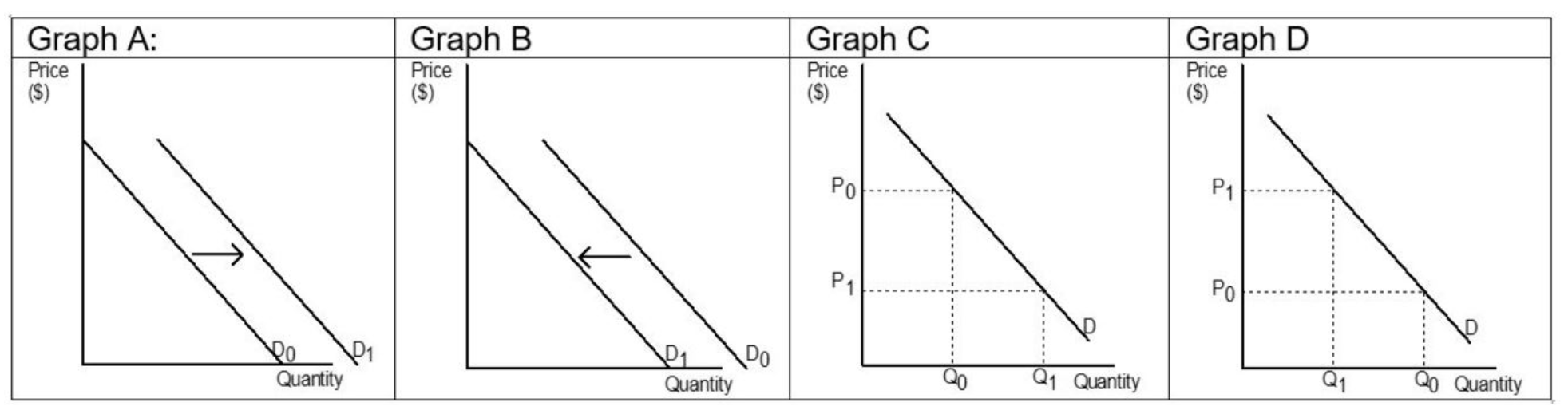
The graphs below depict demand curves for ramen noodles. For each scenario below, select a graph that best describes the situation. Note that it is possible a graph might be used twice, or not used at all!
Droves of college students funnel into their respective college towns after summer vacation.
After the first few months of college, students grow to detest ramen.
The price of ramen increases.
The price of ramen decreases.
Droves of college students funnel into their respective college towns after summer vacation.
Graph A
After the first few months of college, students grow to detest ramen.
Graph B
The price of ramen increases.
Graph D
The price of ramen decreases.
Graph C
Select which of the following scenarios describe a shift in the supply curve (and NOT a movement along the supply curve).
After discovering that flash steaming tuna first, before using mechanical processes to extract meat, removes more tuna flesh, more cans of tuna hit the shelves at all major grocers.
As a result of an increase in wages for licensed electricians, licensed electricians all try to work longer hours.
Grocers are selling more gluten free pasta than ever before, and the price of gluten free pasta has risen substantially.
A national consumer products company produces less of its premium quality soap as a result of lower soap prices.
Americans put up their gold and silver jewelry for sale as a result of rising prices.
Amplitude, a new company, decides to join the smartphone market.

Each graph below shows the supply of textbooks. For each scenario below, select which graph best describes the situation. Note that it is possible a graph might be used twice, or not used at all!
The printing press is invented.
The cost of paper, an input for textbooks, increases.
The price of textbooks falls.
ABC textbook company shuts down, removing the 5th biggest textbook provider from the market.
The printing press is invented.
Graph A
The cost of paper, an input for textbooks, increases.
Graph B
The price of textbooks falls.
Graph D
ABC textbook company shuts down, removing the 5th biggest textbook provider from the market.
Graph B
Match each of the events below with a shift in supply or a movement along the supply curve.
Better weather increases crop yields for broccoli farmers.
Workers who supply labor respond to an increase in the wage they are paid.
New safety regulations require cars to include expensive new equipment.
Farmers who produce and sell wheat respond to a decrease in the price of the wheat.
Better weather increases crop yields for broccoli farmers.
Supply shifts to the right.
Workers who supply labor respond to an increase in the wage they are paid.
Quantity supplied rises
New safety regulations require cars to include expensive new equipment.
Supply shifts to the left
Farmers who produce and sell wheat respond to a decrease in the price of the wheat.
Quantity supplied falls
Some people feed their pets moist food, while others feed them dry food (also known as "kibble"), and some people feed them both moist and dry food.
Suppose the price of moist pet food goes up due to a decrease in the supply of moist pet food. Which of the following will occur in the market for dry pet food?
price rises, quantity falls
price falls, quantity falls
price falls, quantity rises
price rises, quantity rises
price rises, quantity rises
Suppose that a vacation at Disney World, Universal Studios, and similar theme parks and resorts is a normal good. If a recession occurs and incomes generally fall, which of the following would you expect to happen?
price falls, quantity falls
price rises, quantity falls
price falls, quantity rises
price rises, quantity rises
price falls, quantity falls
Consider the market for gasoline. Suppose a hurricane is approaching, and people are concerned that they might lose power, or that gas stations might not have enough gasoline after the hurricane strikes. Which of the following is correct?
Expectations cause people to buy less gasoline now. The price of gasoline falls now, and people buy less gasoline.
Expectations cause people to buy more gasoline now. The price of gasoline rises now, and people buy more gasoline.
People try to buy more gasoline, driving up the price, but governments produce more gasoline, pushing the price back down.
Governments impose laws that prohibit price increases, so that people can buy as much gasoline as they want with no change in price.
Expectations cause people to buy more gasoline now. The price of gasoline rises now, and people buy more gasoline.
Suppose the market for broccoli is in equilibrium. Which of the following changes would cause the price of broccoli to decrease?
a decrease in demand
an increase in supply
an increase in demand
a decrease in supply
a decrease in demand
an increase in supply
Suppose the market for desktop computers is in equilibrium. Intel develops a new process for producing computer chips which does not improve performance, but does allow more chips to be produced at a lower cost. What happens to the equilibrium price and quantity?
Price rises, quantity falls.
Price rises, quantity rises.
Price falls, quantity falls.
Price falls, quantity rises.
Price rises, quantity is indeterminate.
Price falls, quantity is indeterminate.
Price is indeterminate, quantity rises.
Price is indeterminate, quantity falls.
None of the above.
Price falls, quantity rises.
Suppose the market for tequila is in equilibrium, but then two things happen simultaneously. First, a new mixed drink using tequila, known as a “Fancy Spindiffilizer”, sweeps the country. Second, an earthquake in Mexico damages several tequila production facilities. What happens to the equilibrium price and quantity of Tequila?
Price rises, quantity falls.
Price rises, quantity rises.
Price falls, quantity falls.
Price falls, quantity rises.
Price rises, quantity is indeterminate.
Price falls, quantity is indeterminate.
Price is indeterminate, quantity rises.
Price is indeterminate, quantity falls.
None of the above.
Price rises, quantity is indeterminate.
Suppose the market for bread is in equilibrium. Two things then happen at the same time: Warmer-than-usual weather results in a larger harvest of wheat (which is used to make bread), and a new diet, known as the Anti-Atkins-Anti-Paleo diet sweeps the country, encouraging everyone to eat more bread. What happens to the equilibrium price and quantity of bread?
Price rises, quantity falls.
Price rises, quantity rises.
Price falls, quantity falls.
Price falls, quantity rises.
Price rises, quantity is indeterminate.
Price falls, quantity is indeterminate.
Price is indeterminate, quantity rises.
Price is indeterminate, quantity falls.
None of the above.
Price is indeterminate, quantity rises.
Equilibrium occurs when...
the government sets a price at the level that makes consumers as happy as possible.
the government sets a price at the level that makes producers as happy as possible.
firms negotiate a quantity with each other that will cause the price to be the same across all producers.
the price of a good or service is at just the right level to cause the quantity supplied to equal the quantity demanded.
the price of a good or service is at just the right level to cause the quantity supplied to equal the quantity demanded.
If demand shifts, then...
price and quantity will both increase or both decrease.
price and quantity will move in opposite directions.
The direction of change for price and quantity cannot be predicted without more information about supply.
none of the above
price and quantity will both increase or both decrease.
If supply shifts, then...
price and quantity will both increase or both decrease.
price and quantity will move in opposite directions.
The direction of change for price and quantity cannot be predicted without more information about supply.
none of the above
price and quantity will move in opposite directions.
Suppose the government places a tax on caskets, paid for by the buyers (i.e. the family of the deceased). Which of the following will occur?
Remember that the price here is what the buyer pays the seller. It doesn't include the tax itself; that's paid to the government.
price rises, quantity falls
price falls, quantity rises
price rises, quantity rises
price falls, quantity falls
price falls, quantity falls
Suppose the government places a tax on caskets, paid for by the sellers (i.e. the funeral home or the company that produced the casket). Which of the following will occur?
Remember here that the price here is what the buyer pays the seller. In this case, the tax is hidden inside the price, as you'll see if you draw the graph.
price rises, quantity falls
price falls, quantity rises
price rises, quantity rises
price falls, quantity falls
price rises, quantity falls
A tax on consumers shifts demand to the _____, and a tax on producers shifts supply to the _____. (fill in the blanks)
left; right
left; left
right; left
right; right
left; left
Suppose the graph below represents the labor market for low-wage workers.

A minimum wage of $14 per hour is being considered. If imposed, the minimum wage will result in a __________ of _________ workers. (fill in the blanks)
shortage, 2 million
surplus, 4 million
shortage, 4 million
surplus, 6 million
surplus, 4 million
Suppose that the city of Lethbridge decrees that all restaurants located within a 15 mile radius of the University of Lethbridge can charge no more than $1 a meal so that college students can eat out economically. Which of the following is NOT a likely result of this price ceiling?
People will waste time standing outside long lines to camp for food.
Some restaurants will choose to secretly sell meals at $5 each to consumers who are willing to pay this higher price.
The portion sizes and quality at the finest dining establishments at Lethbridge will decrease significantly.
There will be food surpluses at many of the restaurants as quantity supplied exceeds quantity demanded at a price of $1 per meal.
There will be food surpluses at many of the restaurants as quantity supplied exceeds quantity demanded at a price of $1 per meal.
Suppose that the city of Halifax decrees that all restaurants located within a 15 mile radius of the University of Halifax must charge at least $10 a meal so that college students can become more refined in their dining. What is a likely result of this price floor? (Note that the last problem asked you which was not likely; this one asks which one is likely.)
There will be a surplus of food at many of the restaurants as quantity supplied exceeds quantity demanded at a price of $15 per meal.
The price floor will make restaurants more efficient by limiting their menu to just the demands of students, which results in less food waste.
Fewer meals will be sold than if Halifax had established a price ceiling.
Some restaurants like Le Cordon Bleu will switch to selling simple baloney sandwiches at $15 a sandwich instead of the fancy rustic chicken and imported cheese paninis they sold at $10 per sandwich.
There will be a surplus of food at many of the restaurants as quantity supplied exceeds quantity demanded at a price of $15 per meal.
The year is 1779 in Iceland. Light sources, such as oil lamps, are precious commodities (as harnessed electricity is not yet available, and the nights are long for much of the year). The government wants to intervene in the pricing of oil lamps so that its citizens don't pay outrageous amounts of money for lighting. The currency used in Iceland at the time was the Rigsdaler. Below is a graph depicting Iceland's hypothetical supply and demand for oil lamps.

If Iceland’s governor chooses to set a price ceiling of 40 Rigsdaler for an oil lamp, what will occur?
There will be a surplus of oil lamps.
The equilibrium price of an oil lamp will change.
Nothing will change.
There will be a shortage of oil lamps.
Nothing will change.
The graph below shows the market for corn with a price ceiling of $6 per bushel.

After the ceiling is in place, how many bushels of corn are bought and sold?
7 bushels.
5 bushels.
3 bushels.
4 bushels.
3 bushels.
The graph below shows the market for corn with a price ceiling of $6 per bushel.

The market is not in equilibrium after the price ceiling is imposed. Rather, there is a _______ of ______ million bushels.
surplus, 4
shortage, 4
shortage, 7
surplus, 7
shortage, 4
In the neighborhood of Sesame Street, cookies are in particularly high demand. The demand is, in fact, so great that prices for cookies are skyrocketing, and average citizens can no longer obtain this staple food. The government is considering a price control to keep cookies affordable for its citizens.
Which kind of price control is the government considering?
price ceiling
ad valorem tax
excise tax
price floor
price ceiling
Which of the following is a possible effect of a binding price ceiling on housing?
Housing prices are lower than they would be in equilibrium.
There will be fewer people seeking housing but unable to find it than in equilibrium.
Housing becomes more abundant than it would be in equilibrium.
Housing quality improves compared to what would be available in equilibrium.
Housing prices are lower than they would be in equilibrium.
Suppose the market price of strawberries is $26 per pound, and a law is passed setting the price at exactly $26 per pound. Which of the following best describes the effect of this law?
Nothing will happen for now, but when supply or demand shift a surplus or shortage of strawberries will occur.
The price of strawberries will rise.
A shortage of strawberries will occur.
A surplus of strawberries will occur.
The price of strawberries will fall.
Nothing will happen for now, but when supply or demand shift a surplus or shortage of strawberries will occur.
If a good has an elasticity of demand of 0.95, it means that...
If price rises by 1%, quantity demanded rises by 0.95%.
If price rises by 1%, quantity demanded falls by 0.95%.
If price rises by 95%, quantity demanded falls by 100%
If price rises by $1, quantity demanded falls by 95 units.
If price rises by 1%, quantity demanded falls by 0.95%.
Which of the following goods is most likely to have a high (i.e. greater than 1) elasticity of supply?
housing in notoriously over-regulated San Francisco
Concert tickets for a popular artist who is already performing 300 shows this year.
mass-produced cloth
water that bubbles up from a natural spring
mass-produced cloth
Which of the following goods is most likely to have a high (i.e. less than -1, or greater than 1 in absolute value) elasticity of demand.
life-saving medication
a particular brand of clothing
coffee
gasoline
a particular brand of clothing
"Elastic" means...
vertical.
responsive.
not responsive.
easy-to-calculate.
responsive.
Which of the following is correct?
Given two demand curves that pass through the same point, the flatter one is more inelastic.
Given two supply curves that pass through the same point, the thicker one is more elastic.
Given two demand curves that pass through the same point, the flatter one is more elastic.
Given two supply curves that pass through the same point, the steeper one is more elastic.
Given two demand curves that pass through the same point, the flatter one is more elastic.
If a good has an elasticity of supply of 0.25, it means that...
If quantity supplied rises by 0.25%, price rises by 100%.
If price rises by 1%, quantity supplied rises by 0.25%.
If quantity supplied rises by 25%, price rises by 1%.
If price rises by 25%, quantity demanded falls by 25%.
If price rises by 1%, quantity supplied rises by 0.25%.
Elasticity of demand (or more accurately, own-price elasticity of demand) is...
a measure of the stretch coefficient of a dollar bill.
a measure of how much price changes relative to a change in quantity demanded.
a measure of how much quantity demanded responds relative to a price change.
a measure of the slope of the demand curve.
a measure of how much quantity demanded responds relative to a price change.
Elasticity of supply (or price elasticity of supply) is...
a measure of how much output changes relative to a change in inputs used.
a measure of how much price changes relative to a change in quantity supplied.
a measure of the slope of the supply curve.
a measure of how much quantity supplied responds relative to a price change.
a measure of how much quantity supplied responds relative to a price change.
Consumer surplus is
the difference between what consumers are willing to pay and what they actually pay.
the triangle-shaped area between the height of the demand curve and the price.
a measure of the net gain to consumers from buying goods and services.
all of the above
all of the above
Suppose the government proposes a $100 per phone tax on smartphones, arguing that the producers of smartphones can easily afford to pay it. An economist would respond that…
because smartphone demand is completely elastic, producers will likely bear all the burden of the tax.
consumers will end up paying some of the tax, because the burden of a tax is not determined by the legal assignment of the tax.
taxes are used to fund important public services.
there is never a good argument in favor of taxes.
consumers will end up paying some of the tax, because the burden of a tax is not determined by the legal assignment of the tax.

This tax has been legally placed on...
consumers
producers
both consumers and producers
government
producers
Which of the following statements is correct?
Binding price ceilings create shortages, binding price floors create surpluses, and taxes reduce the equilibrium quantity.
Binding price ceilings create surpluses, binding price floors create shortages, and taxes increase equilibrium quantity.
Binding price ceilings create shortages, non-binding price floors create surpluses, and taxes reduce the equilibrium quantity.
Taxes create shortages, price ceilings create shortages, and price floors reduce the equilibrium quantity.
Binding price ceilings create shortages, binding price floors create surpluses, and taxes reduce the equilibrium quantity.
The graph below shows the effect of a tax.

This tax has been legally placed on...
consumers.
producers.
both consumers and producers.
government.
consumers
The graph below shows a tax.

This tax has been legally placed on...
consumers
producers
both consumers and producers
government
producers
Match the descriptions below with the appropriate term.
Price Ceiling
Equilibrium
Price Floor
Consumer Surplus
Match the descriptions below with the appropriate term.
Price Ceiling
Government making it illegal to charge a price above a certain threshold.
Equilibrium
The condition that occurs when the price is at just the right level to cause the quantity demanded to equal the quantity supplied.
Price Floor
Government making it illegal to charge a price below a certain level.
Consumer Surplus
The difference between what a person is willing to pay for a good, and what they actually pay.
Suppose the government places a tax on buyers of bananas. The elasticity of demand for bananas is 1.2, and the elasticity of supply for bananas is 0.73. Which of the following is correct?
Consumers will bear more of the burden of the tax because demand is more inelastic than supply.
Producers will bear more of the burden of the tax because supply is more elastic than demand.
Consumers will bear more of the burden of the tax because demand is more elastic than supply.
Producers will bear more of the burden of the tax because supply is more inelastic than demand.
Producers will bear more of the burden of the tax because supply is more inelastic than demand.
In terms of total surplus (also called economic surplus), the effect of a tax is...
it reduces consumer and producer surplus, causing deadweight loss.
it increases consumer and producer surplus.
it reduces consumer surplus but increases producer surplus.
it reduces producer surplus but increases consumer surplus.
It reduces consumer and producer surplus, causing deadweight loss.
Congressman Jerk McStupidface suggests a new tax on airline tickets bought at the last minute. Thinking about people who buy airline tickets at the last minute, airlines who sell them, and the way that affects pricing currently, you can conclude that the burden of this tax is likely to fall more heavily on…
airlines.
last-minute buyers of airline tickets.
passengers who buy airline tickets far in advance.
whomever the tax is legally assigned.
last-minute buyers of airline tickets.
Producer surplus is
the difference between what producers are paid and their marginal cost of producing goods or services.
the triangle-shaped area between the price and the height of the supply curve.
a measure of the net gain to producers from selling goods and services.
all of the above
all of the above
In equilibrium Total Surplus (also called Economic Surplus) is...
minimized.
maximized.
transferred from producers to consumers.
collected by the government as tax revenue.
maximized.
A binding price ceiling or floor...
causes total surplus to rise.
causes deadweight loss.
causes tax revenue to rise.
all of the above
causes deadweight loss
Suppose the market price of strawberries is $26 per pound, and a law is passed setting the price at exactly $26 per pound. Which of the following best describes the effect of this law?
The price of strawberries will fall.
A shortage of strawberries will occur.
Nothing will happen for now, but when supply or demand shift a surplus or shortage of strawberries will occur.
The price of strawberries will rise.
A surplus of strawberries will occur.
Nothing will happen for now, but when supply or demand shift a surplus or shortage of strawberries will occur.
Market Failure refers to...
the dissatisfaction people sometimes feel regarding their jobs.
a situation in which equilibrium in a market results in deadweight loss, as a result of too many or too few transactions taking place.
an increase in the price of an important good, which angers consumers.
a situation in which government policymakers impose a policy without understanding its effect on a market.
a situation in which equilibrium in a market results in deadweight loss, as a result of too many or too few transactions taking place.
A positive externality exists when...
buyers and sellers do not bear the full costs of their actions, so they do too much of a harmful thing.
buyers and sellers do not bear the full costs of their actions, so they do too little of a harmful thing.
buyers and sellers do not enjoy the full benefits of their actions, so they do too much of a beneficial thing.
buyers and sellers do not enjoy the full benefits of their actions, so they do too little of a beneficial thing.
buyers and sellers do not enjoy the full benefits of their actions, so they do too little of a beneficial thing.
To qualify as a public good, a good must have two characteristics. They are:
nonrivalrous
produced by the government
funded by tax revenue
nonexcludable
nonrivalrous, non excludable
Sulfur Dioxide pollution is emitted from a power plant in Kentucky, and drifts on the wind into Canada, where it causes acid rain to fall, damaging buildings and forests. This is an example of…
a positive externality.
lack of competition.
a negative externality.
a public good.
a negative externality.
Sulfur Dioxide pollution is emitted from a power plant in Kentucky, and drifts on the wind into the upper atmosphere, where it blocks some sunlight and slows down climate change. As a result, sea levels rise more slowly, desertification happens more slowly, and the costs of climate change are generally pushed off further into the future. When it comes to these beneficial effects, this is an example of...
a negative externality.
a positive externality.
a tragedy of the anticommons.
lack of competition.
a positive externality.
Consider the light from a lighthouse. Lighthouses shine light over bodies of water, so that ships do not run aground on reefs, shoals, sandbars, other dangers at sea. A ship that can see the light does not reduce the ability of other ships to see the light, and a crew that hasn’t paid the lighthouse operator can’t be excluded from seeing the light—anyone near the lighthouse can see the light. One could therefore argue that a lighthouse is an example of a…
negative externality
public good.
deadweight loss.
tragedy of the commons.
public good
Back in the days before it was easy to lock down computers so that users couldn't screw them up, computers in computer labs tended to quickly be infected with viruses, spyware, and unnecessary programs. The failure of users to take care of these computers is an example of…
a public good.
lack of competition.
a positive externality.
the tragedy of the commons.
the tragedy of the commons.
If you get vaccinated against polio, COVID19, the flu, measles, chicken pox, and other contagious diseases, you protect yourself, but you also protect other people (to varying degrees depending on the disease). Some people nonetheless choose not to get vaccinated, usually because of conspiracy theories about vaccines, or because they do not want to go to the time and trouble to get vaccinated (instead relying on the protection provided by others being vaccinated). This results in more people being infected.
The market failure that best describes vaccination is...
Tragedy of the Commons
Tragedy of the Anticommons
Positive Externality
Government Subsidy
Positive Externality
AT&T, originally American Telephone and Telegraph, gradually gained more and more market share, particularly in long distance service, in the late 19th century. It did so by using patents (which it got from Alexander Graham Bell) to keep competitors from developing similar technology, and this worked until those patents began to expire. At that point other firms began to enter the market to compete, but AT&T aggressively bought some of these firms, which brought government scrutiny. In 1913 the government reached an agreement with AT&T: The company could not buy a phone company without also selling one. Instead of encouraging competition, however, this led to AT&T making deals with local phone companies to divide the country into territories over which AT&T or the local companies would have exclusive control. AT&T maintained complete and exclusive control over the wires that connected these local networks (this was called "long distance" service). This, combined with government-imposed prices, prevented competition from appearing in the telephone service markets.
What kind of market failure best fits AT&T?
tragedy of the anticommon
negative externality
public good
monopoly/lack of competition
monopoly/lack of competition
Match each market failure with a government policy that might be able to address the problem. (Of course, it is not guaranteed that the government will get it right.)
Public Good
Monopoly/Lack of Competition
The Tragedy of the Commons
Negative Externality
Public Good
Taxes are collected, and the revenue is used to provide a good that the market cannot provide.
Monopoly/Lack of Competition
Antitrust policy used to break up big firms or prevent big firms from merging or buying other firms.
The Tragedy of the Commons
Privatize the overused resource, or if that is not possible, try to simulate private property using tradeable permits
Negative Externality
Pigovian taxes on the harmful activity.
Azir works the night shift and sleeps in his apartment during the day. Unfortunately, his neighbors are active during the day, and they make a lot of noise walking on the creaky floors, going up and down stairs, playing loud music, and playing with their kids outside. Azir has an idea: he can pay them all to be quiet when he's trying to sleep. He offers the residents of each of the ten nearby apartments $100 per week--a total of $1,000 to try to keep the noise down. This is worth $2,000 to Azir. The cost to the residents of the apartments is $50 per week in inconvenience, so the deal provides a net gain to Azir, and a net gain for the other residents.
His neighbors are open to the idea, but one of them has an epiphany, and privately demands $250 instead of $100. There's still a net gain for Azir, so he agrees--but then the other residents somehow find out about this secret deal, and they all start asking for $250.
Which of the following is correct?
It's not worthwhile for Azir to pay each apartment $250 per month. Azir has encountered the Tragedy of the Anticommons.
It's worthwhile for Azir to pay each apartment $250 per month, so the area remains quiet.
It's not worthwhile for Azir to pay each apartment $250 per month. Azir has encountered the Public Good problem.
It's not worthwhile for Azir to pay each apartment $250 per month. Azir has encountered a positive externality
It’s not worthwhile for Azir to pay each apartment $250 per month. Azir has encountered the Tragedy of the Anticommons.
Information problems arise because...
everyone has the same information, but differing interpretations of it.
some people have important information that others lack, and the people with the information have no incentive to reveal it to people who would benefit from it.
governments classify too much information.
all of the above.
some people have important information that others lack, and the people with the information have no incentive to reveal it to people who would benefit from it.
Scarcity
The foundational economic condition where human wants exceed the limited resources available to satisfy them.
Choice & Opportunity Cost
Choice is the selection of one alternative over others. Opportunity Cost is the value of the next-best alternative given up when a choice is made.
Incentives
Rewards or penalties (financial or non-financial) that motivate individuals or firms to act in a specific way.
Rational Self-Interest
The foundational economic assumption that decision-makers weigh expected costs against benefits and choose options that maximize their personal net satisfaction.
Positive vs. Normative Economics
Positive economics focuses on objective, testable statements describing "what is." Normative economics involves subjective value judgments about "what ought to be."
Thinking on the Margin
Making decisions by evaluating incremental adjustments—weighing the additional (marginal) benefit against the additional (marginal) cost of one more unit.
Simple Trade (Voluntary Exchange)
A transaction between consenting parties that creates economic value because both sides expect to be better off.
Production Possibilities Frontier (PPF)
A graphical model showing the maximum output combinations of two goods an economy can produce given fixed resources and technology.
Comparative Advantage & Specialization
Comparative advantage is the ability to produce a good at a lower opportunity cost than another producer. Specialization occurs when an individual, firm, or country concentrates production on goods where they hold a comparative advantage.
Terms of Trade
The relative rate or price ratio at which two goods or services are exchanged between trading partners.
Marginal Decision Making MB=MC
The principle that net economic benefit is maximized when an activity is expanded until Marginal Benefit equals Marginal Cost.
Law of Demand
Ceteris paribus (holding all else constant), as the price of a good rises, the quantity demanded falls (an inverse relationship).
Demand Schedule & Demand Function
A demand schedule is a table showing the quantity demanded at various prices. A demand function is a mathematical equation representing this relationship.
Change in Demand vs. Change in Quantity Demanded
A change in quantity demanded is a movement along a fixed demand curve caused solely by a change in the good's price. A change in demand is a shift of the entire curve caused by non-price factors.
Shifters of Demand
Determinants that shift the demand curve, including consumer income (normal vs. inferior goods), prices of related goods (substitutes vs. complements), buyer tastes/demographics, and future expectations.
Market Demand
The horizontal summation of all individual consumer demand curves in a market.
Height of Demand Curve
Indicates the marginal benefit or maximum willingness to pay of consumers for that specific unit.
Law of Supply
Ceteris paribus, as the price of a good rises, the quantity supplied increases (a direct relationship).
Supply Schedule & Supply Function
A supply schedule is a tabular list of quantities supplied at various prices; a supply function is the algebraic representation.
Change in Supply vs. Change in Quantity Supplie
A change in quantity supplied is a movement along the curve due to a price change. A change in supply is a shift of the entire supply curve caused by non-price determinants.
Shifters of Supply
Determinants including input/resource prices, production technology, the number of sellers, government taxes/subsidies, and producer expectations.
Market Supply
The horizontal summation of individual firm supply curves across the entire market.
Height of Supply Curve
Indicates the marginal cost or minimum acceptable price for producers to supply that specific unit.
Market Equilibrium
The price and quantity point where quantity demanded equals quantity supplied Qd = Qs