Cell transport
 Call Kai
 Learn
Learn Practice Test
 Spaced Repetition
 Match
Match Flashcards
 Knowt Play
1/32

There's no tags or description
Looks like no tags are added yet.
Name | Mastery | Learn | Test | Matching | Spaced | Call with Kai | Chat |
|---|
No analytics yet
Send a link to your students to track their progress
33 Terms
What is the function of the cell membrane?
To control what substances can enter & leave the cell
Why is the cell membrane called a fluid mosaic model?
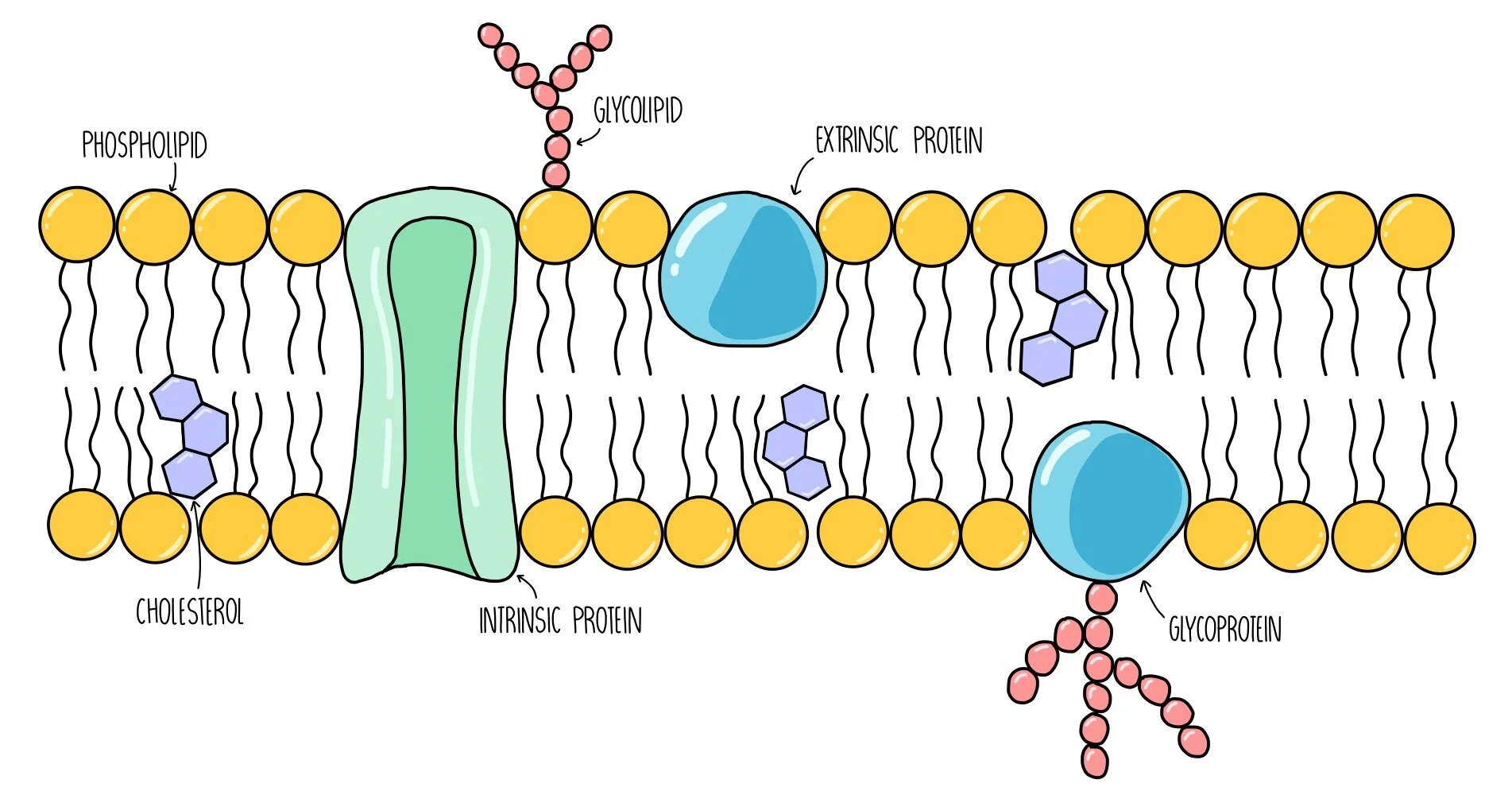
Due to the mixture & sideways movement of the phospholipids, proteins, glycoproteins & glycolipids it is made of

How do the phospholipids arranged themselves?
In a phospholipid bilayer:
the hydrophilic, polar phosphate heads face outwards towards the water (aqueous environment)
the hydrophobic, non-polar fatty acid tails face inwards towards each other
they’re amphipathic
What is the difference between integral/intrinsic & peripheral/extrinsic proteins?
Integral/intrinsic proteins: span from one side of the phospholipid bilayer to the other
Peripheral/extrinsic proteins: sit on one of the surfaces of the phospholipid bilayer

What is the function of integral/intrinsic & peripheral/extrinsic proteins?
Integral/intrinsic proteins:
protein carriers/channel proteins involved in the transport of molecules across the membrane
Peripheral/extrinsic proteins:
provide mechanical support, or are connected to proteins/lipids to make glycoproteins/glycolipids
cell recognition, as receptors
What is the function of cholesterol in the cell membrane?
Restricts the sideways movement of other molecules in the membrane
Makes the membrane less fluid at higher temperatures & prevents water/dissolved ions leaking out of the cell (maintains membrane fluidity)
What are enzyme proteins?
Catalyse reactions in the cytoplasm or outside the cell (e.g. maltase in the small intestine)
What is the difference between glycoproteins & glycolipids?
Glycoproteins: proteins with carbohydrates attached
Glycolipids: lipids with carbohydrates attached
What are the four key types of transport?
Simple diffusion (i.e. lipid diffusion)
Facilitated diffusion
Active transport
Osmosis
What is simple diffusion?
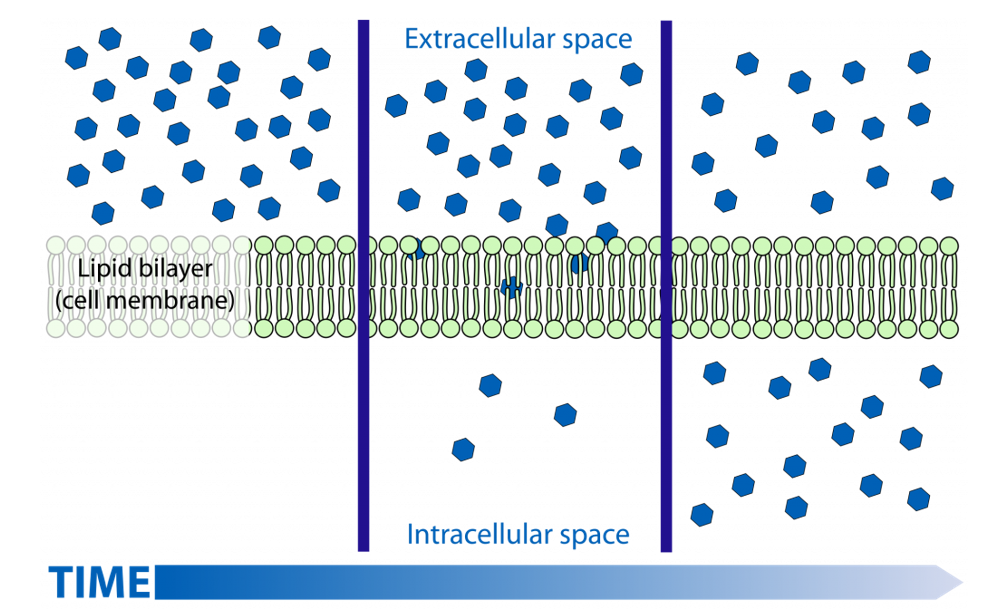
The net movement of molecules/ions from a region of higher concentration to a region of lower concentration until equilibrium is reached (doesn’t require ATP)
What is a requirement of molecules in simple diffusion?
They must be lipid-soluble, small & non-polar (e.g. steroid hormones, O2 & CO2)
What is facilitated diffusion?
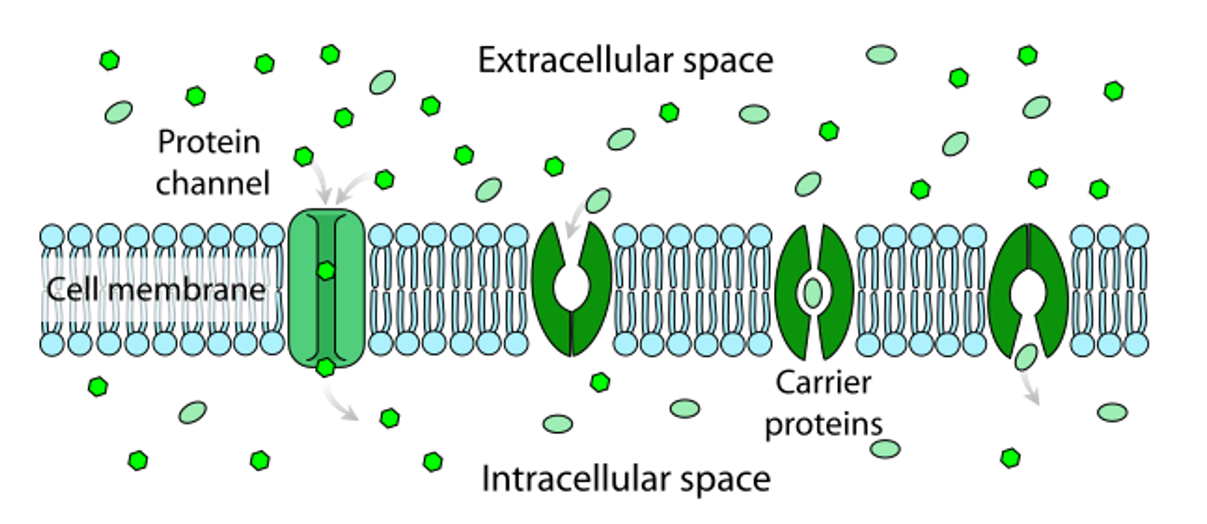
Protein channels or carrier proteins are used to transport ions/polar molecules across the cell membrane (doesn’t require ATP)
What is the difference between protein channels & carrier proteins?
Proteins channels:
form tubes filled with water, enabling water-soluble ions to pass through the membrane
selective process → only open in the presence of certain ions
Carrier proteins:
bind with a molecule (e.g. glucose) which causes it to change shape, enabling the molecule to be released to the other side
How is the glucose transporter is an example of a carrier protein?
Glucose binds to the glucose transporter on the exterior of the cell, which induces a conformational change
This releases the glucose molecule on the other side of the membrane & the carrier protein returns to its original conformation

How are ion channels an example of a protein channel?
Ion channels are coated, so they only open on a specific signal & have a high degree of specificity → don-t just allow positively-charged ions, but can distinguish between Na+ & K+
They can control the net movement of a large number of ions (e.g. during nerve signalling)

What is osmosis?
The net movement of water molecules from a region of higher water potential to a region of lower water potential across a partially permeable membrane

What is water potential (Ψ) ?
The pressure exerted by water in a solution on the container (measured in kPa)
What is the water potential of pure water?
0 kPa:
when solutes are dissolved in water, the water potential becomes negative
the more negative the water potential, the more solutes dissolved in it

What is the equation to calculate water potential?
Water potential = turgor pressure + osmotic pressure/potential
turgor pressure: inward pressure exerted by cell wall
osmotic pressure/potential: ability of water to move across a partially permeable membrane
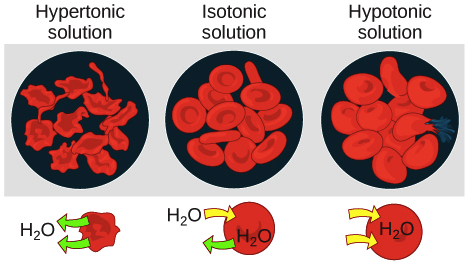
What is a hypotonic solution & what happens to the cell?
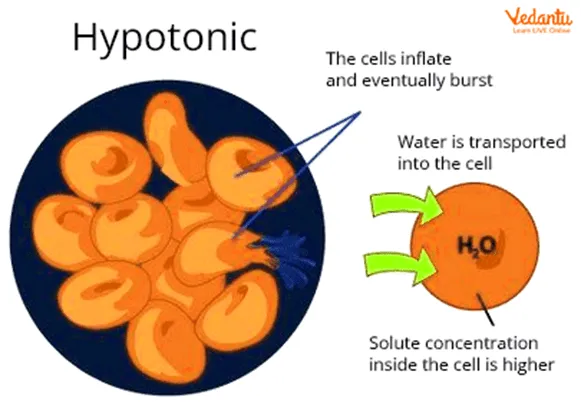
Water potential of the cell is lower than the solution around it → water moves into the cell
animals cells: burst
plant cells: become turgid
how to remember → think ‘hippotonic’
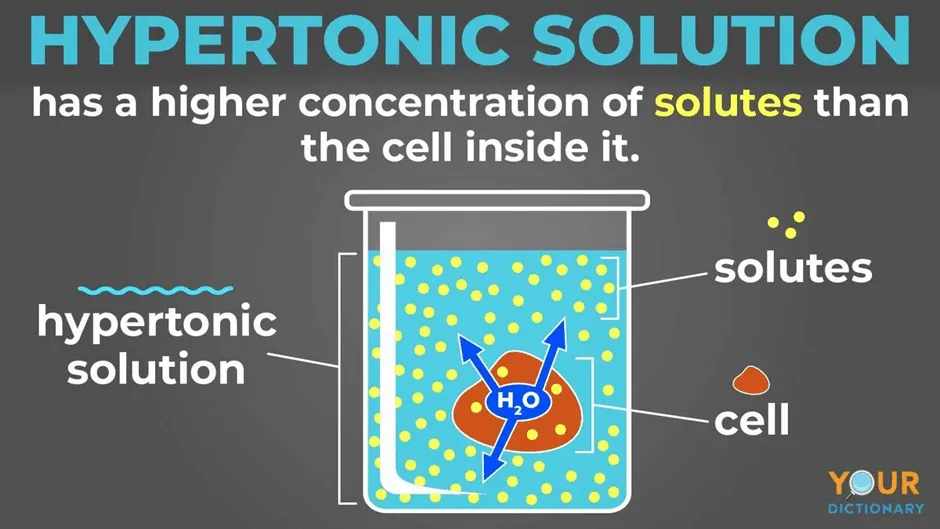
What is a hypertonic solution & what happens to the cell?
Water potential of the cell is higher than the solution around it:
water moves out of cell, causing it to shrink or become flaccid
how to remember → when someone is ‘hyper’, they burn calories, so become skinny
What is an isotonic solution & what happens to the cell?
Water potential is the same in the cell & solution around it:
water moves in & out of cell equally, so cell remains same size
how to remember → think isoperfect, like ‘i’m so perfect’, so no change
What is active transport?
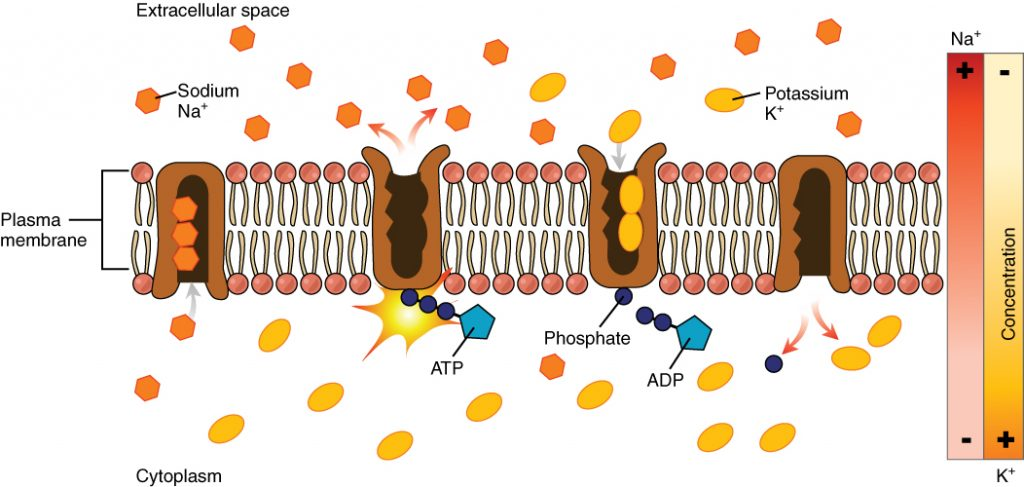
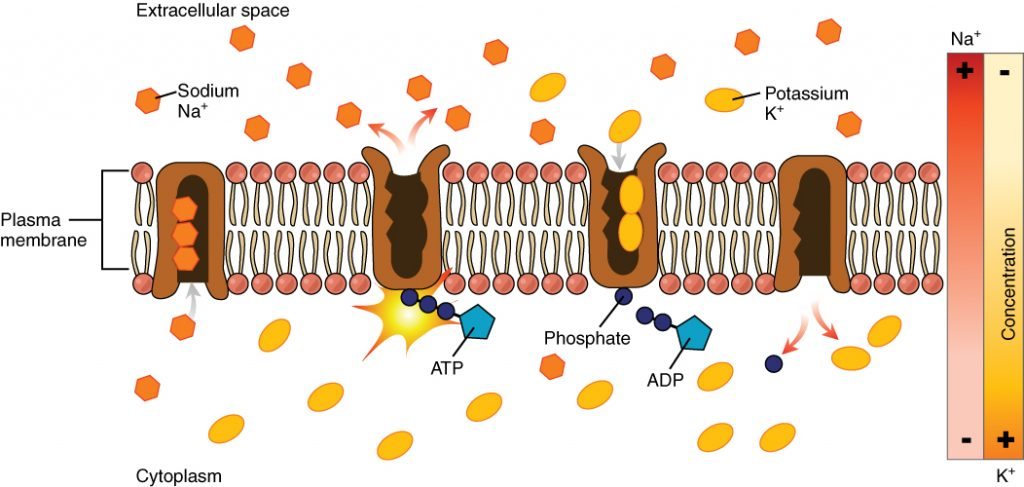
The net movement of molecules/ions from a region of lower concentration to a region of higher concentration (against a concentration gradient) using ATP & carrier proteins
How is ATP used in active transport?
ATP binds to the protein on the inside of the membrane & is hydrolysed into ADP & Pi
This causes the molecule to be released on the other side of the membrane
The phosphate molecule is then released from the protein & this results in the protein reverting back to its original shape
How might solubility, size & charge affect how a molecule is transported?
Solubility: lipid-soluble molecules pass through membranes more easily
Size: smaller molecules diffuse faster
Charge: charged molecules cannot diffuse by simple diffusion
What is bulk transport (cytosis) & what are the two types?
The transport of large macromolecules into & out of cells using vesicles:
endocytosis: bulk transport into cells
exocytosis: bulk transport out of cells
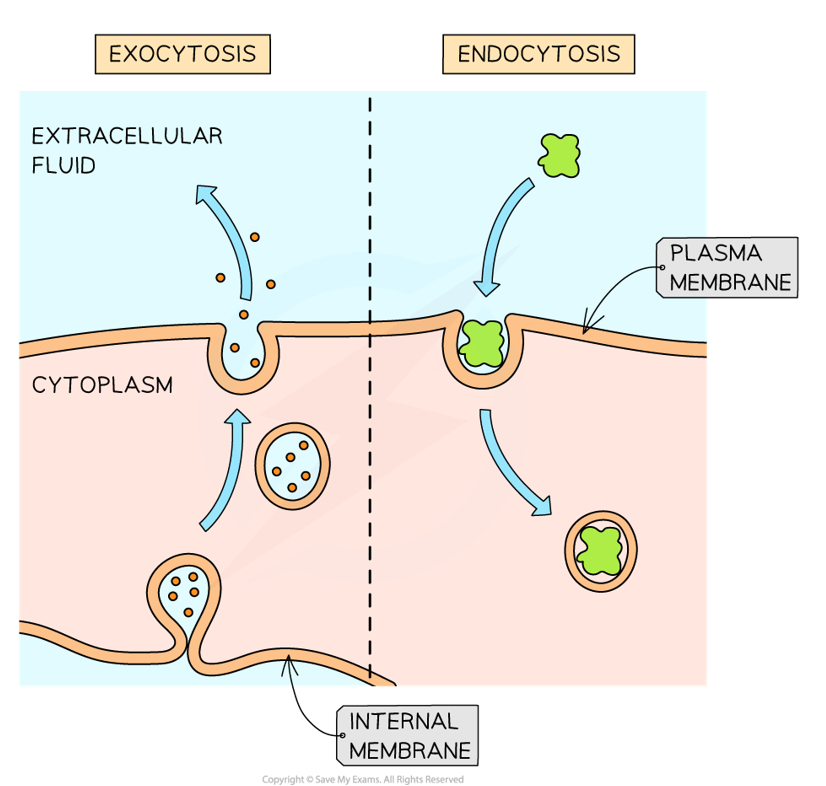
What is pinocytosis & phagocytosis?
(examples of endocytosis)
Pinocytosis: a cell takes in liquids & dissolved substances by forming small vesicles from its cell membrane
the cell membrane folds inward & traps droplets of fluid
a small vesicle forms & moves into the cell
Phagocytosis: a cell engulfs large solid particles (e.g. bacteria & cellular debris)
the cell surrounds the particle with its membrane & the particle is enclosed in a vesicle
enzymes help break down & digest it

What is co-transport?
A transport protein moves two or more substances across a membrane together as part of the same transport process:
there are two main types of co-transport (symport & antiport)
co-transport commonly uses the movement of one substance down its concentration or electrochemical gradient to help move another substance against its gradient
What is uniport, symport & antiport transport?
Uniport transport: moves one type of substance across the membrane & usually moves it in one direction at a time (e.g. a GLUT protein transporting glucose into a cell)
Symport transport: moves two or more substances in the same direction across the membrane (e.g. Na+ & glucose entering an intestinal cell together)
Antiport transport: moves two different substances in opposite directions across the membrane (e.g. sodium-potassium ATPase)
What is Fick’s law?
The rate of diffusion is proportional to the surface area & concentration difference & is inversely proportional to the thickness of the membrane


Using Fick’s law, what will happen to the rate of diffusion to a person with celiac disease?
There is a decrease in surface area, therefore a decrease in the rate of diffusion → less diffusion points available
(rate of diffusion is proportional to the surface area)

Using Fick’s law, what will happen to the rate of diffusion in a person with IDF lungs?
There is an increase in the membrane thickness, therefore a decrease in the rate of diffusion → takes longer for molecules to diffuse through a thicker membrane
(rate of diffusion is inversely proportional to the membrane thickness)

Using Fick’s law, what will happen to the rate of diffusion in a person with pulmonary fibrosis?
If they have a high-flow nasal cannula, there is an increase in the rate of diffusion compared to their home environment → increase in concentration difference increase rate of diffusion
(rate of diffusion is proportional to the concentration difference)