LRA 218 Final Exam
 Call Kai
 Learn
 Practice Test
 Spaced Repetition
 Match
 Flashcards
 Knowt Play
1/47

There's no tags or description
Looks like no tags are added yet.
48 Terms
What is the common term for idiopathic chronic adhesive capsulitis?
Frozen Shoulder
Which of the following AP shoulder projections demonstrates the lesser tubercle in profile medially?
Internal Rotation
For AC joint weight-bearing studies, patients should not be asked to hold on to the weights with their hands; rather, the weights should be attached to the wrist.
True
A posterior dislocation of the shoulder occurs more frequently than an anterior dislocation.
False
Sonography is an effective diagnostic tool in studying the shoulder joint.
True
A radiograph of an AP axial projection of the clavicle demonstrates that the clavicle is within the mid-aspect of the lung apices. What should the technologist do to correct this error?
Increase the cephalic CR angle during repeat exposure
The AP humerus requires that the humeral epicondyles are ________ to the IR.
parallel
A patient enters the department with multiple injuries including a possible fracture of the left proximal humerus. Which positioning rotation should be performed to determine the extent of the humerus injury?
AP and horizontal beam transthoracic lateral shoulder projection
Which of the following AP shoulder projections demonstrates the lesser tubercle in profile medially?
Internal Rotation (2)
A lateral elbow radiograph demonstrates about half of the radial head superimposed by the coronoid process of the ulna. Which of the following occurred?
No positioning errors occurred
A radiograph of the elbow demonstrates the radius directly superimposed over the ulna and the coronoid process in profile. Which projection of the elbow has been performed?
Medial rotation oblique
Which routine projection of the elbow will best demonstrate an elevated or visible posterior fat pad?
True lateral with 90º flexion
Which of the following projections can be performed using a breathing technique?
Scapular Y lateral projection
What is the most commonly fractured carpal bone?
scaphoid
A general positioning rule is to place the long axis of the part _______ to the long axis of the image receptor.
Parallel
How many carpal bones are there in the wrist?
8
How much rotation of the humeral epicondyles is required for the AP medial oblique projection of the elbow?
45º
What two bony land marks are palpated for positioning of the elbow?
Humeral epicondyles

Which radiographic examination is being performed below?
Lateromedial projection
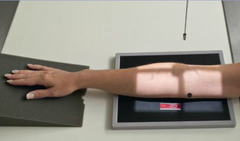
Which radiographic examination is being performed below?
Medial internal rotation obligue.

When the elbow cannot be fully extended, it is appropriate to perform an AP projection of the elbow in the manner depicted below?
True

In order to position for an AP of the elbow, as demonstrated below, which of the descriptions from the choices provided does not meet the criteria for this examination?
Center elbow joint to center of IR

The picture below demonstrates a lateral of the forearm.
True

The radiograph below depicts an AP of the forearm. The collimation shown meets the criteria for this study.
True
Where should the CR be directed when performing an AP of the forearm?
mid forearm
When positioning for a AP of the forearm, the radiographer must ___________.
All of the above

The picture below demonstrates a PA of the forearm.
False
A referring physician suspects that a subacromial spur may be the cause for a patient's arm numbness. She asks the technologist for a projection that would best demonstrate any possible spurs. Which of the following projections would accomplish this objective?
PA scapular Y lateral with 10º to 15º caudal angle
Where is the CR centered for a transthoracic lateral projection for proximal humerus?
Level of surgical neck
The use of a grid during shoulder radiography will result in higher patient dose over nongrid procedures.
True (6)
A radiograph of the inferosuperior axial projection (Lawrence method) demonstrates the acromion process of the shoulder to be located most superiorly (anteriorly).
False
The use of a grid during shoulder radiography will result in higher patient dose over nongrid procedures
True
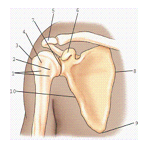
Which view and projection of the proximal humerus is represented in the figure?
External rotation, anteroposterior (AP) projection
What additional maneuver must be added to the inferosuperior axial shoulder (Lawrence method) projection to best demonstrate a possible Hill-Sachs defect?
Perform exaggerated external rotation of the affected upper limb
What medial central ray (CR) angle is required for the inferosuperior axial shoulder (Lawrence method)?
25 degrees to 30 degrees
Which of the following shoulder positions is considered a trauma projection (can be performed safely for a possible fracture of dislocation)?
AP apical oblique axial (Garth Method) projection
Which AP projection of the shoulder and proximal humerus is created by placing the affected palm of the hand facing inward toward the thigh?
neutral rotation
Which rotation of the humerus will result in a lateral position of the proximal humerus
Internal rotation (epicondyles perpendicular to image receptor)
a radiograph of a PA oblique of the hand reveals that the mindaspect of the fourth and fifth metacarpals is superimposed. What specific positioning error has been committed?
Excessive rotation of the hand and/or wrist
A radiograph of a PA projection of the hand reveals that the distal radius and ulna and the carpals were cut off. What should the technologist do to correct this problem?
Repeat the PA projection to include all the carpals and about 1 inch of the distal radius and ulna.
A patient enters radiology with a possible Bennett's fracture. Which of the following routines should be performed to confirm the diagnosis?
thumb

What radiographic image is demonstrated below?
Oblique thumb
When performing a PA Hand radiographic examination, the central ray (CR) should be centered to the _____.
3rd MCP joint

Which of the following statements is INCORRECT when positioning for an AP Axial Thumb (Modified Roberts) view:
All statements are correct

When performing a PA Finger examination, the CR (Central Ray) is perpendicular and centered to the __________ joint.
PIP

In order to obtain a PA Oblique Hand image, the entire hand and wrist should be rotated _____ laterally.
45 degrees

In which position is the following radiograph of the 1st digit (thumb) presented?
AP
The bending or forcing of the hand laterally with the hand pronated in a posteroanterior (PA) projection is known as:
Ulnar deviation