Chapter 10: Radical Reactions (Useful Reagents and Reactions)
 Call Kai
 Learn
 Practice Test
 Spaced Repetition
 Match
 Flashcards
 Knowt Play
1/11

There's no tags or description
Looks like no tags are added yet.
12 Terms
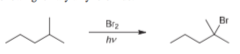
Br2, hv (Radical bromination)
Under these conditions, an alkane undergoes bromination, with installation of the Br at the most substituted position.
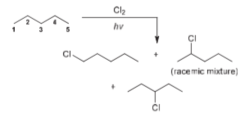
Cl2, hv (Radical chlorination)
Under these conditions, an alkane undergoes chlorination. This reaction is less selective than bromination (but faster) and as such, it is generally most useful in situations where only one regiochemical outcome is possible.

HBr, ROOR (Hydrobromination)
When treated with HBr in the presence of peroxides, an alkene undergoes anti-Markovnikov addition of H and Br.

NBS, hv (Allylic bromination)
NBS, or N-bromosuccinimide, is a reagent that can be used to install a bromine atom at the allylic position of an alkene.
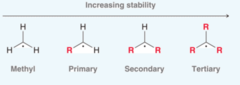
Stability of Radicals
The order of stability for radicals follows the same trend exhibited by carbocations in which benzylic radicals, then allylic radicals, then tertiary radicals are more stable than secondary radicals, which are in turn more stable than primary radicals.
Stereochemistry of Halogenation
Halogenation that creates a new chiral center leads to a racemic mixture. Halogenation at an existing chiral center also leads to a racemic product. The formation of diastereomers occurs when bromination occurs and there is an existing chiral center.
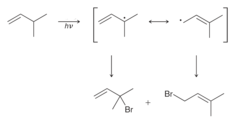
Allylic Bromination
Br2, NBS
Hydrogen abstraction at the allylic site generates a resonance-stabilized allylic radical. In order to avoid ionic addition of bromine across the pi bond, NBS is added in place of Br2 to keep the concentration of bromine low. NBS is an alternate source of bromine radical.
Radical Initiator
A compound that contains an especially weak bond that serves as a source of radicals. Examples include alkyl peroxides as well as acyl peroxides.

Radical Inhibitors/Scavengers
A compound added to prevent the propagation of free-radical chain reactions. In most cases, the inhibitor reacts to form a radical that is too stable to propagate the chain.
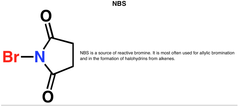
N-Bromosuccinimide (NBS)
Resonance stabilized alternative source of bromine radical.

Radical Addition of HBr: Anti-Markovnikov Addition
Can generate a new chiral center which results in a mixture of enantiomers.

Halogenation as a Synthetic Technique
Bromination is slower but more selective than chlorination. When the starting material has equivalent hydrogens, chlorination can be accomplished, but otherwise bromination is more favorable and avoids a mixture of products. The greatest utility of radical halogenation is to introduce a functional group to the alkene which then can go through a substitution or elimination reaction.