Clinical audit
 Call Kai
 Learn
 Practice Test
 Spaced Repetition
 Match
 Flashcards
 Knowt Play
1/8

There's no tags or description
Looks like no tags are added yet.
9 Terms
What is a clinical audit?
A quality improvement process that seeks to improve patient care and outcomes through systematic review of care against explicit criteria and the implementation of change. Aspects of the structure, processes, and outcomes of care are selected and systematically evaluated against explicit criteria. Where indicated, changes are implemented at an individual, team, or service level and further monitoring is used to confirm improvement in healthcare delivery.
What are the 7 pillars of clinical governance?
Clinical audit
Clinical effectiveness
Risk management
Use of information
Education and training
Staffing management
Client experience and involvement
Why is a clinical audit important?
Plays a part in risk management
Identify risks or benchmark a service/treatment for a particular condition
Patient care and safety, and the development and improvement of your professional practice
Helps demonstrate services and identify areas where for real improvement
What are the aims of a clinical audit?
Continuous cycle of quality improvement
Seeks to improve patient care and outcomes through systematic review of care against explicit standards and best practice, and to use any shortfalls in standards of care to enable improvements to be made
Determine whether a current service or procedure reaches a specified standard
Information used to inform improvements in care, and then evaluate those changes by re-auditing
How often should each type of pharmacist do a clinical review?
Community pharmacist with an NHS contract are required to conduct at least 2 a year
Hospital pharmacists are required as part of practice to conduct/be involved in clinical audits to contribute to the national priorities for the performance of your trust. NHS Trusts are required to support audit work from central funding.
Primary Care audits to improve quality/safety/cost effectiveness of prescribing
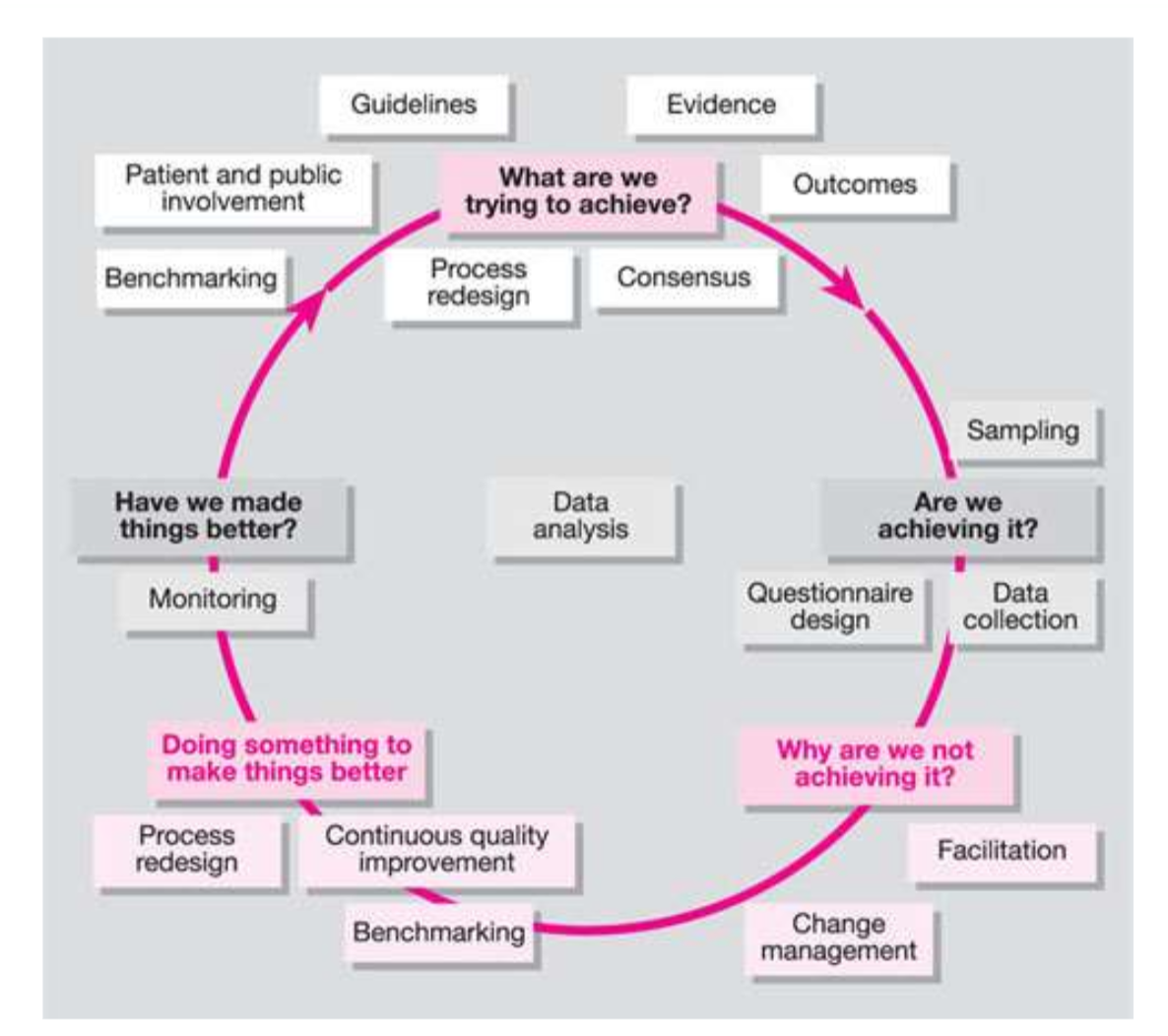
What are the steps for an audit?
Identify audit topic
Set the standard
Design the method
Collect data
Analyse data
Implement change
Repeat
Examples of community pharmacy audits
Asthma – Use of salbutamol therapy
Owings Audit – Common drugs (improve stock levels)
Smoking Cessation – Quit Rates/Product Recommendations
Waste Medicines – What are patients returning to pharmacy
NSAID Rx, without PPI
Supply of EHC – PGD/OTC requests
Examples of hospital pharmacy audits
Insulin Prescribing audit – Drug Chart
Snapshot antibiotic Audit
Missed Dose Audit
Prompt switching of intravenous antimicrobial treatment to the oral route of administration as soon as patients meet switch criteria (60-40%)
Examples of primary care pharmacist audits
Prescribing of antidiabetics in-line with NICE criteria
Prescribing of DOACS and renal function
Monitoring of ACEI – appropriate bloods?
Cost Effective Prescribing of Gliptins