Chemistry Exam Revision
 Call Kai
 Learn
 Practice Test
 Spaced Repetition
 Match
 Flashcards
 Knowt Play
1/13

There's no tags or description
Looks like no tags are added yet.
14 Terms
Describe the properties of Alkali metals
Chemical properties:
Group 1 - have 1 valence electron, and charge of +1
Highly reactive - readily loses 1 e to achieve a stable octet
> reactive violently with water to form a strong alkaline base (metal hydroxide) and hydrogen gas.
Physical properties:
Soft, low melting and boiling points

Describe the properties of Alkaline earth metals
Chemical properties:
Group 2 - have 2 valence electron, and charge of +2
Very reactive (not as must as Group 1) - readily loses 2 e to achieve a stable octet
> reactive with water to form a strong alkaline base (metal hydroxide) and hydrogen gas.
Physical properties:
Soft (harder than Group 1), low melting and boiling points (still higher than G1)

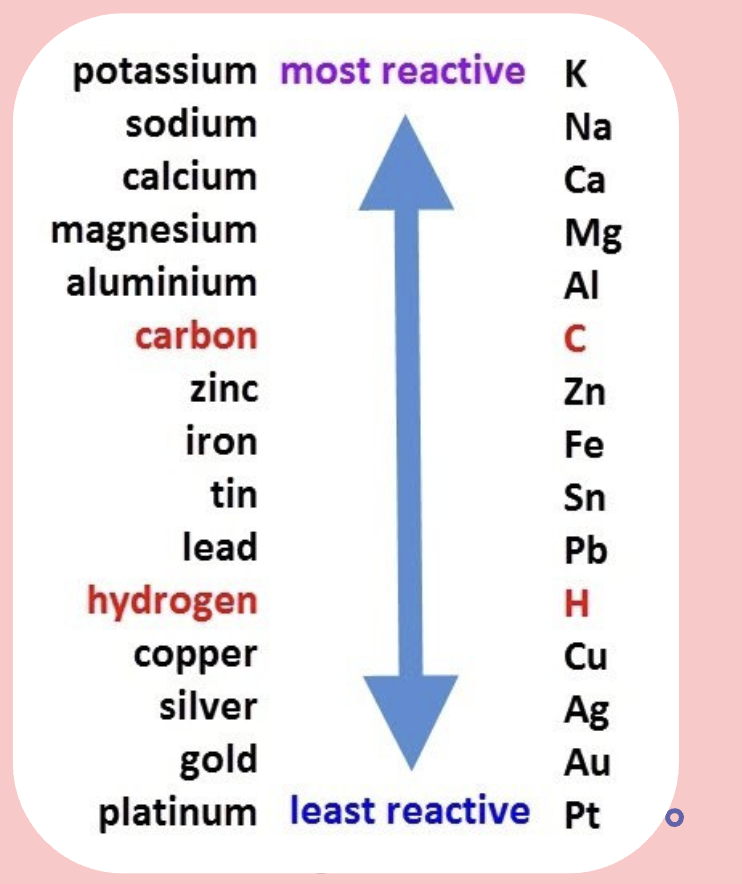
6 most reactive metals (out of 20 elements)
Potassium
Sodium
Calcium
Magnesium
Aluminium
Carbon (not metal)
Describe the properties of Transition metals
Physical properties:
middle block in periodic table (G3 - G12)
Some are magnetic
Gold and Copper are the only two that are not silvery in colour
Chemical Properties:
Many form coloured compounds
Some have variable valencies e.g. Fe (II) and Fe (III)
Evaluates reasons for placement of transition metals in periodic table:
Reasons for placement:
Sequential subshell filling of d-block: Positioned between Groups 2 and 13 because their d-subshells are progressively filled across the period.
Chemical Transition: Act as a transitional bridge between highly reactive s-block metals and less reactive p-block metals.
Characteristics due to placement:
Variable Oxidation States: The 3d subshells have the same amount of energy, allowing them to lose a variable number of electrons and form ions with different charges.
Catalytic & Physical Traits: Their incomplete d-subshells => unique properties e.g. acting as catalysts, forming coloured compounds, and exhibiting strong magnetism.
Describe the properties of Halogens
Chemical properties:
Group 7: 7 valence electrons, charge of -1
Highly reactive non-metals that react with metals to form ionic salts
Reactivity decreases down the group
Physical properties:
the only group featuring all three states: gases (fluorine, chlorine), liquid (bromine) and solids (Iodine, Astatine) at room temperature.
Melting and boiling points increase down the group: molecules get larger and heavier, increasing energy required to break intermolecular bonds
exist as diatomic molecules: F2, Cl2, Br2
Describe the properties of Noble gases:
Chemical properties:
8 valence electrons, all have a charge of 0 as they have a complete octet (except for Helium which forms a stable duet)
Cannot form ions, therefore are uncharged
Are naturally inert, as they have a complete valence shell.
Physical properties:
All colourless, odourless gases at room temp
Exist as monatomic gases: He, Ne
MP and BP increase down groups (atoms larger and heavier)
Explains the reactivity of alkali metals and halogens in terms of core charge and/or electronegativity
Core charge: the net positive charge experienced by valence electrons, calculated by no. of protons - no. of inner shell electrons.
Alkali metals:
Have low electronegativity and weak core charge of +1
The positive attraction of the nucleus over the valence electrons is weak, making it highly reactive as it is easily loses its 1 valence e.
Halogens:
Halogens are the opposite:
Strong core charge of +7 and high electronegativity
Strong positive pull of the nucleus on valence electrons makes the element highly reactive - easily gains 1e to complete octet.
Explain the relationship between atomic number and placement on the periodic table:
The atomic number determines the type of element, thus determining its organisation within the table.
The elements are arranged, where the atomic no. increases from left to right and downwards in the periodic table.
When a period (shell) is full, the atomic number moves to the next row, aligning elements with the same number of valence electrons into the same groups.
Property Trends: Valence electron counts repeat in a trend as the atomic number increases, causing chemical and physical properties to recur in a pattern
Outline trends in the periodic table: atomic radii, electronegativity, 1st ionisation energy, core charge, metallic and non-metallic character, chemical reactivity
Atomic radii: the distance from the centre of the atom to its outermost shell:
increases down the group, decreases across the period
Electronegativity: The ability of an atom to attract electrons towards itself:
decreasing down a group, increases across a period
1st ionisation energy: The minimum amount of energy required to remove the first valence electron from its atom in gaseous state
decreases down a group, increases across a period
Core charge: The net positive charge experienced by a valence electron (no. of protons minus no. of inner shell electrons)
stays constant down a group, increases across a period.
Metallic character: a measure of how easily an atom becomes a cation
LHS of periodic table
Non-metallic character: a measure of how easily an atom becomes an anion
RHS of periodic table
What is a physical change
A changes in which the physical properties of the substance change, yet its chemical identity remains constant.
Indicators:
reversible action
no new chemical substances are created
e.g. shifting between different states (steam to liquid water)
What is a chemical change:
A process where a substance is transformed into a new substance with a different chemical identity, properties and rearranged chemical bonds.
Indicators:
colour change
effervescence
burning
change in odour.