Microbio lab practical
 Call Kai
 Learn
 Practice Test
 Spaced Repetition
 Match
 Flashcards
 Knowt Play
1/164

There's no tags or description
Looks like no tags are added yet.
165 Terms

what type stain is this?
negative stain

what type of stain is this? what do A and B represent
B= Acid-fast positive red/pink; A=non-acid-fast cells take counterstain.

what type of stain is this?
Capsule Stain

what type of stain is this?
Endospore stain

what type of stain is this?
Flagella stain: thin threadlike flagella extending from cells.

what does growth vs no growth tell you from this medium?
Growth means gram-pos cocci
What bacteria type is PEA selective for?
Phenylethyl alcohol agar (PEA): selective for Gram-positive cocci.
What types of bacteria does PEA supress and how?
Inhibits Gram - by breaking down membrane permeability, interfering wiith DNA Synthesis
What specific organisms does PEA isolate? What does it filter out?
Used to isolate staphylococci, streptococci, enterococci, lactococci. Filters out Gram - contaminants like E.Coli, prevents Proteus species from swarming across the surface of the agar
What does PEA smell like?
Alcohol

What does a positive vs. negative test look like on MacConkey Agar, what does it tell you about the bacterium?
MacConkey: pink = lactose fermentation; pale/colorless growth = non-lactose fermentation.
MacConkey is used to differentiate what based on their ability to ferment lactose
Enterobacteriaceae
Positive MacConkey test shows becteria is part of what group?
Coliform

Bile Esculin agar growth tells you what regarding selectiveness?
Growth shows organism can tolerate Bile

How does Bile Esculin Test differentiate bacteria, what does pos/neg look like?
Growth with black shows organism can hydrolyze esculin in the presence of bile.
Bile Esculin Test is selective for what type of bacteria specifically?
Selective for enteric bacteria and streptococcus bovis,( Gram-positive)

MSA plate pictured, what is pos/neg result, what does it tell you about the bacterium?
(Positive)yellow = mannitol fermentation
red with growth = negative, no fermentation
no growth = inhibition, can’t tolerate 7.5%NaCl
MSA is useful in the identification of?
Staphylococcus Aureus
neumonic- MSA stand for M.S.(Staph)A.(aureus)
MSA selective for?
Gram positive, high salt tolerant organisms(7.5%NaCl)
MSA uses which PH indicator?
Phenol Red
EMB is selective for what type of bacterium, due to what dye?
Gram negative, inhibits gram positive growth through methylene blue
How do you interpret color results on EMB agar?
Pink and Mucoid: Ferments lactose with little acid production
Dark With or Without Metallic Sheen: Ferments lactose and or sucrose with acid production
Colorless: Gram - that does not ferment lactose or sucrose
What makes HE Hektoen Enteric Agar Selective, and what type of selective media is it?
Bile salts and the dyes bromothymol blue & acid fuchsin inhibit most Gram(+)
HE Hektoen Enteric is used to isolate what 2 specific bacterium?
Used to isolate Salmonella and Shigella
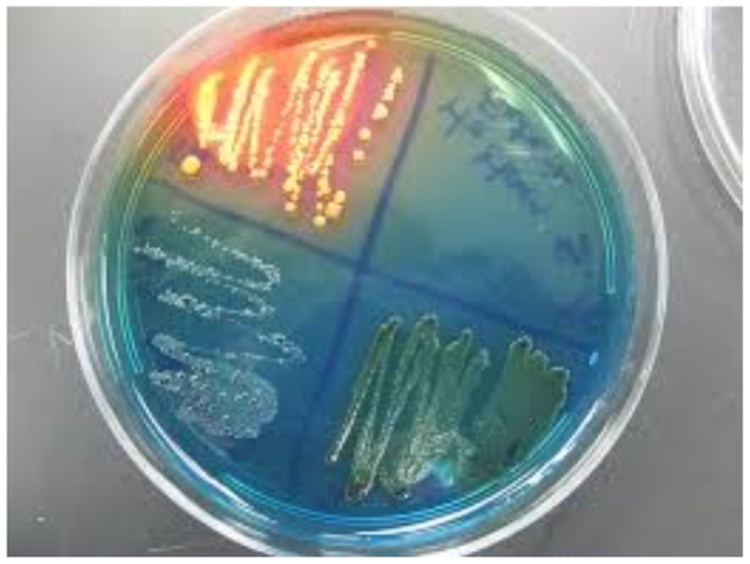
What do HE Hektoen Enteric Results look like and what do they mean?
Pink to Orange: Organism produces acid from lactose fermentation
Blue Green with Black Precipitate: Neg for lactose fermentation but sulfur reduction to H2S - indicates Salmonella
Blue Green without Black Precipitate: Neg lactose fermentation and sulfur reduction - possible Salmonella or Shigella
How is Xylose Lysine Desoxycholate selective? What makes it selective?
Selective for gram -
Contains desoxycholate to inhibit Gram positive growth

How do you interpret XLD agar results?
Fermentation of xylose produces yellow clearing
red = alkaline/nonfermenting reaction
red with black centers = H₂S production (typical Salmonella).
XLD is especially useful for what bacteria?
especially Legionella pneumophila.
Shigella and Providencia

How do you interpret O/F glucose tubes? (p. 20)
Both yellow = fermentative (E. coli); open yellow only = oxidative (Pseudomonas); neither yellow, green/blue = nonsaccharolytic (Alcaligenes).
What does the oxidation-fermentation (O/F) test detect and why is mineral oil used? (p. 20)
Glucose oxidation versus fermentation; mineral oil creates anaerobic conditions in one tube. The other tube remains open to oxygen.
What is blood agar used to test and how are alpha, beta and gamma hemolysis read? (p. 21; hemolysis diagram p. 12)
Strep tests and RBC hemolysis. Alpha = partial/greenish; beta = complete/transparent clearing; gamma = no hemolysis.
What does phenol red carbohydrate broth test,
Fermentation of a specific carbohydrate.

How do you interpret these phenol red results? the left is the control
Yellow Broth: Fermentation by acid production
Red Broth: No acid production
What does Voges-Proskauer (VP) test detect?
Test for the production of Acetoin and 2,3-butanediol after glucose fermentation
What does Methy Red (MR) part of MRVP test for?
Tests for Mixed acid fermentation

Interpret the pictured MR results?
Immediate red color indicates positive, remains yellow is negative

Interpret the picture VP results
(right tube)Red after reaction = positive
(left tube)no red = negative.
What reagents are used in VP Test? What do they do
Alpha-naphthol and KOH, (Lab manual says A and B)
Reagents are used to oxidize by products which yields a red color if positive
What does catalase test detect?
detect presence of catalase (an enzyme that breaks down H2O2 to water and H)
list the steps for performing a catalase test
Smear: Use a wooden stick or plastic loop to smear a small colony of bacteria onto a clean glass slide. (Avoid touching the agar, especially if it contains blood).
Drop: Add 1–2 drops of 3% hydrogen peroxide directly onto the bacteria.
Look: Watch immediately for bubbles.

Explain these catalase test results
Positive: bubbles form because the bacterium has catalase, which breaks down H₂O₂ into water and oxygen gas. Negative: no bubbles because the bacterium lacks catalase, so H₂O₂ remains unbroken.
Oxidase test test’s for presence of what?
Cytochrome C Oxidase(an enzyme that is present within a cells ETC)

Interpret these oxidase test results.
A is positive, B is negative.
Test is conducted with a chemical that produces purple color once oxidized
If I do a nitrate reduction test and after incubation tube is removed from incubator and I see a bubble what does that mean?
Positive result for nitrate reduction (specifically via denitrification to nitrogen gas) if organism is a nonfermenter. Organism reduces nitrate to N2 producing nitrogen gas, Test completed no reagents needed
If no bubble are seen in nitrate reduction after incubation so Reagants A & B are mixed in, interpret the results of one tube turning red, and the other not.
Color change to red is positive result for nitrate reduction to nitrate(NO3—>NO2)
No color change requires addition of zinc
You perform 2 nitrate test add Reagents A and B (Alpha-napth Sulf-Acif), no color changes, so you add zinc, one tube stays the same color, the other turns red. Interpret the results.
Red: organism does not reduce nitrate(Negative)
No change: Organism reduces nitrate to smth other then nitrite(Positive for reduction)

Identify the following helminth
Wuchereria Bancrofti(Filariworm)
Wuchereria Bancrofti causes what? and is what specific type of worm?
Causes: lymphatic filariasis
Filariworm which is a type of roundworm
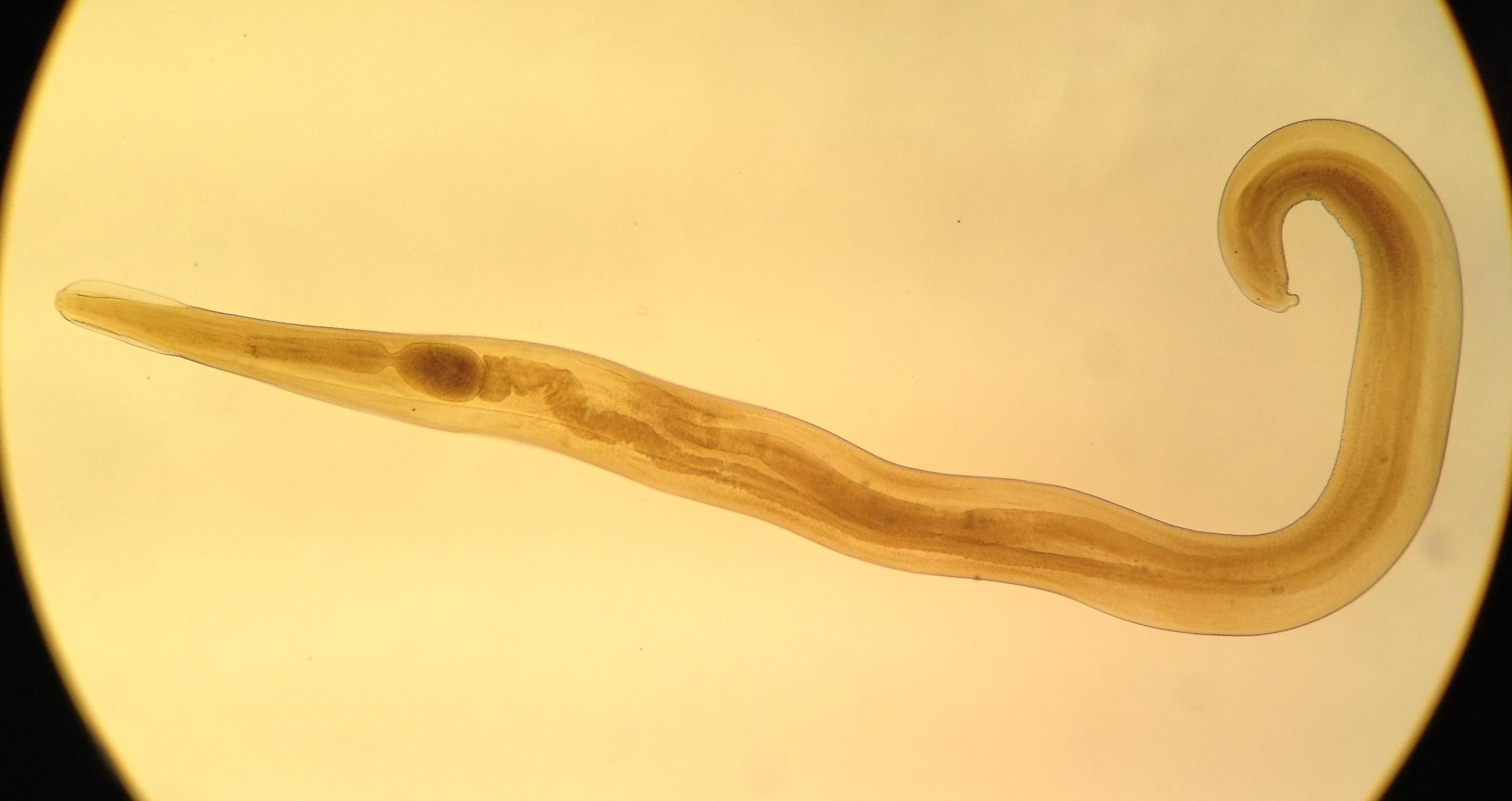
Identify the following helminth
Enterobius Vermicularis(Pinworm)
Enterobius Vermicularis effects what part of body?
Small intestine
Enterobius Vermicularis is what specific type of worm?
Round worm specifically pinworm
What 2 types of helminths were studying are hookworms?
Ancylostoma duodenale, Necator americanus

Identify the helminth
Ancylostomiasis = Ancylostoma duodenale

Identify the helminth
Necatoriasis= Necator americanus

Identify the helminth
Ascaris Lumbricoides (Roundworm) -causes ascariasis

Identify the helminth
Taenia saginata (beef Tapeworm)
Taenia saginata causes what in humans?
taeniasis in humans
Taenia saginata causes what in cattle?
cysticercosis in cattle

Identify the helminth
Dipylidium Caninum (Tapeworm)
Dipylidium Caninum (Tapeworm) is what 2 types of tapeworm?
flea tapeworm
cucumber tapeworm
What special feature does Diplydium Caninum have?
Double- pored tapeworm
Genital pores on both sides

Identify the helminth, and its egg morphology?
Schistosoma Mansoni (Blood Fluke)
Organisms that grow in very low temperatures, roughly -10 to 20 degrees Celsius
Psychrophiles: grow in very low temperatures, roughly -10 to 20 degrees Celsius.
Organisms that grow in low temperatures, roughly 0 to 30 degrees Celsius
Psychrotrophs: grow in low temperatures, roughly 0 to 30 degrees Celsius.
Organisms that grow in moderate temperatures, roughly 10 to 50 degrees Celsius
Mesophiles: grow in moderate temperatures, roughly 10 to 50 degrees Celsius.
Organisms that grow at higher than normal temperatures, roughly 40 to 70 degrees Celsius
Thermophiles: grow at higher than normal temperatures, roughly 40 to 70 degrees Celsius.
Organisms that grow in extremely hot temperatures, roughly 65 to 110 degrees Celsius
Hyperthermophiles: grow in extremely hot temperatures, roughly 65 to 110 degrees Celsius.
For acid fast staining how do Ziehl-Neelsen and Kinyoun acid-fast staining differ on the slide? (p. 8)
Ziehl-Neelsen: steaming/heat, methylene blue counterstain. Kinyoun: no steaming, brilliant green counterstain (as listed on slide).