Phonological Processes
 Call Kai
 Learn
Learn Practice Test
 Spaced Repetition
 Match
Match Flashcards
 Knowt Play
1/15

There's no tags or description
Looks like no tags are added yet.
Name | Mastery | Learn | Test | Matching | Spaced | Call with Kai | Chat |
|---|
No analytics yet
Send a link to your students to track their progress
16 Terms
phonotactics
possible sound sequences
real work: [tr]ick
non-word but possible: [tw]ick
impossible: [tl]ick or [tn]ick
common phonotactic constraints
nasal + oral consonant should agree in place of articulation ([mb], [nt], [ŋg], but *[mt])
voicing agreements in obstruents - if 2 obstruents are together, than they tend to have the same voicing (both voiced/voiceless when together) (word endings in english)
systemic gaps
sequences that fail to occur (and speakers judge ungrammatical)
ex: [tl] in english - just doesn’t sound like something we say
accidental gaps
potential word or sound sequence phonologically well-formed, but doesn’t exist in language, e.g. [twɪk] in english
systematic gaps and alternations
phonotactic constraints cause…
alternations
positionally-condition changes (which we can express via rules)
ex: [tʰ] vs [t] vs [ɾ], vs [ʔ]
types of alternations/phonological processes
assimilation, dissimilation, insertion, deletion, metathesis, coalescence, strengthening, and weakening
assimilation
when a sound becomes more like a neighboring sound with respect to some phonetic property
ex: in english nasals, depending on the next consonant, the nasal will change to match the place of articulation of the following consonants (the nasal takes on the same place of articulation as the consonant following it)

vowel harmony
is a subclass of assimilation where all vowels in a word must share certain phonetic features, such as being front or back, rounded or unrounded
dissimilation
where two close or adjacent sounds become less alike with respect to some property
ex: in the picture the stops turn into fricatives because it makes it change the manner of articulation so it is easier to pronounce

insertion (epenthesis)
when a sound appears in the surface phonetic form which was not in the underlying phonemic form
ex: in the picture, the voiceless stops make the transitions easier to pronounce (like n → s is hard)

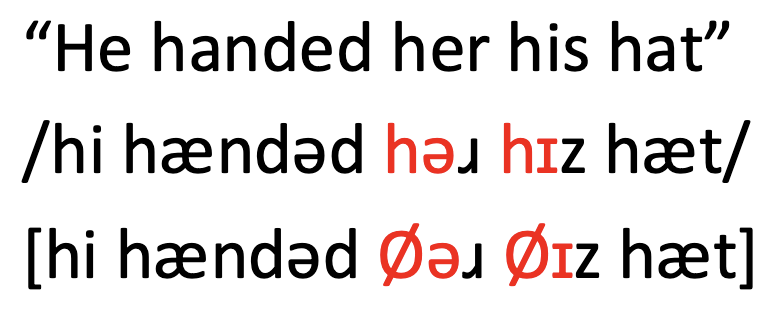
deletion (elision)
when a sound, which is present in the underlying phonemic form, is not expressed at all in the surface phonetic form
ex: in the picture, the h is not taken away at the beginning of the sentence since it is a content word, but are taken out in the middle which are function words
tends to happen when speaking quicker
metathesis
when there is a change in order of sounds
ex: in the picture, there is a reversal because it is hard to pronounce because of 3 consonants in a row for the first 2 words. but when reversed, there are only 2 consonants in a row, making it easier to pronounce

coalescence
combination of two sounds into one
in the image, the high vowel + the low vowel = mid vowel

strengthening (fortition)
when a sound become stronger
rule: voiceless stops become aspirated at the beginning of a stressed syllable (we should hear it more clearly when stressed so it makes sense)
ex: english aspiration - aspirated stops are longer compared to unaspirated stops, and something that is longer, we are more likely to hear
weakening (lenition)
when a sound becomes weaker
rule: an alveolar oral stop /t/ or /d/ becomes a flap when it occurs after a stressed vowel and before an unstressed vowel (flap is much quicker than a /t/ or /d/ and it obstructs airflow a lot less so it makes sense)
ex: english flapping/tapping ALSO when a voiced sound becomes devoiced