The Citric Acid Cycle I - Lecture 29
 Call Kai
 Learn
 Practice Test
 Spaced Repetition
 Match
 Flashcards
 Knowt Play
1/34

There's no tags or description
Looks like no tags are added yet.
35 Terms
In oxygen rich environments
organisms can generate far more energy from aerobic metabolism than anerobic metabolism.
from the conversion of glucose to pyruvate
glycolysis nets two molecules of ATP and two molecules of NADH
In the citric acid cycle
the metabolites are oxidized aerobically to generate more reducing power in the form of NADH and FADH2
NADH and FADH2
are high energy electron carriers that are fed into oxidative phosphorylation to produce much more ATP
intermediary
the citric acid cycle is an intermediary cycle between glycolysis and oxidative phosphorylation
amphibolic
the citric acid cycle is amphibolic bc it plays a major role in both catabolism and anabolism
Most metabolites in the citric acid cycle are oxidized (broken down)
while many products can act as starting points for other anabolic pathways
Other names of the citric acid cycle are
tricarboxylic acid cycle (TCA) or the Krebs Cycle
Where do the reactions of the citric acid cycle take place?
the mitochondria
Where are the reactions of the citric acid cycle primarily localized?
the mitochondrial matrix
This intermediate step is an important precursor to the citric acid cycle
Pyruvate happens to permeable to the mitochondria and once inside the matrix it is converted to acetyl-CoA
The conversion of pyruvate to acetyl-CoA is notable because
it produces one molecule of NADH and one molecule of CO2 during oxidative decarboxylation, also this is the first of the 3 total carbons lost during one turn of the cycle.
The FIRST step of the citric acid cycle
the two-carbon acetyl-CoA molecule condenses with a four-carbon oxaloacetate to produce a six carbon citrate ion
Over the next few steps of the citric acid cycle
the citrate isomerizes and then loses two carbons through oxidative decarboxylation, which generates two more NADH molecules
The citric acid cycle is completed when
four-carbon succinate is converted to oxaloacetate, which can be condensed with another acetyl-CoA molecule; completing the cycle generates one additional NADH molecule, one GTP molecule and one FADH2 molecule
What does the citric acid cycle produce overall?
s three (3) NADH molecules, one (1) GTP molecule and one (1) FADH2 molecule per two-carbon acetyl-CoA
an overview of the citric acid cycle

what is pyruvate?
it is a versatile metabolite that can be generated from a variety of sources within the cell;
pyruvate is permeable
to the mitochondria by virtue of a specific transport protein localized to the outer mitochondrial membrane (OMM)
Pyruvate dehydrogenase complex
a specialized protein complex in the mitochondria that is responsible for the conversion of pyruvate to carbon dioxide and the acetyl portion of acetyl-CoA
Coenzyme A (CoA)
a high-energy thiol (-SH) molecule that is used to activate specific molecules for subsequent breakdown by metabolic processes
Thioester Linkage
is what links CoA to the acetyl group and makes acetyl-CoA a high energy molecule
subsequent hydrolysis of this thioester can generate enough energy to drive other downstream reactions.
The reaction of converting pyruvate to acetyl-CoA
Pyruvate + CoA-SH + NAD+→ acetyl-CoA + CO2+ NADH + H+
this reaction is energetically favorable
the NADH produced can be used to generate ATP
There are three enzymes within the pyruvate dehydrogenase complex that are involved in conversion of pyruvate to acetyl
pyruvate dehydrogenase, dihydrolipoyl transacetylase, and dihydrolipoyl dehydrogenase
pyruvate dehydrogenase
decarboxylate pyruvate and links the two-carbon unit to thiamine pyrophosphate (TPP)
Dihydrolipoyl transacetylase
transfers the two-carbon unit to lipoic acid and ultimately CoA; this step generates acetyl-CoA
dihydrolipoyl dehydrogenase
regenerates the lipoic acid by oxidizing the dithiol moiety of lipoic acid; generates NADH at this step
STEP 1 of reaction of pyruvate dehydrogenase complex
pyruvate is decarboxylated and the remaining two-carbon unit is linked to a thiamine pyrophosphate (TPP); the TPP cofactor is not covalently linked to the enzyme
STEP 2 of reaction of pyruvate dehydrogenase complex
the two-carbon unit is transferred to lipoic acid, a dithiol containing cofactor that is linked to the acetyl group through a thioester bond
STEP 3 of reaction of pyruvate dehydrogenase complex
the thiol (-SH) moiety of CoA attacks the carbonyl of the lipoic-acetyl thioester; this transfers the acetyl group to CoA, generating acetyl-CoA
STEP 4 of reaction of pyruvate dehydrogenase complex
the lipoic acid is reoxidized (forms disulfide bond) to reset the system for another incoming acetyl group.
the mechanism of the pyruvate dehydrogenase reaction
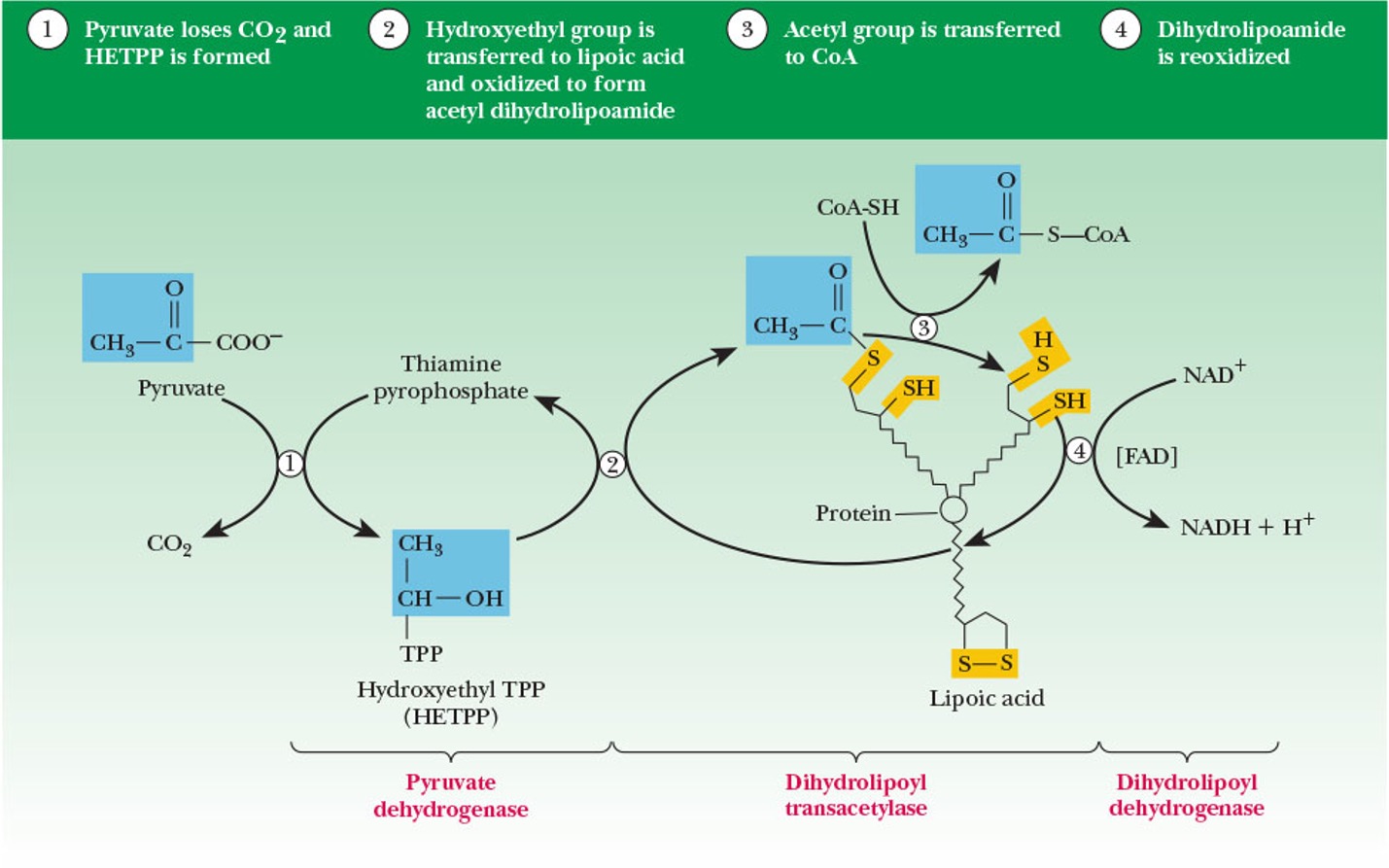
why is there a highly efficient conversion of pyruvate to acetyl-CoA
the spatial orientation of the enzymes within the pyruvate dehydrogenase complex is relatively compact
the first advantage of the multienzyme arrangement using individual enzymes to carry out the reaction
the various stages of the reaction can take place more efficiently because the enzymes are close to each other (proximal)
the second advantage of the multienzyme arrangement using individual enzymes to carry out the reaction
regulatory controls can be applied more efficiently in multienzyme complexes than in individual enzyme systems