Respiratory system part 1
 Call Kai
 Learn
 Practice Test
 Spaced Repetition
 Match
 Flashcards
 Knowt Play
1/33

There's no tags or description
Looks like no tags are added yet.
34 Terms
Respiratory system functions
Air conduction and conditioning
Gas exchange
Regulation of pH
Conducting portion
Nasal cavity to terminal bronchioles
Respiratory portion
Respiratory bronchioles to alveoli
Upper respiratory tract
Nasal to larynx
Lower respiratory tract
Trachea to alveoli
Resistance in respiratory system
decreases as air travels from the trachea down to the alveoli
Respiratory Mucosa
Epithelium, basement membrane, and lamina propria
Lamina propria
LCT with extensive elastic fibers directly underneath respiratory epithelium
Muscularis mucosa
Smooth muscle that controls airway diameter in lower respiratory tract
Submucosa
DICT that regulates distensibility
Location of exocrine glands, arterioles, venules, and nerve fascicles
Musculo-Cartilaginous layer
Hyaline cartilage: nose to segmental bronchi
Elastic cartilage: smooth muscle
Trachealis: smooth muscle
Skeletal muscle is limited to pharynx
Adventitia
LCT to DICT- binds to surrounding structures
Respiratory epithelium
PSCC-> ciliated columnar-> ciliated cuboidal-> simple cuboidal-> squamous
Basal cells
Give rise to all respiratory epithelium except for alveolar cells
Goblet cells
secretes mucus
Located in upper respiratory to primary bronchiole
Brush cell
receptor cell with microvilli that detect bacterial protein and forms synapse with visceral afferent to initate cough reflex
found in upper respiratory to primary bronchiole
Granule cell
enteroendocrine cells; innervated; detects gases and regulates the diameter of airways
Upper respiratory to primary bronchiole
Clara (club) cells
dome surface; prevents collapse by secreting lipoprotein that reduces surface tension
Primary bronchiole to respiratory bronchiole

Type 1 alveolar cell (pneumocyte
faciliate gas exchange
location: alveoli

Type 2 alveolar cell (pneumocyte)
Secrets surfactant, to prevent collapse of alveoli; stem cell population for type 1
Location: elveoli

Respiratory serous gland characteristics
water protein secretion that is found in the nasal cavity
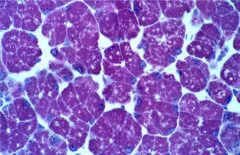
Respiratory serous gland function
dissolves odorant molecules for olfaction, hydrating mucosa and conditioning air
Respiratory mucous gland characteristics
Carbohydrate sticky secretion; found in larynx, trachea, and bronchi

Respiratory mucous gland function
role in conditioning air
Respiratory seromucous gland characteristics
mixed secretion; found in upper respiratory to bronchi

Respiratory seromucous gland function
role in conditioning air
Nasal cavity
made up of nasal vestibule, respiratory region, olfactory region
Nasal vestibule
Transition between skin and respiratory epithelium
contains vibrissae and sebaceous glands to entrap particles

Respiratory region
lined by PSCC epithelium, lamina propria contains capiallary loops to warm air
concha: increases surface area and creates turbulent air flow to entrap particles and humidify air

Olfactory region
olfactory epithelium facilitates smell

Nasal infections
capillaries become engorged and leaky
lamina propria of mucosa swells with fluid and immune cells
Increased seromucous secretions
Paranasal sinuses
AIr filled spaces that extend from nasal cavity
contains respiratory epithelium and numerous goblet cells
provides additional conditioning of air

Pharynx
connects nasal and oral cavities to larynx and esophagus
composed of nasopharynx, oropharynx, laryngopharynx

Larynx
Tubular structure containing hyaline and elastic cartilage
produces phonation and continues into trachea
