fa26 ARCH.2210.01: Architectural History Midterm
 Call Kai
 Learn
Learn Practice Test
 Spaced Repetition
 Match
Match Flashcards
 Knowt Play
 Podcast
1/77

There's no tags or description
Looks like no tags are added yet.
Name | Mastery | Learn | Test | Matching | Spaced | Call with Kai | Chat |
|---|
No analytics yet
Send a link to your students to track their progress
78 Terms
Vernacular Architecture
local or regional building, using traditional materials and resources form the area.
Dolmen
a prehistoric monument of two or more upright stones supporting a horizontal stone slab
Vault
a roof in the form of an arch
Monolith
a large single upright block of stone
Neolithic
"new stone age," the beginning of agriculture, first cities
Abstraction
dealing with ideas; art that is free from representational qualities
Sacred Landscape
geographic areas that have special meaning for people who have a longstanding or historical association and relationship within a region
Cistern
a tank for storing water
Barrio
"neighborhood"
Roofcomb
structure that tops a pyramid
Theocracy
a system of government in which priests rule in the name of God
Geometry
"earth measurement"; mathematics concerned with points, lines, surfaces, solids
Neolithic Period
"new stone age"; the period when agriculture begins (10,000-2,200 BCE)
Axis
a line of orientation
Axis Mundi
symbolic center of the world, connection to the heavens
Hypostyle Hall
interior space with rows of columns
Pylon
monumental gateway with truncated pyramid towers
Altar
table for religious rituals
Obelisk
tapered stone pillar
Orthogonal
involving right angles and straight lines
Imhotep
architect of Djoser's stepped pyramid
Order
an assemblage of parts subject to uniform established proportions, regulated by rules for

how the parts are combined.
Greek orders
Doric, Ionic, Corinthian
Democracy
a system of government by the whole population
Stoa
a building that is mostly an open colonnade; multipurpose and public
Oikos
household
Polis
city-state (e.g. Athens, Sparta)
Procession
orderly movement along a religious route
Entablature
a horizontal, continuous lintel on a classical building, supported by columns
Pediment
the triangular upper part of the front of a building in classical style
Pericles
a Greek politician and general during the Golden Age of Athens
Republic
a state in which supreme power is held by the people and their elected representatives
Mausoleum
magnificent tomb
Forum
public meeting place
Basilica
large rectangular hall used as law courts in ancient Rome, and for early Christian
churches
Domus
town house for wealthy Romans
Atrium
a central hall or court
Villa
a large country house for wealthy Romans
Spolia
stone taken from an old structure and repurposed for new construction
Constantine
the first Roman emperor to convert to Christianity
Qibla
the direction of the Kaaba (the sacred building at Mecca), to which Muslims turn at prayer. Mosques face in this direction.
Muquarnas
a form of ornamented vaulting in Islamic architecture
Imaret
public soup kitchen
Algorithm
a process or set of rules to be followed. (This term is derived from the name of a 9th-century Arabic mathematician.)
Ablaq
alternating rows of light and dark stone
Mihrab
a niche in the wall of a mosque toward which the congregation faces
Minaret
a tall slender tower for calling Muslims to prayer
earliest remains of dwelling
Terra Amata, France, 400,000 BCE
early use of symbolic expression
Lascaux Caves, France, 15,000 BCE

early nomadic religious site
Göbekli Tepe, Turkey, 9,500 BCE

early permanent settlement / city
Çatal Höyük, Turkey, 7,100 BCE

religious complex of the Olmec, whose name means "rubber
people" and who were known as the "mother culture" of the region
Mount Alban, Mexico, 500 BCE

early center of Maya society
Tikal, Guatemala, 300 BCE

known as the "city of the gods"; the largest city in pre-colonial Americas
Teotihuacan, Mexico, 100 BCE

later Maya religious center
Chichen Itza, Mexico, 800

an important Sumerian city-state in ancient Mesopotamia
Eridu, Iraq, 3800 BCE

stepped pyramid / temple
Ziggurat of Eridu, Iraq, 2000 BCE

early (stepped) pyramid
Pyramid of Djoser, Egypt, 2650 BCE

the largest pyramid, tomb of Khufu
Great Pyramid of Giza, Egypt, 2570 BCE

large temple complex; axial organization
Temple of Karnak, Egypt, 1950 BCE
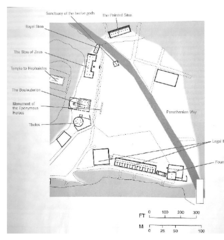
central public space
Agora, Athens, Greece, 500 BCE

ancient temple complex
Acropolis, Athens, Greece, 450 BCE

main temple on the Acropolis
The Parthenon, Athens, Greece, 432 BCE

early gridded city plan
Miletus, Greece, 470 BCE

giant amphitheater for contests and spectacles
Colosseum, Rome, 80

sprawling palace near Rome
Hadrian's Villa, Tivoli, 120

Roman military colony
Timgad, Algeria, 100

spherical dome, built of concrete
Pantheon, Rome, 125

large public baths
Baths of Caracalla, Rome, 216

commemorating military victories
Arch of Constantine, Rome, 315

stone building at the center of Islam's holiest site
Kaaba, Mecca, Saudi Arabia

Islamic shrine on the Temple Mount
Dome of the Rock, Jerusalem, Israel, 692

one of the largest and oldest mosques
Great Mosque of Damascus, Syria, 715

center of learning and capital of Abbasid empire
Round City of Baghdad, Iraq, 766
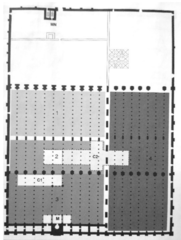
large mosque, expanded several times
Great Mosque of Cordoba, Andalusia, Spain, 988

ornate palace and fortress complex
The Alhambra, Granada, Andalusia, Spain, 1360