PHGY209 nervous system
 Call Kai
 Learn
 Practice Test
 Spaced Repetition
 Match
 Flashcards
 Knowt Play
1/77

There's no tags or description
Looks like no tags are added yet.
78 Terms
what are the elements of the CNS? the PNS?
CNS
brain and spinal cord
PNS
sensory/motor neurons
what are the main components of a neuron?
soma (cell body) → metabolism, organelles, cell function
dendrites → receives synapse
axon → sends synapse
what is the resting membrane potential of a neuron?
the charge of the interior of a neuron compared to the outside
~ -70mV
at rest, what is the relative abundance of ions inside/outside of a neuron? how is the resting membrane potential made?
inside → high in K+ and negatively charged proteins
outside → high in Na+ and negatively charged proteins
at rest, K+ channels are open and K+ tends to leak out → (-) overall charge
what is the membrane potential dependant on? how is it changed?
depends on concentration gradient and relative permeability of ions
concentration changes little
permeability changes because of pumps
what pump maintains sodium and potassium gradients?
sodium potassium pump
uses ATP to pump out 3 Na+ and pump in 2 K+ into cell
what is a action potential?
rapid change in membrane potential travels along an axon
how can an action potential be generated?
voltage gated sodium channels closed at resting potential
when depolarized past the threshold level, they open → Na+ enters the cell
rapidly inactivates
compare the density of voltage-gated sodium channels to leak potassium channels in an axon
voltage gated sodium channels → much more dense
peak of action potential → Na+ into the cell is far more permeable than K+ out
how does an axon repolarize after an action potential?
opening of voltage gated potassium channels
how is an action potential propagated down an axon?
diffusion of Na+ down the axon from the initial segment
what are the types of refractory periods for action potentials?
absolute refractory period → Na+ channels inactivate and another action potential cannot follow
relative refractory period → K+ channels are open and hyperpolarize the axon → another action potential is less likely to fire
what determines the intensity of a nerve signal?
frequency/pattern of action potentials
what does pufferfish tetrodotoxin do? what about Phyllobates batrachotoxin?
tetrodotoxin → inhibits sodium channels → prevents depolarization/action potential
batrachotoxin → activates sodium channels → seizures
how do local anaesthetics affect action potentials?
block Na+ channels
far less potent than neurotoxins
how do antiepileptics affect action protentials?
slightly inhibit Na+ channels
not enough to cause sedation but enough to prevent seizures
what determines the rate of action potential propagation?
axon diameter
myelination
what is myelination? what are the types of myelin cells?
myelin wrapped around axons
CNS → Schwann cells
PNS → oligodendricytes
describe saltatory conduction
nodes of ranvier in between myelin have a lot of sodium channels
Na influx at each node → charge spreads down axon to active Na channels at next node
faster than constantly reactivating action potentials along the axon
what causes multiple sclerosis?
unmyelinated regions of axons
what is the difference between white and grey matter?
white matter → myelinated → mostly axons
grey matter → unmyelinated → cell bodies, dendrites, synapses
what is the structure of synapses?
presynaptic terminal → contains presynaptic vesicles with NTs → concentrated at the active zone
synaptic cleft
postsynaptic spine → postsynaptic density contains proteins to which NTs bind
what channels are present in each side of the synapse?
presynaptic → voltage gated Ca+ channels open and Ca+ influx trigger NT release
postsynaptic → ligand-gated ion channels activated by NTs
what is the process of synaptic transmission?
action potential enters presynaptic terminal → Ca+ channels open and Ca+ enters terminal
presynaptic vesicles fuse with membrane to release NTs into synaptic cleft
NTs activate receptors in the postsynaptic cleft to depolarize it
what are the types of postsynaptic response?
excitatory (EPSP) → depolarization of postsynaptic membrane
inhibitory (IPSP) → hyperpolarization of postsynaptic membrane
what is the main excitatory NT?
glutamate
what are the types of excitatory postsynaptic receptors?
AMPA → faster response
NMDA → responsible for learning/ synaptic plasticity
how do AMPA receptors work?
glutamate binding opens the channel to allow Na+ into the postsynaptic membrane → depolarization
how do EPSPs initiate action potentials?
one EPSP cannot depolarize past the action potential threshold
many at once are needed
what are the key properties of NMDA receptors?
activated by both glutamate and glycine
at rest, blocked by Mg2+ → depolarizing expels Mg2+
open pore is highly permeable to Ca2+
how do NMDA receptors strengthen EPSPs?
many EPSPs at once will depolarize the post synaptic membrane enough to open NMDA receptors → coincidence detector
future EPSPs will be stronger → synaptic plasticity
what model describes how synaptic plasticity is measured?
LTP (long term potentiation)
high frequency of EPSPs open NMDA receptors (control)
more AMPA receptors are formed (induction)
EPSPs afterwards are larger (LTP)
why is high glutamate concentration toxic to neurons?
excitotoxicity
excess Ca2+ influx by NMDA receptors kills cells
what is the main inhibitory NT? how does it hyper polarize the postsynaptic membrane?
GABA → binds to GABA receptors → influx of Cl-
what is the difference between where excitatory synapses and inhibitory synapses synapse?
excitatory → dendrite spines
inhibitory → dendrite shafts closer to soma
what type of receptors are AMPA and NMDA receptors? what other type exists in glutamate synapses?
ionotropic receptors → influx of ions
metabotropic receptors (mGluRs) release secondary messengers
what kinds of secondary messengers are released by mGluR?
G protein activators
actives transcription factors
activates protein kinases
what are neurotransmitters that act of metabotropic receptors instead of ionotropic?
neuromodulators
i.e. dopamine, serotonin, endorphins
modulate global brain state (like mood, attention, alertness)
produced in brain stem and midbrain and axons diffuse through brain
what does the CNS encompass?
brain and spinal cord → cranial and spinal nerves
afferent (sensory input)
efferent (motor output)
what are the types of efferent signals from the CNS? what muscles do they affect and how?
somatic → excite skeletal muscle
autonomic → excite and inhibit smooth and cardiac muscle
enteric → controls digestive muscles

label the anatomy of the brain

what are the divisions of the spinal cord?
cervical → neck shoulders arms and hands
thoracic → shoulders chest and upper abdomen
lumbar → lower abdomen, hips, legs
sacral → genitals and lower digestive tract
coccygeal
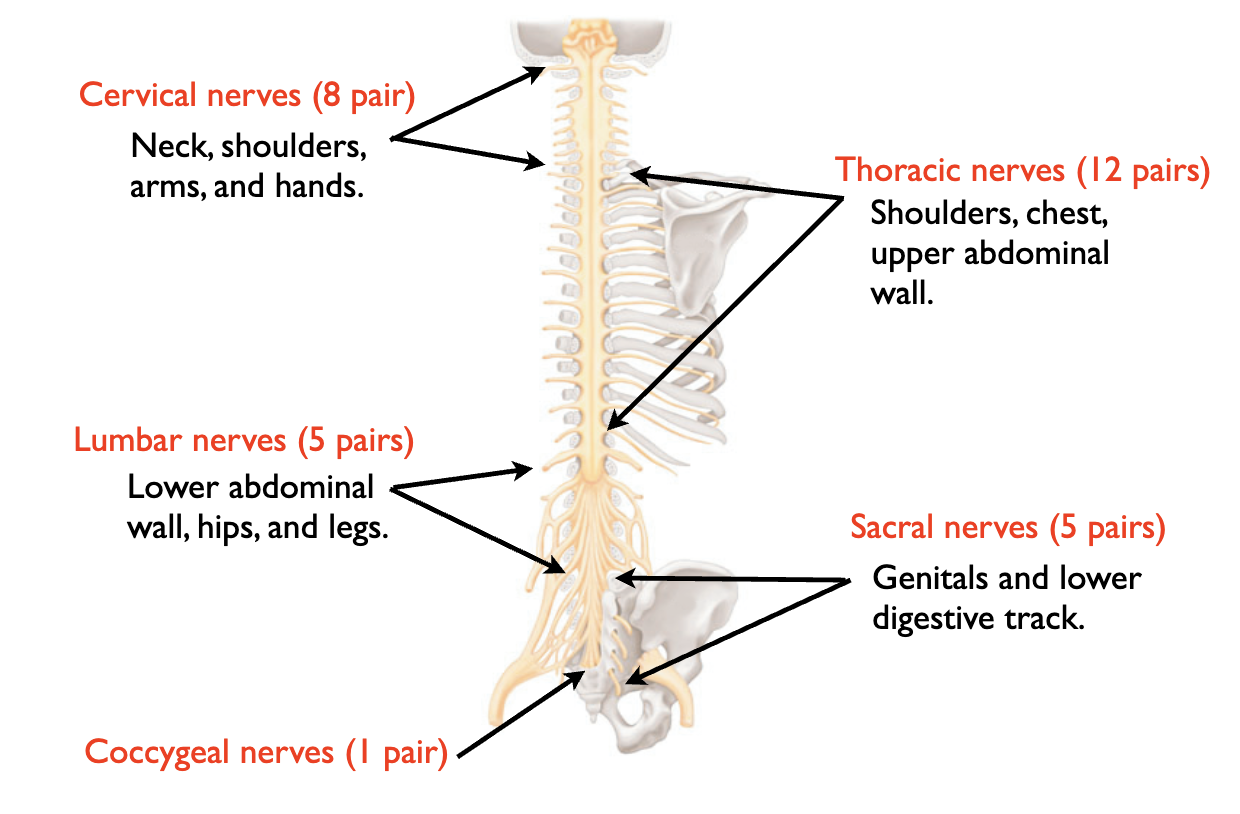

label the spine anatomy

what are some examples of cranial nerves?
olfactory nerve
optic nerve
what can be the result of brain adema?
increased intracranial pressure → pushes on optic nerve that regulate pupillary response
what is the process of embryonic nervous system development?
early cells have a divided mass of cells → forms the neural plate
neural plate has layers endoderm, mesoderm, ectoderm
ectoderm converges to form neural groove
pinches off to form neural tube → becomes CNS
what are the vesicles of the neural tube? which part of the CNS does each become?
forebrain → cerebrum and thalamus
midbrain → midbrain
hindbrain → cerebellum, pons, medulla
the cavity become the ventricles and central canal
where is CSF contained?
2 lateral ventricles
third and fourth ventricle
where is CSF made?
the choroid plexus (mainly of lateral ventricles)
what are the functions of CSF?
support and cushion CNS
nourishment of the brain
removal of waste by absorption at the arachnoid villi
describe the process of CSF circulation
foramen of Monro drains CSF into third ventricle
cerebral aqueduct in midbrain drains it into the fourth ventricle and central canal
foramens of Lushka and Magendie drain into subarachnoid space
arachnoid villi take it from subarachnoid space to blood stream
what is hydrocephalus? what are the types?
CSF build up
communicating → CSF can flow through ventricles but can be reabsorbed
non-communicating → CSF circulation between ventricles is obstructed
what are the 3 meninges of the CNS? where is the subarachnoid space?
dura mater
arachnoid membrane
pia mater
subarachnoid space in between pia mater and grey matter
how does CNS re enter the blood stream?
dura converges down the midline to form the dural sinus
CSF is drained into the dural sinus via arachnoid villi
how is blood supplied to the brain?
common carotid → splits into internal carotid (inside brain) and external carotid (outside of head)
2 vertebral artery → converge into basilar artery
basilar artery connects with internal carotids to form circle of willis
what are the factors of the blood brain barrier?
tight junctions of epithelial cells
only lipid soluble substances diffuse → ions, active transport of glucose and amino acids, no plasma proteins or large organic molecules
astrocytes
what are the functions of astrocytes?
structural support
induces tight junctions of epithelial cells
NT reuptake
what is the difference between sensation and perception?
sensation: awareness of sensory stimulation
perception: understanding of sensations meaning
what is the law specific nerve energies? what is an example?
regardless of how a sensory receptor is activated, the sensation felt corresponds to the receptor
rub eyes hard and you’ll see light
what is the law of projection? what is an example?
regardless of where in the brain a sensory pathway is stimulated, the sensation is always felt at the location of the sensory receptor
phantom limb pain
how does stimulus cause afferent activity?
stimulus energy depolarizes receptor
adequate stimulus produces action potentials
action potentials propagate to release NTs
what results in different magnitudes of stimulus response?
stronger stimulus energies cause higher magnitude of receptor depolarization
higher frequency of action potentials
higher magnitude of NT release
how can we be sensitive to changes in sensory input?
adaptation → afferent response occurs with changes in stimulus intensity
non adapting → encodes stimulus intensity
slowly adapting
rapidly adapting → encodes fast changes in stimulus
what is the receptive field (RF)?
region of space that activates a sensory receptor
response is stronger closer to the receptor
what is the population code for stimuli? what is acuity?
RFs overlap
the receptor closest to the stimulus has the largest response
acuity is the ability to distinguish one stimulus from another → small RFs have higher acuity
what is lateral inhibition?
inhibitory secondary neurones (interneurons) inhibit responses adjacent to the strongest one
sharpens acuity
what receptors mediate touch? what types are there?
mechanoreceptors (afferent neuron + end organ)
what different mechanoreceptors are in each part of the skin?
surface layer
meissners corpuscle: rapidly adapting→ light stroking/fluttering
merkel disk: slowly adapting → pressure and texture
deep
pacinian corpuscle: rapidly adapting → strong vibrations
ruffini endings: slowly adapting → stretching and bending of skin (shape of objects)
what is proprioception? how is it sensed?
sense of body position
muscle spindles
how are mechanoreceptors activated?
mechanical deformation of cytoskeletal strands pulls open ion channels
how is temperature sensed? how can it be artificially induced?
thermoreceptors have thermally activated ion channels
cold afferents: 0-35C → activated by menthol
hot afferents: 30-50C → activated by capsaicin and ethanol
extreme temperatures activate pain receptors
how is pain sensed?
nociceptors: free nerve endings that respond to intense mechanical deformation, extreme temperature and chemicals
visceral pain receptors: respond to inflammation
how are nociceptors enhanced?
hyperalgesia (bottom-up)
stimulus of nociceptors release substance P in spinal cord
substance P acts backwards on mast cells to produce histamine which enhances pain response
substance P dilates blood vessels near the site of injury
what pathway does touch and proprioception take to the somatosensory cortex?
travels to spinal nerve → dorsal root → up dorsal columns
synapse and crosses midline in the medulla
synapses at thalamus and somatosensory cortex
what pathway does pain and temperature take to the somatosensory cortex?
travels to spinal nerve → dorsal root
synapses at dorsal horn and crosses midline
travels up anterolateral column
branches into reticular formation
synapses at thalamus and somatosensory cortex
what is the difference between the pathways of touch and proprioception versus pain and temperature?
touch and proprioception are ipsilateral in the spinal cord and contralateral in the brain
pain and temperature are contralateral in both
what is referred pain? what is an example?
visceral and somatic pain afferents synapse on the same neurons in the spinal cord
heart attack causes left arm pain
how are nociceptors regulated?
analgesia (top-down)
descending pathways from the brain stem release opiate NTs into spinal cord which inhibit substance
i.e. morphine