Physics: Oscillations, Wave Motions, Superposition
 Call Kai
 Learn
Learn Practice Test
 Spaced Repetition
 Match
Match Flashcards
 Knowt Play
1/39

There's no tags or description
Looks like no tags are added yet.
Name | Mastery | Learn | Test | Matching | Spaced | Call with Kai | Chat |
|---|
No analytics yet
Send a link to your students to track their progress
40 Terms
sign convention for SHM
follow displacement, opposite to direction of force
ω =
2πf or 2π/T
how to find max speed?
max speed occurs at eqb. By POCOE, loss in epe = gain in ke. x for epe = max displacement.
equations of displacement --> vel --> acc
usually x = x0*sin(ωt)
however, if it is released from max disp, then x = x0*cos(ωt)
for v, differentiate x, for a, differentiate v
graphical relation of x,v,a curves
if x = +sin graph, v = +cos graph, a = -sin graph
if x = +cos graph, v = -sin graph, a = -cos graph (a ∝ -x)
amplitude of x,v,a curves
A = x0
x: A
v: ωA
a: ω^2*A
velocity-displacement graph
v0 = ωx0
Acceleration-displacement graph
A = x0
why is bouncing ball not SHM
(in all prove SHM qsn, prove that a = -ω^2x)
ball is alw subjected to force of gravity downwards when its in motion.
acc is alw downwards and is constant, no eqb position
thus ball does not satisfy a ∝ -x, not SHM
SHM qsn
take sign convention to follow disp
by N2L, Fnet = ma (then write the eqn for Fnet which will be negative value)
you will arrive at a = -Cx (C = ω^2)
"thus motion is simple harmonic where ω^2 = C"
does the period of a damped oscillation increase with time
no. T is constant in oscillation
is the frequency of damped osc < undamped?
yes. natural frequency is higher during free osc
graphical significance of a frequency-response graph
Y = amplitude of the oscillating system. X = frequency. C = driver amplitude. its NEVER zero. the peak is when Fd = Fn. max amp, max transfer of energy. when the system has zero damping, the Fn becomes a vertical asymptote. a more damped system will have a lower amplitude and peak at a lower frequency
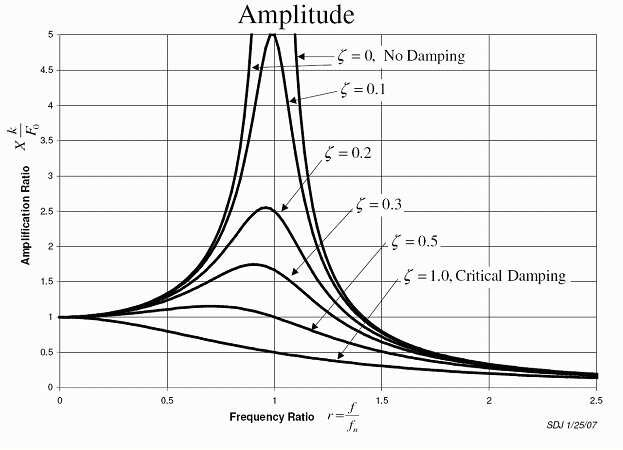
resonance
resonance is a phenomenon in which an oscillating system responds with maximum amplitude to an external periodic driving force when the frequency of the driving force equals to the natural frequency of the system. At resonance, there is a maximum transfer of energy from the driving system to the driven system.
significance of damping in vel-disp graph
spiral inwards clockwise. start from either x0 or -x0 as mentioned in the question
both velocity and displacement amplitudes shrink toward zero due to energy loss.
energy formulae in shm
find eqn of v. KE = 1/2 m v^2
TE = KEmax = 1/2 m (ωx0)^2
PE = TE - KE
restoring force
net force that restores system back to equilibrium
to sketch disp-time graph from disp-dist graph
shift the curve a little in the direction of propogation of wave
are sound waves polarised?
sound waves are longitudinal - they cannot be polarised
phase difference formula
ϕ = ∆x/λ *2π = ∆t/T *2π
v=
fλ
when a wave enters a new medium, what remains unchanged: wavelength, speed, frequency
frequency
intensity =
k(Amplitude)^2 = power/area = rate of energy transfer per unit area across a surface perpendicular to the direction of wave propagation
State how a polarized transverse wave differs from an unpolarised transverse wave.
polarised: oscillations of the particles are confined to a single plane. no restriction for unpolarised
area for intensity from point source
A = 4πr^2, thus I ∝ 1/r^2
what happens to I and A when passing through a polariser
I is halved. A does NOT change.
malus' law
I = I₀ cos²θ
identify R and C from disp-time curve
+ve gradient = R, -ve gradient = C
deduce D/C or I/C
phase diff due to source + phase diff due to path difference = n(pi)
if odd integer of pi, waves meet in antiphase, interfere destructively. vice versa
how are stationary waves formed?
Stationary waves are formed when two waves of the equal amplitude and frequency travelling with the same speed but in opposite directions superpose
when both ends are closed
nodes at both ends
fn = nv/2L, n = 1,2,3… (all harmonics are possible)
when both ends are open
antinodes at both ends
fn = nv/2L, n = 1,2,3… (all harmonics are possible)
one open end, one closed end
node at closed end
antinode at open end
fn = nv/4L, n = 1,3,5… (only odd harmonics possible)
what happens to the signal in a stationary radio wave?
nodes - small / zero amplitude --> weak signal - static sound
antinodes - large / max amplitude --> strong signal - clear audio
double slit formula
x = λD/a
x = distance between two bright fringes or two dark fringes
D = dist bw slit and screen
a = dist bw the two slits
central maxima is 0th order.

single slit formula
sin(θmin) = λ/b = dist between central fringe and first minima
θmin = angle between central maxima and first minima
b = width of the slit
note: central fringe = central maxima, because the central fringe is a maxima (bright)
central fringe is brighter + twice as wide as the other fringes
rayleigh's criterion
two sources are just resolved if the central maximum of one diffraction pattern falls on the first minimum of the diffraction pattern of the other
rayleigh criterion formula
θ = λ/b
θ = angle between the two sources with the vertex being the middle of the slit.
b = width of slit
(for my info: from sin(θ) = λ/b, since θ is small, sinθ = θ (mf27)
does gpe variy exponentially or linearly with displacement in shm
gpe varies linearly with displacement.
when angular velocity is constant, does linear momentum change?
As the particle moves in a circle, its velocity changes in direction, and so momentum also changes and is not constant.