Genetic Code and Translation
 Call Kai
 Learn
Learn Practice Test
 Spaced Repetition
 Match
Match Flashcards
 Knowt Play
1/51

There's no tags or description
Looks like no tags are added yet.
Name | Mastery | Learn | Test | Matching | Spaced | Call with Kai | Chat |
|---|
No analytics yet
Send a link to your students to track their progress
52 Terms
Overview: From Gene to Protein Product
codon - a three nucleotides sequence of DNA/RNA that codes for an amino acid

Primer on the Structure and Function of Proteins
• 20 common amino acids are found in proteins
• all have a similar structure with a central carbon bonded to amino, hydrogen, carboxyl, and R-groups
• the R-groups differ between amino acids
• amino acids are joined by peptide bonds to form a polypeptide
• polypeptides have polarity - one end has a free amino group (N-terminus); the other end has a free carboxyl group (C-terminus)
• the first amino acid in a polypeptide is N-terminal; the last amino acid is C-terminal
• as the polypeptide chain grows amino acids are added to the Cterminus
• alpha () helices and beta () pleated sheets are common secondary structures
• interactions between secondary structures creates tertiary structure

Bacterial RNA Polymerase is a Complex of Polypeptides

The Genetic Code – How is Information Stored in DNA?
• mathematical reasoning suggested that an amino acid could be encoded by a triplet of nucleotides now referred to as a codon
• 1 or 2 nucleotides can only specify 4 or 16 amino acids respectively
• 3 nucleotides can be arranged in 64 combinations, more than enough to specify the 20 amino acids
• using bacteriophages, Frances Crick and colleagues (Brenner, Barnett, Watts-Tobin) confirmed in 1961 that the genetic code is a triplet code
Breaking The Genetic Code: Opening Pandora’s Box
• there are 20 amino acids and 64 possible codons to encode them
• strategies used to break the code ranged from simple to complex
• in one case a poly U RNA was synthesized and translated in vitro - a polypeptide consisting only of phenylalanine resulted …. therefore, UUU codes for phenylalanine
• Francis Crick “the Genetic Code is as important to Biology as the Periodic Table is to Chemistry”

Important Features of The Genetic Code
• the genetic code is written in RNA language
• three codons are stop (termination) codons that signal the end of translation
• only Met (the translation start codon) and Trp are encoded by a single codon

The Genetic Code is Degenerate
• 61 sense codons encode one of the 20 amino acids: therefore, the code is degenerate because more than one codon can specify the same amino acid
• different codons that specify the same amino acid are said to be synonymous

The Genetic Code is Unambiguous
• the genetic code is unambiguous; each codon has a unique meaning
e.g., UUU always means phenylalanine

The Genetic Code is Non-Overlapping
• the genetic code is non-overlapping; a single nucleotide is not included in more than one codon

An mRNA has Three Reading Frames
• a sequence of nucleotides in mRNA has three reading frames - the correct one (reading frame 1) is specified by the translation start (initiation) codon AUG
• each reading frame specifies a different sequence of amino acids


Bacteria and Eukaryotes use Different Forms of Methionine to Initiate Translation
• in bacteria the first amino acid inserted into the polypeptide is N-formyl methionine
• at subsequent internal AUG codons methionine is used
• in eukaryotes the first amino acid inserted into the polypeptide is methionine; eukaryotes do not use Nformyl methionine

Specialized tRNAs are Used to Initiate Translation of an mRNA
• specialized tRNAs are used for translation initiation
• tRNAi fMet and tRNAi Met are the initiator tRNAs in bacteria and eukaryotes respectively
• a different tRNA, tRNAMet, is used for internal AUG codons in bacteria and eukaryotes

The Genetic Code is Universal
• the genetic code is universal to all organisms with a few exceptions found in mitochondria and protozoans
e.g., UGA in human mitochondria encodes Trp

The Genetic Code is Degenerate
• 61 sense codons encode one of the 20 amino acids: therefore, the code is degenerate in the sense that more than one codon can specify the same amino acid
• codons that specify the same amino acid are said to be synonymous

Components of the Translational Machinery
• mRNA
• transfer RNA (tRNA) and aminoacyl synthetases
• ribosomes which consist of ribosomal RNA (rRNA) and ribosomal proteins
• initiation factors, elongation factors, termination factors
• tRNA and rRNA are not translated and function as RNA products
The Mechanism of Translation
• translation begins at the 5’ end of the coding region (3’ end of the 5’UTR) and moves towards the 3’ end of the coding region
• the amino end of the polypeptide is made first with new amino acids added to the carboxyl end
Translation occurs in four stages: 1. tRNA charging 2. Initiation 3. Elongation 4. Termination

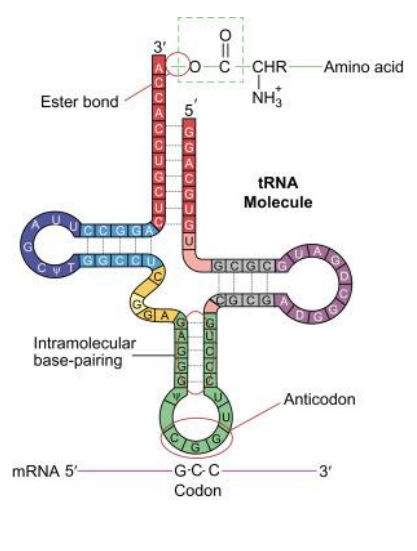
tRNA Charging: Amino Acids are Covalently Linked to the 3’ End of tRNAs
• the 3’ end of a tRNA is always 5’ CCA 3’
• amino acids are covalently bonded to the 3’ adenine • when a tRNA carries an amino acid, it is said to be charged
• the anticodon base pairs with the mRNA codon specifying the amino acid carried by the tRNA
• if tRNAs with different anticodons carry the same amino acid they are said to be isoaccepting tRNAs

tRNA Charging: tRNAs are Charged by tRNA Synthetases
• each type of tRNA has a unique sequence, structure and shape that is recognized by its cognate tRNA synthetase
• tRNA synthetases load the correct amino acid onto a tRNA; there are 20 different tRNA synthetases that specifically recognize each amino acid and the appropriate tRNA for that amino acid
• mistakes are rare ranging from 1/10,000 to 1/100,000 due to proofreading activity by the synthetase
Overview: Translation Initiation in Bacteria and Eukaryotes
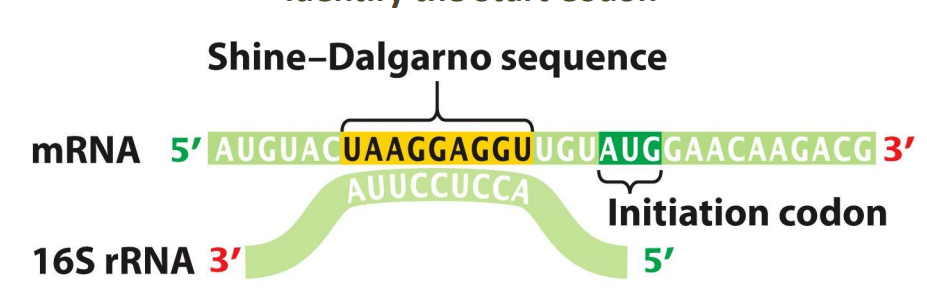
• in bacteria the small subunit of the ribosome recognizes the start codon by binding to the Shine-Dalgarno sequence which is seven nucleotides upstream of the start codon
• in eukaryotes the small subunit of the ribosome binds to the 5’ cap and scans along the mRNA until it finds an AUG (start) codon in a Kozak consensus

In Bacteria Base Pairing Between the Shine-Dalgarno Sequence and the 16S rRNA Allows the Ribosome to Identify the Start Codon
• the 16S rRNA plays a functional role in initiation of translation
• the small subunit of the bacterial ribosome recognizes the ShineDalgarno sequence in the mRNA by complimentary base pairing with the 16S rRNA
• this allows the ribosome to know exactly where the AUG translation start codon is
Initiation of Translation in Eukaryotes
• in eukaryotes the small subunit of the ribosome binds to the 5’ cap and is stabilized by interactions between proteins bound to the cap and the polyA tail
• the small subunit of the ribosome then scans along the mRNA until it finds the Kozak consensus which includes the AUG codon
• vertebrate Kozak sequence (ACCAUGG)


Initiation of Translation in Bacteria
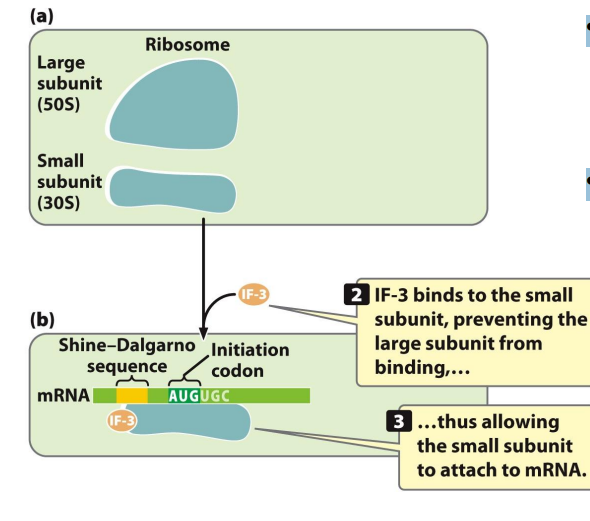
• the Shine-Dalgarno sequence is in the 5’UTR of the mRNA
• IF-3 = initiation factor 3
• the anti-codon of tRNAi fmet recognizes and base pairs with the AUG start codon • pairing between the codon and anticodon is antiparallel
i.e., codon 5’AUG 3’ anticodon 3’UAC 5’
• GTP is hydrolyzed
• the initiation factors dissociate from the 30S initiation complex
• the 70S initiation complex forms
Initiation of Translation - What is Important?
Bacterial translational initiation:
• the 16S rRNA in the small ribosomal subunit base pairs with the Shine-Dalgarno sequence in the mRNA identifying the location of the AUG start codon
• IF-3 binds to the small ribosomal subunit and prevents binding of the large subunit until the initiator tRNA is bound
• the initiator tRNAi fmet brings formyl-methionine to the ribosome by base pairing between the anti-codon of the tRNA and the AUG codon … this step is energy dependent and requires GTP
• GTP is hydrolyzed to GDP and the initiation factors dissociate from the complex; the large ribosomal subunit joins the complex to form the 70S initiation complex
Eukaryotic translational initiation:
• the small subunit of the ribosome recognizes the 5’ cap of the mRNA and scans down the mRNA looking for an AUG in a Kozak consensus
• proteins bound to the 5’ cap and the polyA tail stabilize the small subunit of the ribosome on the cap
Elongation of the Polypeptide in Bacteria: (Similar in Eukaryotes)
• the ribosome has three sites; E (exit), P (peptidyl) and A (aminoacyl)
• the initiator tRNA is the only tRNA to bind to the mRNA at the P site - all other tRNAs enter the ribosome through the A site (also true in eukaryotes)


Elongation of the Polypeptide
• the elongation factor EF-Tu, GTP and a charged tRNA form a complex which moves into the unoccupied A site
• GTP is hydrolyzed providing the energy to stabilize the charged tRNA in the A site
• EF-Tu is released and EF-Ts replaces GDP with GTP so the EF-Tu can be recycled

Elongation of the Polypeptide - Formation of a Peptide Bond
• fMet on the tRNA in the P site is linked via a peptide bond to the amino acid on the tRNA in the A site (proline in the figure); the polypeptide is transferred to the tRNA in the A site
• the peptide bond forms in the peptidyl transferase center of the ribosome and is catalyzed by the 23S/28S rRNA in bacteria/eukaryotes respectively

Elongation of the Polypeptide - Translocation
• the ribosome moves one codon down the mRNA (translocation)
• energy for this step is provided by an EF-G:GTP complex
• the uncharged tRNAi fMet exits from the E site and is charged with an amino acid by the appropriate tRNA synthetase; the newly charged tRNA then recycles for use in translation
• the A site is open to receive another charged tRNA
• the cycle is repeated until a termination codon is encountered

Elongation of Translation - What is Important?
• the ribosome has three sites, E, P, and A
• the initiator tRNA is the only tRNA that binds to the mRNA at the P site; all other tRNAs bind at the A site
• EF-Tu brings charged tRNAs into the A site … this step is energy dependent and requires GTP
• when the GTP bound to EF-Tu is hydrolyzed, EF-Ts exchanges GTP for GDP on EF-Tu so that EF-Tu can be recycled
• a peptide bond is formed between the amino acids in the P and A sites and the polypeptide is transferred to the tRNA in the A site … the 23S/28S rRNAs provide the catalytic peptidyl transferase activity to make the peptide bond (i.e., the rRNAs act as enzymes or ribozymes)
• the ribosome translocates down the mRNA placing the uncharged tRNA in the P site into the E site from which it exits
• EF-G is required for translocation which is an energy dependent (GTP) process
• the tRNA carrying the polypeptide in the A site moves into the P site and the A site is open to receive another charged tRNA
• the cycle repeats until a termination codon is encountered

Termination of Translation
• RF-1 recognizes and binds to UAA and UAG
• RF-2 recognizes and binds to UAA and UGA
• the polypeptide is released from the ribosome
• GTP is hydrolyzed which releases RF-1 or RF-2 from the A site and moves the uncharged tRNA into the E site
• all components: ribosomal subunits, mRNA, tRNAs, initiation, elongation and termination factors are recycled
• the product of translation is an unfolded polypeptide

The Unfolded Polypeptide Must Fold to Become Functional
• the folded polypeptide may have to interact with other polypeptides or be modified (e.g., addition of a carbohydrate or phosphate group) to become functional

Termination of Translation - What is Important?
• when a termination codon is encountered release factors enter the A site
• the polypeptide is released and must fold to become functional
• GTP hydrolysis triggers dissociation of the ribosome/mRNA complex
• all components of the ribosome including the mRNA are recycled
Summary of Translation
• initiation occurs when the small subunit of the ribosome identifies the start codon and the anticodon of an initiator tRNA base pairs with the start codon
• the initiator tRNA base pairs with the codon in the P site of the ribosome and the large subunit joins the complex
• charged tRNAs enter the A site and the growing polypeptide is transferred to the tRNA in the A site by peptidyl transferase
• following translocation, the uncharged tRNA in the P site moves into the E site where it leaves the ribosome and is charged for reuse
• when a termination codon is reached release factors release the polypeptide and trigger dissociation of the ribosome
• the polypeptide must fold and sometimes associate with other polypeptides to become a functional protein or enzyme
DNA/RNA Pairing
• the tRNA anti-codon has same sequence and polarity as the template strand of the DNA except T U
• the amino acid sequence of a protein can be read directly from the non-template strand of the DNA (after introns are removed)

Expected Properties of the Genetic Material
•capable of storing large amounts of complex information
• capable of accurate replication
• must be expressed to generate phenotypes
• must be able to vary between individuals and species
Mutations Lead to Altered Proteins and Phenotypes
Mutation - an alteration in the sequence of DNA that may or may not result in a phenotype
• mutations can occur in somatic or germ-line cells: only mutations in germ-line cells are inherited, however, somatic mutations can give rise to diseases such as cancer
• mutation is important for creating new genetic diversity within a population and adaption to environmental challenges
Base Substitutions in the DNA Alter a Single Codon

Missense Mutation
missense mutation - a mutation that alters a codon to a codon for a different amino acid …. a missense mutation that does not significantly impact the function of the protein is referred to as a neutral mutation

Nonsense Mutation
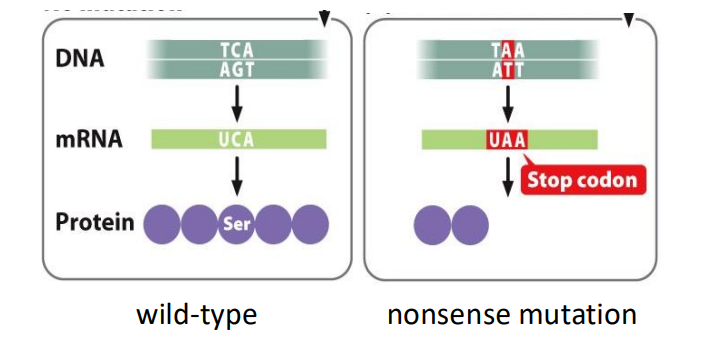
nonsense mutation - a mutation that alters a codon for an amino acid to a stop codon causing protein synthesis to terminate prematurely
Silent Mutation
silent mutation - a mutation that makes no change in the amino acid sequence and does not alter protein function (also called a samesense or neutral mutation)
• most base substitutions in the third position of a codon will result in a silent mutation
• most base substitutions in the first or second positions of the codon result in missense or nonsense mutations

Base Insertions and Deletions in the DNA Alter the Reading Frame
• base insertions and deletions are more common than base substitutions and are referred to as frame-shift mutations

Frame-shift Mutations Cause a Disruption in the Protein Reading Frame
• frame-shift mutations can cause a protein to be shorter (truncated) or longer than expected depending on whether a stop codon in the new reading frame occurs before or after the correct stop codon
• the proteins produced by frame-shift mutations have amino acids not seen in the wild-type protein and are usually non-functional

Odds and Ends of Interest
• how much energy does a cell devote to translation?
• what is the error rate in translation?
• is translation efficient?
How much energy does a cell devote to translation?
.... a lot
• each translation elongation cycle (adding one amino acid to the polypeptide chain) requires two GTP molecules … a 500 amino acid protein requires 1002 GTP molecules to be hydrolyzed to GDP (1000 + 1 for initiation and 1 for termination)
• there are > 20,000 ribosomes translating at any given time in our cells
• additional energy in the form of ATP is needed to charge tRNAs and to transcribe mRNAs, tRNAs, and rRNAs
Most of the RNA in a cell is used for translation

What is the error rate in translation?
•tRNA synthetases have proofreading capability when adding amino acids to tRNAs; mistakes are 1/10,000 to 1/100,000
•there is a decoding center in bacterial and eukaryotic ribosomes that assesses base pairing between the codon and anticodon in the A site; mismatched tRNAs are rejected ….. the 16S/18S rRNAs are the active molecules in the decoding center
•the translation error rate is approximately 1/10,000 amino acids, c.f. 1 per billion nucleotides for DNA replication
• the average protein is 500 amino acids, so 1/20 proteins will be altered (in many cases the protein will be functional if a non-essential region of the protein is altered) > 95% of proteins will be functional so the error rate is acceptable; if the DNA is altered all the protein products will be affected in homozygotes
Is translation efficient?
..... yes
• Wobble hypothesis
• Polysomes
Crick’s Wobble Hypothesis
• the 5’ nucleotide of the anticodon is positionally flexible and can base pair with more than one 3’ nucleotide of a codon
• the mRNA 3rd nucleotide of a serine codon can be either U or C
•the tRNA 5’ anticodon nucleotide guanine (purine) will pair with either mRNA pyrimidine (uracil or cytosine)
• a single tRNA species with anticodon 3’ AGG 5’ will recognize the UCC and UCU codons - this improves the efficiency of translation

The Genetic Code is Degenerate

In Bacteria a Single mRNA can be Simultaneously Translated by Many Ribosomes
• in bacteria, transcription and translation are coupled (i.e., they occur simultaneously)
• in eukaryotes transcription and translation is uncoupled (i.e., they occur in separate cellular compartments
polysome (polyribosome) - a structure composed of two or more ribosomes associated with mRNA and engaged in translation - if fully loaded a polyribosome produces a new polypeptide every 2 seconds

Electron Micrographic Image of a Polysome

MAKE SURE YOU UNDERSTAND THIS
DNA Polymerase carries out DNA Replication
RNA Polymerase copies DNA into RNA (Transcription)
Ribosomes translate mRNA into polypeptides (Translation)
Major Concepts: The Genetic Code and Translation
• proteins are composed of 20 different amino acids
• the amino acids in a protein are linked together by peptide bonds
• chains of amino acids fold and associate to form the secondary, tertiary, and quaternary structures of proteins
• the genetic code is a triplet code where three nucleotides specify a single amino acid
• the genetic code is degenerate meaning that more than one codon may specify an amino acid
• due to degeneracy of the genetic code different tRNAs (isoaccepting tRNAs) may carry the same amino acid
• the genetic code is unambiguous, non-overlapping and universal
• Wobble allows different codons to base-pair with the same anticodon
• Wobble occurs at the 3’ position of the codon and allows some nonstandard base pairing at this position, improving the efficiency of translation
• the reading frame is set by the translation initiation (start) codon
• the end of the protein coding section of an mRNA is indicated by one of three termination codons
• ribosomes are composed of several RNA molecules and numerous proteins
• protein synthesis has four steps: binding of amino acids to the appropriate tRNAs, initiation, elongation, and termination
• the binding of an amino acid to a tRNA requires a specific aminoacyl-tRNA synthetase
• the amino acid is attached by its carboxyl end to the 3’ end of the tRNA
• translation initiation requires initiation factors and GTP
• in bacterial translation initiation the small subunit of the ribosome attaches to the mRNA and is positioned over the start codon …. the start codon is recognized by its proximity to the Shine-Dalgarno sequence which base pairs with the 16S rRNA
• in bacteria a tRNA carrying formyl methionine base pairs with the start codon in the P site, and the large subunit of the ribosome associates with the complex
• initiation factor IP3 prevents the large subunit of the ribosome from joining the complex until the initiator tRNA is in place
• in eukaryotic translation initiation the small subunit of the ribosome recognizes the 5’cap of the mRNA and scans along the mRNA until it finds a translation start codon in a Kozak consensus
• during elongation all charged tRNAs enter the ribosome through the A site: EF-Tu, EF-Ts and GTP is required for this process
• a peptide bond is formed between the amino acids in the P and A sites: the polypeptide in the P site is transferred to the tRNA in the A site • the ribosome translocates along the mRNA to the next codon; this process requires EF-G and GTP
• translation is terminated when the ribosome encounters a termination codon; release factors and GTP are needed for termination
• an mRNA may be simultaneously translated by multiple ribosomes producing a structure called a polysome or polyribosome
• mutations are heritable changes in genetic information
• mutations can occur in somatic cells or in germ line cells that give rise to gametes; mutations in somatic cells are not inherited but can cause disease
•one type of mutation is a base substitution which changes a single base pair of DNA
• transitions are base substitutions in which purines are replaced by purines or pyrimidines are replaced by pyrimidines
• transversions are base substitutions where a purine is replaced by a pyrimidine or vice versa
• insertions result from the addition of nucleotides; deletions result from the removal of nucleotides
• insertions and deletions create frameshift mutations changing the reading frame of the mRNA
• a missense mutation alters the coding sequence so that one amino acid is substituted for another
• a nonsense mutation changes a codon that specifies an amino acid into a termination codon
• a silent mutation results in a synonymous codon that does not change the amino acid
• a neutral mutation may be a missense mutation that does not affect the function of the protein, or a silent mutation