Electricity
 Call Kai
 Learn
 Practice Test
 Spaced Repetition
 Match
 Flashcards
 Knowt Play
1/50

There's no tags or description
Looks like no tags are added yet.
51 Terms
Charge
Property of matter experiencing force when put in electrical field
Protons + electrons carried
Unit: Coulombs (or micro uC)
Lost/gained ion = ion
Anion
Net surplus of electrons
-ve charge
Cation
Net deficit of electrons
+ve charge
Current
Flow of electric charge through a circuit
Intensity
Unit: Amperes/amps (A), miliamps (mA), micro amps (uA)
Application to PT
Body has charged particles
+current to tissues
Safe Current limits
0.5-1 mA
1-10 mA
Threshold for sensation; tingling?
0.5-1.0mA
Current for tingling thru discomfort
1-10 mA
Voltage
Potential energy btwn 2 points on circuit
Electromotive push current along path
Unit: Volts, milivolts, microvolts (uV)
Power sources we use to apply current to tissues?
Wall
Batteries
Resistance (R)
Difficulty passing current thru circuit
Ohms (Ω)
Impedance (Z)
Resistance in alternating current
WANT TO REDUCE IMPEDANCE!
Patient doesn’t feel as much of current
Ways to reduce impedance during stim?
Clean skin w/ alcohol wipe
Moisturizer
Remove dry skin cells
Hot soak
Ohm’s Law
V = I x R
I: current
R: resistance
Intensity of current DIRECTLY proportional to voltage
Intensity of current is inversely proportional to resistance
Ohm’s law in Tissues
Need to maximize current flow by reduce impedance
Cathode
Net negative
Black cats are negative
Surplus of electrons, delivers electrons
Attracts +ve particles (cations)
Black lead
Anode
Net positive
Deficit of electrons
Attracts -ve electrons
Red lead
How is a circuit made on tissue?
2+ electrodes on tissue
Direct current
Continuous until turned off
Min time: 1s
Current travels in 1 direction
+ve/-ve direction
Alternating Current
Flow of electric charge periodically reverses direction
Sinusodial current
Alternate btwn ± ve
Pulsed currents
3+ pulses grouped tgthr
Have on/off time
2 Types of pulsed currents
Unidirectional (monophasic): 1 charge
Cathode/anode are constant
Bidirectional (biphasic): on for +/- ve
Alternate polarity. Both fxn as anode and cathode during stim
Waveform
Shape of current on graph
I.e. Square, rectangle, triangular
Frequency
Monophasic current: # pulses/s
Alternating current: # cycles/s
Unit: Hertz (Hz), rate, pulses per second (PPS)
Phase
Pulsed current
1 uninterrupted pulse flowing in 1 direction
Phase duration
Amount of time phase is on
Pulsed current

Pulse duration
Amount of time that BOTH phases are on in 1 cycle/period
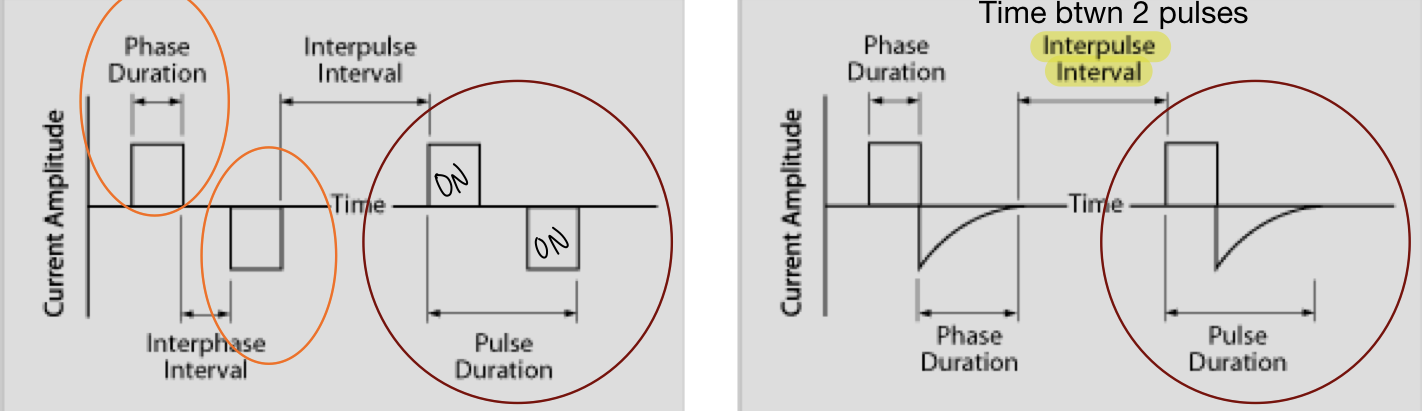
Interphase interval
Amount of time btwn phases
Interpulse interval
Time btwn pulses/cycles/periods
What can we adjust?
Frequency
Pulse duration
Rare: phase duration, interval pulse
Biphasic symmetrical waveform
Same shape + size for each phase in both directions
0 net charge > electrical charge = 0

2 types of Biphasic asymmetric waveforms
Balanced
Unbalanced
Biphasic asymmetric waveforms - BALANCED
Phases have the same net charge
IFC and Russian mm stim
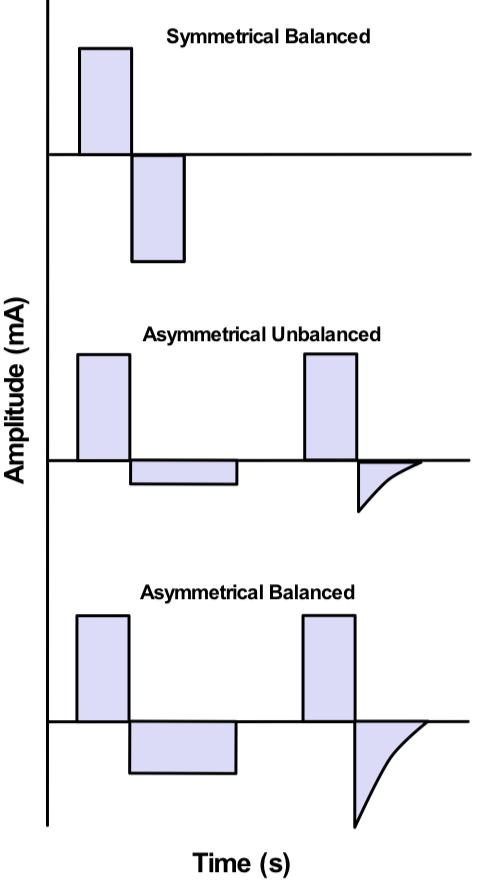
Biphasic asymmetric waveforms - UNBALANCED
1 phase has greater net charge

Bursts of pulses
Stim current is interrupted, delivered in bunches/bursts
Burst-mode TENS and IFC
Work & rest time
Electrodes
Apply + distribute current to body
Diff types: conductive rubber, metal/foil
Requires a coupling medium for a conductive bridge btwn skin + electrode
Gel pads
Water-soluble gel (carbon-impregnated silicone rubber)
Gel, wet cotton gauze/sponge (metal + carbon electrodes)
How does current move in tissues”
Path of least resistance
Current is carried by ion movement btwn electrodes
Anions move to anode (+ve charge)
Cations (+ve) move to cathode (-ve charge)
How does current flow under cathode (-ve)?
-ve charge accumulates on surface of nerve fibres
Nerve exterior is more -ve, inside more +ve
Causing depolarization > Action potential
How does current flow under anode (+ve)?
Membrane exterior becomes more +ve
Membrane interior becomes -ve
Causes hyperpolarization
Cathode = active electrode
What patient feels?
Low tingling
Activation of sensory receptors: low tingling
Activation of pain receptors: @ high stim, feel pain
Mm contraction
Optimal intensity to get desired response
E-stim benefits
Less pain
Strengthen mm
Attenuate disuse atrophy
Neuromuscular re-education
Relax skeletal mm
Augment ROM
Promote tissue + wound healing
Reduce edema
Increase BF
Deliver medicine/ions transdermally
What parameters influence what the patient feels?
Pulse duration and intensity
Shorter pulse duration, feel less, less effective
Strength Duration Curve
Need optimal intensity to get right physiological response
Amplitude
Pulse duration
Higher pulse duration, less amplitude to get response.
A beta: tingling
Motor: mm twitch
A delta: mm contraction
C: pain
Large vs small electrodes?
Large electrodes spread the current
Lower current density
Feel less
Need higher amplitude
Over remote site
Small
Over target motor point
HIGH density
Feel more
Where is current density highest?
Where electrodes meet the skin
Diminishes as electricity penetrates into deeper tissue
Electrodes closer tgthr, highest current density is superficial
Electrodes far, higher density DEEPER in tissues (nerve + mm)
Fat btwn electrode and nerve reduces effectiveness of depolarizing deeper tissue
How to place electrodes if want to target deeper tissues?
Space farther apart
Current density decreased w/ depth
IFC vs TENS
IFC: larger + deeper structures
TENS: superficial
Does impendance of skin change during stim?
YES
Skin becomes more hydrated, lower impedance
Constant Voltage
Same voltage
Keeps electromotive force consistent
Current can fluctuate w/ changing impedance
Constant Current
Same current
Consistent electron flow
Current is consistent despite changing impedance
WHAT WE SET TO
Adjusts voltage based on skin resistance
Safety/preparation
No contraindications/precautions
Explain rx: benefits/dangers
Inspect + test equipment
Inspect skin for cuts
Test skin sensation
Determine electrode placement
Turn on equiptment BE4 connect to the patient
Clean skin: alcohol swab, soap + water. Leave it moist
Monitor patient thru rx
Turn intensity off before disconnect from patent (in case of surge)